

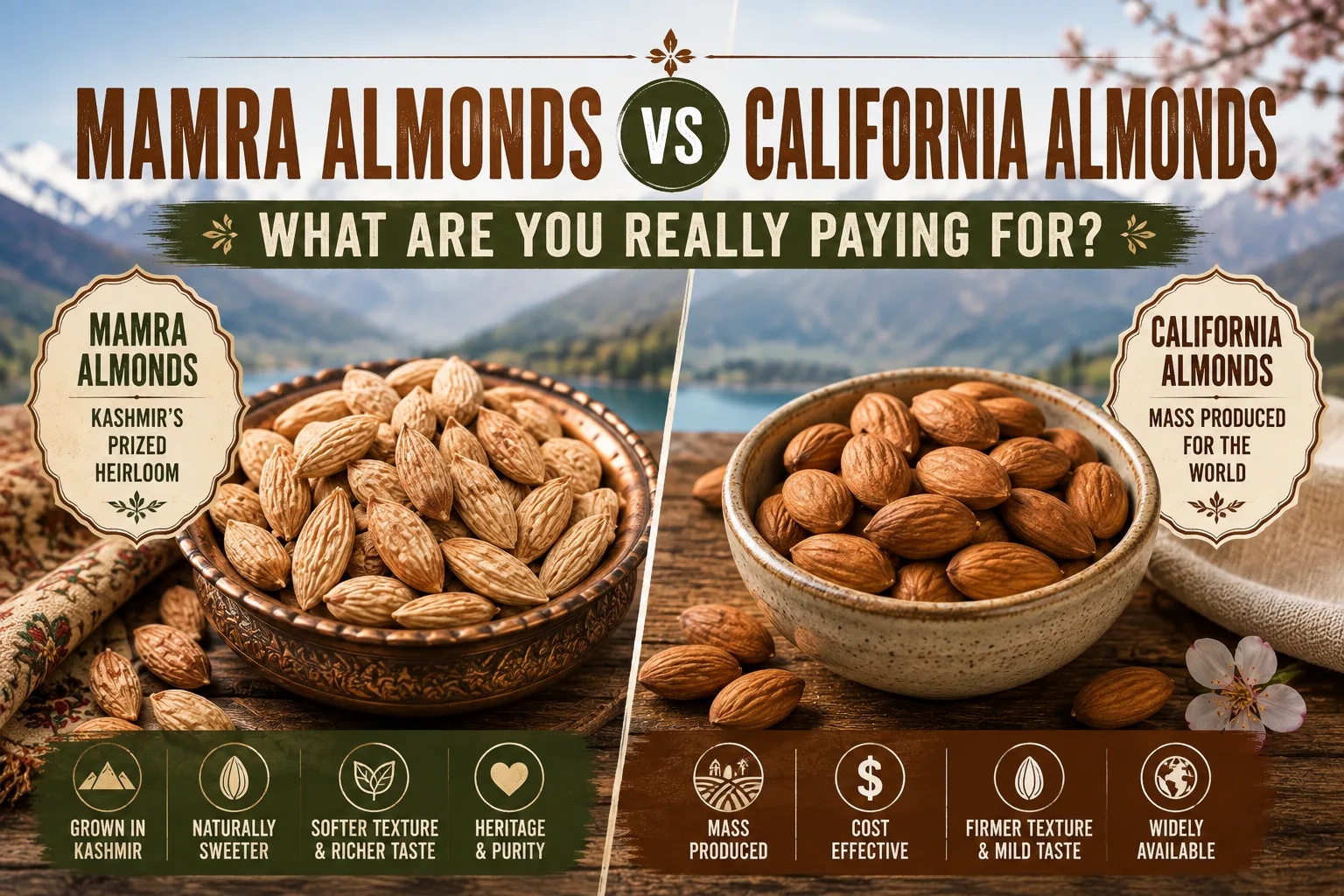
Walk into any dry fruit shop and ask for almonds. You will get California almonds, because that is what almost every shop in India stocks. They are uniform, flat, pretty, and cheap. About 80 percent of the world’s almond supply comes from Californian orchards.
Now ask the same shopkeeper for mamra. Watch the price triple, sometimes more. Same nut family, wildly different product. Is mamra worth it, or is it a story sellers tell? Let’s break it down honestly.
What mamra actually is
Mamra badam is a traditional almond variety grown in a narrow belt: parts of Iran, Afghanistan, and the higher orchards of Kashmir. The trees are mostly rain fed, the yields are a fraction of what commercial orchards manage, and the kernels grow curved and plump instead of flat.
That low yield is the whole economics lesson. A California orchard is an irrigated, mechanized production line. A mamra orchard is a slope of old trees that produce when the season allows. Scarcity, hand processing, and import duty stack up, and that is your price difference. Nobody is inventing it.
The differences you can actually verify
Shape and texture. Mamra kernels are curved, almost crescent shaped, and visibly oily when you break one. California kernels are flatter and drier inside.
Oil content. This is the real separator. Mamra almonds typically carry noticeably more natural oil than commercial varieties. Crush a mamra kernel on paper and it leaves an oil mark. That oil is where the flavor lives, and it is why two or three mamra almonds feel more satisfying than a handful of flat ones.
Taste. Mamra is sweeter with no bitter aftertaste, which is why it is eaten raw or soaked overnight rather than roasted and salted. Roasting mamra is like cooking an expensive steak well done. You can, but why would you.
Nutrition. Both are genuinely healthy. Almonds broadly are among the best studied nuts in nutrition science, with consistent evidence around heart health and satiety. The honest position: mamra offers more healthy fats per kernel, but a California almond is not junk. If budget rules, eating California almonds daily beats eating mamra once a month.
How to spot fake mamra
Because mamra commands three times the price, the market does what markets do. Common tricks:
- Selling Gurbandi (a smaller, cheaper Afghan almond) as mamra. Gurbandi is a fine almond, but it is not mamra and should not be priced like it.
- Mixing 30 percent mamra with 70 percent commercial kernels and selling the blend at full mamra rates.
- Polishing old stock with oil to fake freshness.
Your defenses: buy from sellers who state origin and grade in writing, check the curve and the oil mark, and taste before committing to a large quantity. A seller who will not tell you the origin has answered your question already.
How to eat them (the Kashmiri way)
In Kashmir, almonds are soaked overnight and eaten peeled in the morning, often alongside a cup of kahwa that has a few slivers floating in it. Soaking softens the kernel and, per common belief, makes it gentler on digestion. Five or six kernels a day is a sensible habit, and general dietary guidance from bodies like the FSSAI puts nuts firmly in the daily diet column, not the occasional treat column.
The bottom line
Buy mamra if you eat almonds raw and care about taste and oil content. Buy California if you cook with almonds or eat them roasted, where the difference mostly disappears. Just never pay mamra prices for kernels that cannot pass the curve and oil test.
We are building our dry fruits line on exactly that promise: stated origin, stated grade, and a batch code on every pack you can verify. Our snow white walnut kernels and sun dried apricots are live now, and mamra almonds from the high orchards join them this season.