
Loading page
We are not taking orders right now. Back soon.
We are not taking orders right now. Back soon.
Origin & Culture · 6 Nov 2026
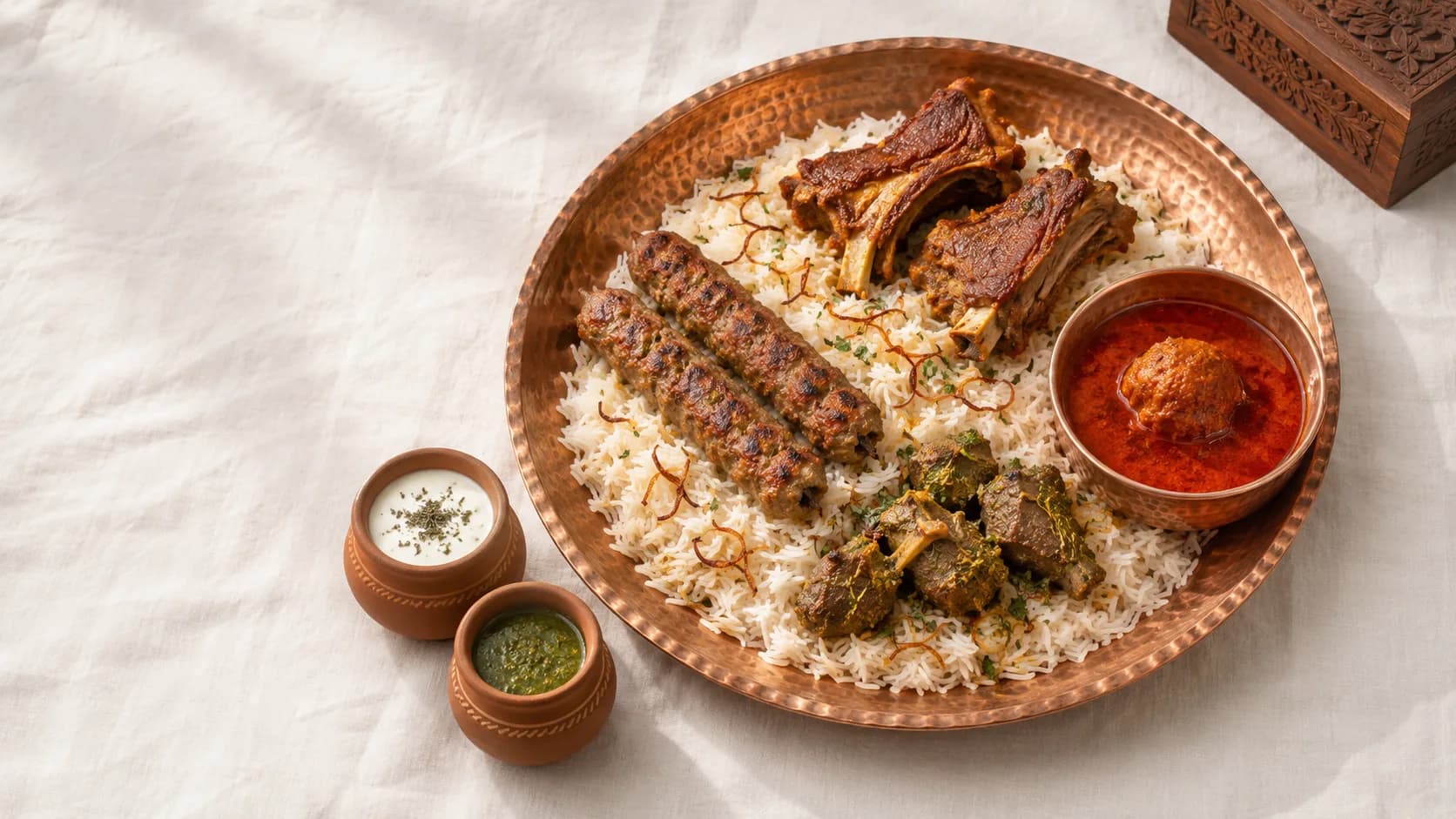
Autumn is wedding season in the valley, and in Srinagar's old city the cooking for a feast starts while the guests are still asleep. Copper pots go onto wood fires the night before. By the next afternoon, groups of four sit around a single platter and eat their way through course after course of mutton until one large, pale meatball tells them it's over.
That feast is Kashmiri wazwan. Most people outside Kashmir know it as "the 36-course meal" and little else.
So here's the plain version. Below you'll find what wazwan means, where it came from, how the cooks build it, which dishes reach the trami and in what order, and which of its flavours you can cook in an ordinary kitchen.
Start with the word. In Kashmiri, waza means cook and wan means shop, according to the Ministry of Tourism's Incredible India guide. Put together, wazwan is the cook's craft, the whole set of dishes a team of professional cooks prepares for an occasion.
That matters. Wazwan isn't one recipe. It's a sequence, cooked by specialists, served in a fixed order, and eaten in a fixed way.
It's mostly mutton. The Wikipedia entry on wazwan describes the royal version as 36 courses, of which 15 to 30 can be meat. Real weddings rarely go that far. Sahapedia puts a full wazwan at 12 to 24 dishes, and a September 2026 Reuters photo essay published by Al Jazeera says the count today is around 20.
Key takeaway: "36 courses" is the ceremonial ceiling, not the usual wedding menu.
The usual story points to Central Asia. The Incredible India guide says that in 1398, during Timur's invasion of Hindustan, skilled cooks came from Samarkand, in present-day Uzbekistan, and their methods blended into Kashmiri cooking. The Reuters essay dates the arrival to the 14th century, when rulers brought chefs along with carpet and shawl weavers.
Here's the thing: dates for food history are always a little soft. What the sources agree on is the shape of the story. Wazwan began small, Sahapedia says as a seven-dish meal about 600 years ago, and grew over the centuries.
The cooks stayed a hereditary trade. Reuters profiled Ghulam Nabi Baba, a 74-year-old waza whose forefathers settled in Srinagar's old city among a community of cooks known as Wazpora. He joined his father at 15. Forty years ago, in a north Kashmir village called Delina, he cooked 4,500 kg of meat for one very large wedding.
The average wedding is far smaller. Reuters puts it at about 200 kg of meat.
A wazwan kitchen is set up where the event is. Sahapedia describes temporary kitchens in the host's courtyard, run by a head cook, the vasta waza, who oversees everything from the butchering to the final pot. For 200 to 300 kg of meat, that's typically 3 to 4 waza plus helpers.
The method is old and physical:
The meat is sorted by cut. Tender meat goes to rista and gushtaba, fattier ribs to tabakh maaz.
The meatball meat is pounded by hand. Cooks beat it with wooden mallets on stone until it turns almost silky, per Reuters.
A broth comes first. Lamb is simmered into yakhni, a stock that becomes the base for several later dishes, according to Sahapedia.
Everything cooks slowly over wood. Large copper pots sit over fruit-tree wood such as apple, walnut or plum.
And it gets better. Sahapedia notes that praan, the Kashmiri shallot, runs through the whole menu, at roughly 7 to 10 kg of shallot paste for every 100 kg of meat. That's the quiet sweetness under the chilli.
Wazwan isn't plated per person. Guests sit in groups of four around a large copper platter called the trami, and eat from it together, as both Wikipedia and the Incredible India guide describe.
Before anything arrives, an attendant carries a portable basin, the tash-t-naer, around the group so everyone can wash their hands. Then the trami comes in already loaded. Wikipedia lists the opening spread as a mound of rice quartered by two seekh kababs, with four pieces of methi maaz, two tabakh maaz, one safed kokur (chicken in a white gravy) and one zafran kokur (saffron chicken). Yogurt and chutney arrive on the side in small clay pots.
The result? Each person has a quarter of the rice and a share of the first meats in front of them. Every later course is served onto the same plate, a portion at a time.
Sahapedia adds one more custom worth knowing. At the end, the eldest at the trami portions the gushtaba for the group. Guests often carry leftovers home, so very little goes to waste.
Menus vary by family, budget and cook, so treat this as the common pattern rather than a fixed rulebook. These are the dishes you're most likely to meet:
Seekh kabab: minced meat on skewers, roasted over coals.
Methi maaz: tripe cooked with dried fenugreek leaves.
Tabakh maaz: lamb ribs simmered, then fried in ghee until crisp at the edges.
Rista: pounded meatballs in a red gravy built on Kashmiri chilli, fennel and saffron, with its colour deepened by dyer's alkanet (ratanjot), per Wikipedia.
Rogan josh: lamb in a deep red gravy. The Incredible India guide credits its character to Kashmiri chilli, mawal flower and shallot paste.
Aab gosht: lamb in a sweet, milky gravy with fennel and cardamom.
Marchwangan korma: the fiery one. The Incredible India guide says it uses about three-quarters of all the chillies in the whole wazwan.
Daniwal korma: lamb with yogurt, onion and a finish of fresh coriander.
Haakh, and now and then dum aloo: collard greens, and potatoes in a yogurt gravy. Wikipedia notes the potato dish is rarely served.
Gushtaba: the large, soft meatball in a yogurt gravy. It always comes last, and its arrival signals the end of the main meal.
After the main meal comes dessert, hot in winter and cold in summer, per Wikipedia. Then kahwa, the saffron green tea, which Sahapedia describes as the warm close to a Kashmiri feast.
Look at a trami and you'll see a lot of red. Rista, rogan josh and marchwangan korma all glow.
Most of that colour is chilli chosen for colour, not fire. Kashmiri chilli gives a deep red with mild heat, which is why the waza can use so much of it without wrecking the meal. The exception is marchwangan korma, where the heat is the point. Ratanjot and mawal push the red further in some dishes.
Real wazwan red isn't paint. It's chilli, bark and flower, cooked down slowly in fat.
If you want the difference in plain terms, our guide to Kashmiri chilli powder vs red chilli powder explains why the two behave so differently in a pan.
The tradition is under steady pressure, mostly from cost and scale. In 2017, the Jammu and Kashmir government announced a Guest Control Order through its Food, Civil Supplies and Consumer Affairs department, Business Standard reported. It capped a daughter's wedding at 500 guests and limited the menu to seven non-vegetarian dishes.
Seven. The same number Sahapedia gives for the original Central Asian meal.
The cooks are changing too. In the Reuters essay, Ghulam Nabi Baba's son chose to open a restaurant rather than work round-the-clock wedding shifts, and other younger chefs are moving wazwan dishes into restaurant kitchens. The core methods, the pounding, the copper and the slow wood fire, have changed very little.
You won't cook 36 courses at home, and you don't need to. A wazwan dinner at home is really two or three dishes, cooked slowly, with the right chilli and patience.
A few practical ways in:
Start with one red dish. Rogan josh or a simple rista-style meatball curry teaches you how Kashmiri chilli behaves. Use a chilli powder that brings colour without too much bite. Our Kashmiri red chilli powder is stone-ground from sun-dried Kashmiri chillies with no added colour.
Add a vegetable dish from the same table. Our Kashmiri dum aloo recipe uses yogurt, fennel and dry ginger, the same backbone you'll taste in several wazwan gravies.
Know where ver fits. None of the wazwan accounts we read list ver. It's a home cook's spice cake, crumbled into rogan josh, rajma or haakh while the oil is hot. Our explainer on ver masala covers how to use it.
End the meal the Kashmiri way. A cup of kahwa after a heavy dinner is the closest thing to a wazwan finish. Our kahwa recipe walks you through it, or you can simmer a teaspoon of our Saffron Kehwa Blend for 3 to 4 minutes, never at a rolling boil.
If winter cooking is what brought you here, our piece on Kashmiri winter food shows what the valley eats once the wedding season ends and the cold sets in.
Wazwan isn't a long menu. It's a long tradition, cooked by specialists and eaten by four people at a time from one copper plate.
If you're going to your first Kashmiri wedding, wash your hands at the basin, eat from your quarter of the trami, and wait for the gushtaba before you think about leaving. If you're cooking at home, pick one red dish, use a chilli made for colour, and cook it slowly. If you want the finish, make kahwa.
If you'd like to cook with the same red chilli, saffron and ver that Kashmiri kitchens rely on, explore our Kashmiri saffron and spices.
Kashmiri wazwan is a multi-course feast, mostly of mutton, cooked by professional cooks called waza and served at weddings and family functions. The name joins waza (cook) and wan (shop). Guests eat it in groups of four from a shared copper platter called a trami.
The royal wazwan is described as 36 courses. Most weddings serve fewer: Sahapedia puts a full wazwan at 12 to 24 dishes, and a 2026 Reuters report says around 20 today.
Gushtaba, a large pounded-meat ball in a yogurt gravy, is served last. Its arrival tells guests the main meal is over, and dessert and kahwa follow.
A trami is the large copper platter that four guests share. It arrives loaded with rice, two seekh kababs and the first meat dishes, and later courses are served onto it one by one.
It's mostly mutton, with some chicken. A vegetable dish such as haakh may appear, and dum aloo occasionally, but a traditional wazwan is built around meat.
Not the full feast, which takes a team of cooks and hundreds of kilos of meat. You can cook one or two dishes at home, such as rogan josh or a rista-style meatball curry, using Kashmiri chilli for colour and finishing with kahwa.
Taste the difference yourself.
Mongra saffron and fresh-crop dry fruits, sealed to order in Anantnag.
Shop the harvest