
Loading page
We are not taking orders right now. Back soon.
We are not taking orders right now. Back soon.
Recipes · 3 Nov 2026
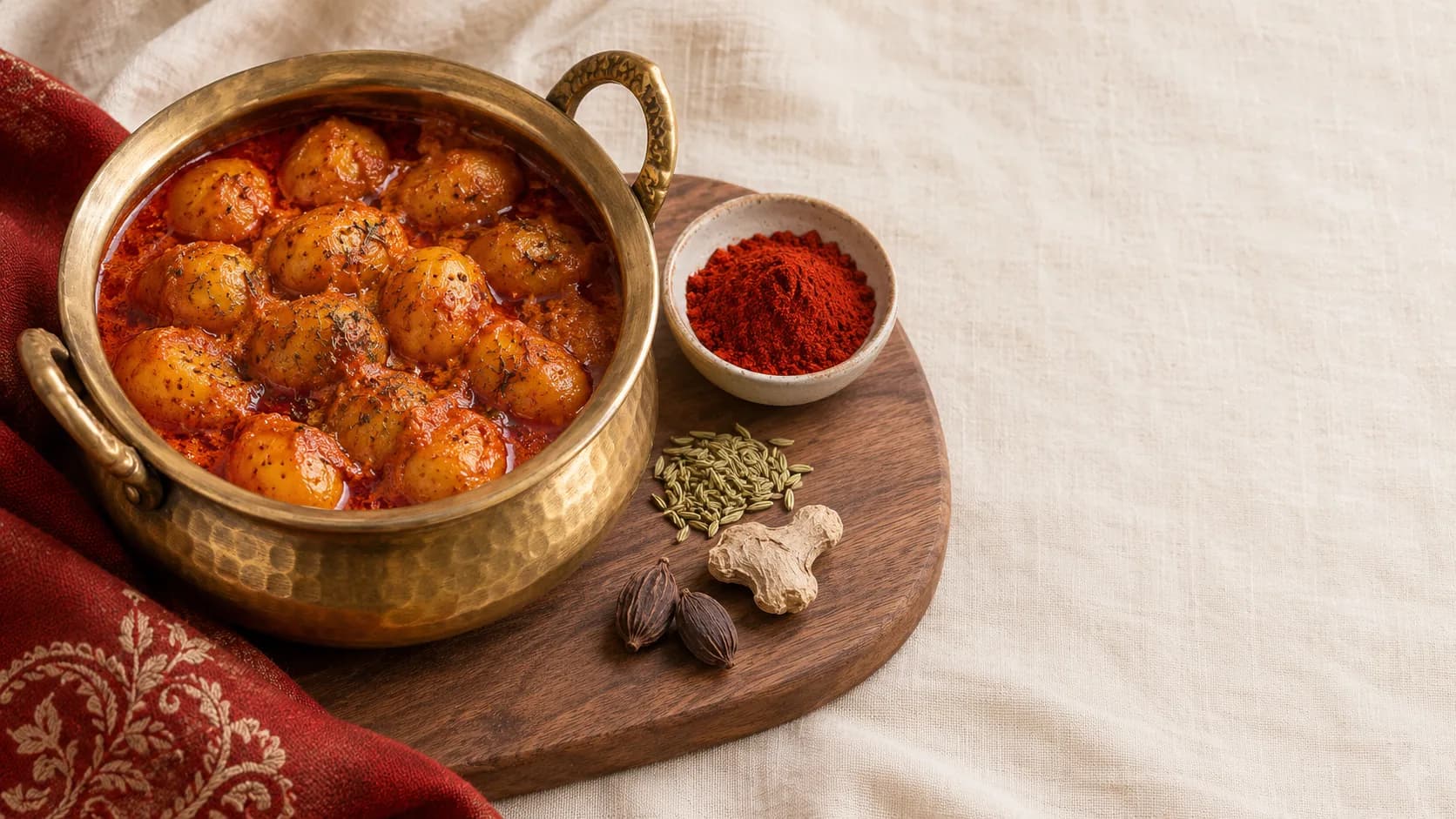
Kashmiri dum aloo has no onion, no garlic and no tomato. The red comes from chilli and the body comes from yogurt, with fennel and dry ginger carrying the flavour. Most versions that go wrong at home add the missing three back in, or use a chilli that brings fire instead of colour.
So the dish turns into a generic potato curry.
Below, you'll get the Kashmiri Pandit method with exact quantities for four people, why each ingredient is there, the one step where yogurt usually splits (and how to stop it), and how to tell if your chilli powder is the right kind. If you've cooked our Kashmiri rajma recipe, you'll recognise the same quiet, spice-led logic here.
Punjabi dum aloo usually starts with a fried onion and tomato masala, sometimes with cashew paste for richness. The Kashmiri Pandit version skips all of that. Its base is curd, cooked slowly with ground fennel (saunf), dry ginger powder (saunth) and Kashmiri chilli.
That's not an accident. The Jammu and Kashmir tourism department's guide to Kashmiri cuisine notes that in Pandit cooking, almost no dish is cooked without curd, and that heeng (asafoetida) and curd are what set Hindu Kashmiri cooking apart. Dum aloo sits right in that tradition. The same page lists "Dum Alu" among the region's signature dishes.
The result tastes warm rather than hot. Fennel gives a soft sweetness, saunth gives a slow heat at the back of the throat, and the chilli gives colour you can see from across the room.
Key takeaway: if your recipe has onion, garlic or tomato in it, it isn't the Pandit-style Kashmiri dum aloo. It may still be tasty. It's just a different dish.
Here's the part most recipes skip. The deep red of a good Kashmiri dum aloo comes almost entirely from the chilli powder, so the chilli you buy matters more than anything else in your basket.
According to the Spices Board of India's chilli catalogue, Kashmiri chilli is grown in Jammu and Kashmir and Himachal Pradesh, harvested between November and February, and described as long, fleshy and deep red. The Board lists its colour value at 54.10 ASTA units and its capsaicin at 0.325 percent. For comparison, it lists Byadgi chilli from Karnataka at 159.9 ASTA with negligible pungency.
So what does that mean in your kitchen? Kashmiri chilli is chosen for a balance of colour and gentle heat, not for colour alone. And not every mountain chilli is mild. A 2023 study by ICAR's Central Institute of Temperate Horticulture in Srinagar, published in the Indian Journal of Horticulture, measured 22 Himalayan hot pepper lines and found pungency ranging from about 16,000 to 64,160 Scoville heat units. Same region, very different heat.
The practical lesson? Buy chilli powder that says what it is, and taste a pinch before you use a full tablespoon.
Keep it simple. You need few ingredients, but each one does a job.
For the potatoes
500 g baby potatoes, about 15 to 18 small ones of even size
Mustard oil for frying, about 1 cup (250 ml)
1/2 tsp salt for the boiling water
For the gravy
3 tbsp mustard oil (reuse from frying)
A pinch of heeng (asafoetida)
4 cloves, 2 green cardamom, 1 black cardamom, 1 small stick of cinnamon, 1 bay leaf
1 tbsp Kashmiri red chilli powder, mixed into 3 tbsp water
250 g thick curd (dahi), at room temperature, whisked smooth
2 tsp fennel powder (saunf)
1 tsp dry ginger powder (saunth)
1 tsp salt, or to taste
1 cup (250 ml) hot water
1/4 tsp garam masala to finish
One note on chilli quantity. A tablespoon gives a bold red gravy with mild warmth. If your chilli runs hot, start with 2 teaspoons.
Put the potatoes in a pot of salted water and boil until a knife goes in with light resistance, about 10 to 12 minutes. You want them about 80 percent cooked, not soft. Peel while warm.
Now prick each potato all over with a fork or toothpick, ten to twelve times. This is what lets the gravy soak right to the centre later. Skip it, and you'll get a flavourful sauce around a bland potato.
Heat the mustard oil in a kadhai until it smokes lightly, then let it cool for a minute. This takes the raw edge off the oil. Fry the potatoes on medium heat, turning often, for 8 to 10 minutes until the outside is golden and slightly crisp.
Lift them out and set aside. Pour off all but 3 tablespoons of oil.
Warm the 3 tablespoons of oil on low heat. Add the heeng, cloves, cardamom, cinnamon and bay leaf, and let them sizzle for about 20 seconds.
Now take the pan off the heat. Stir in the chilli paste (chilli powder mixed with water). The water keeps the chilli from burning, so it turns the oil a deep red instead of brown and bitter. Put the pan back on low heat and cook for a minute.
This is where most dum aloo splits. Keep the heat at its lowest. Add the whisked curd a few spoonfuls at a time, stirring continuously in one direction.
Keep stirring for 3 to 4 minutes after the last spoonful goes in. The curd will darken and thicken, and oil will start to show at the edges. That's your sign the curd is cooked and won't split.
Here's the thing: cold curd and high heat are the two causes of grainy gravy. Take the curd out of the fridge 30 minutes ahead, whisk it fully smooth, and never rush this step.
Stir in the fennel powder, dry ginger powder and salt. Cook for another 2 minutes on low, stirring. The kitchen will smell sweet and warm at this point, the fennel taking the lead.
Pour in the hot water and bring it to a gentle simmer.
Add the fried potatoes and turn them to coat. Cover the pan with a tight lid, and if you like, seal the edge with a rope of atta dough. Cook on the lowest flame for 15 to 20 minutes.
The word "dum" means to breathe, as the Michelin Guide's kitchen glossary explains, and sealed slow cooking lets the food breathe in its own aromas. In practice, that's when the potatoes drink up the gravy through those fork holes. Open the lid once halfway to give a gentle stir.
Sprinkle the garam masala, turn off the heat and let the pot rest, covered, for 5 minutes. The gravy should be thick enough to cling to the potatoes, with a layer of red oil on top.
Serve with steamed rice. That's how it's usually eaten in Kashmir, rice and gravy together, not with a pile of rotis on the side.
You've got the method. Now the traps.
Using onion and garlic out of habit. They push the fennel and saunth into the background. Leave them out for this version.
Adding chilli powder straight to hot oil. It burns in seconds and turns the gravy dark and bitter. Always take the pan off the heat and use a chilli paste.
Skipping the fork pricks. The potatoes stay plain inside, however long you cook them.
Rushing the curd. High heat or cold curd gives you a broken, grainy sauce.
Using a hot chilli for colour. You'll get the red you wanted, and a gravy no one at the table can finish.
The Pandit version stays free of onion and garlic, and we think it's worth cooking that way first. But plenty of home cooks want a deeper, more savoury dum aloo for a winter dinner.
For that, crumble a small piece of Kashmiri ver masala into the hot oil in Step 3, right after the whole spices. Ours is a sun-dried cake of ground spices, garlic and shallots, so it brings that savoury depth without any chopping. Start with a piece about the size of your thumbnail. It's strong. You can read more about how ver fits into Kashmiri cooking in our guide to Kashmiri pantry staples.
Dum aloo tastes better the next day, once the potatoes have had a night in the gravy. Cool it completely, move it to a covered steel or glass container, and refrigerate.
To reheat, add 2 to 3 tablespoons of water and warm it on low heat, stirring gently. High heat can split the curd again, so take it slowly. A microwave works too, in short bursts with a stir between each.
Kashmiri dum aloo isn't a rich curry. It's a careful one. The red doesn't come from tomato, and the depth doesn't come from onion. It comes from good chilli, slow curd and two quiet spices doing their work.
If your gravy keeps splitting, warm the curd and lower the flame. If your dum aloo looks pale, look at your chilli before you add more of it. If the potatoes taste plain inside, prick them more.
And if you want a chilli powder that brings the colour without the fire, explore our Kashmiri red chilli powder, stone-ground from sun-dried Kashmiri chillies with no added colour. You'll find the rest of our spices in the saffron and spices collection.
Kashmiri Pandit-style dum aloo uses a curd base flavoured with fennel powder, dry ginger powder and Kashmiri chilli, with no onion, garlic or tomato. Punjabi dum aloo is usually built on an onion and tomato masala and is often richer with cream or cashew.
Yes. The traditional Kashmiri Pandit recipe already has no onion and no garlic. Its flavour comes from heeng, whole spices, fennel, saunth, curd and Kashmiri chilli.
The curd was too cold or the heat was too high. Bring the curd to room temperature, whisk it smooth, add it a little at a time on the lowest flame and stir continuously for a few minutes until oil shows at the edges.
For 500 g of baby potatoes, 1 tablespoon gives a deep red gravy with mild warmth. If your chilli powder is hotter than usual, start with 2 teaspoons and taste before adding more.
You can. Cut large potatoes into even 4 to 5 cm chunks after boiling, prick them and fry them the same way. Baby potatoes are traditional because they cook evenly and hold their shape on dum.
In Kashmir it's usually served with plain steamed rice. It also goes well with a simple dal, and with rotis if you prefer.
Taste the difference yourself.
Mongra saffron and fresh-crop dry fruits, sealed to order in Anantnag.
Shop the harvest