
Loading page
Free delivery on orders over ₹3,000
Free delivery on orders over ₹3,000
Kashmir Pantry · 24 Oct 2026
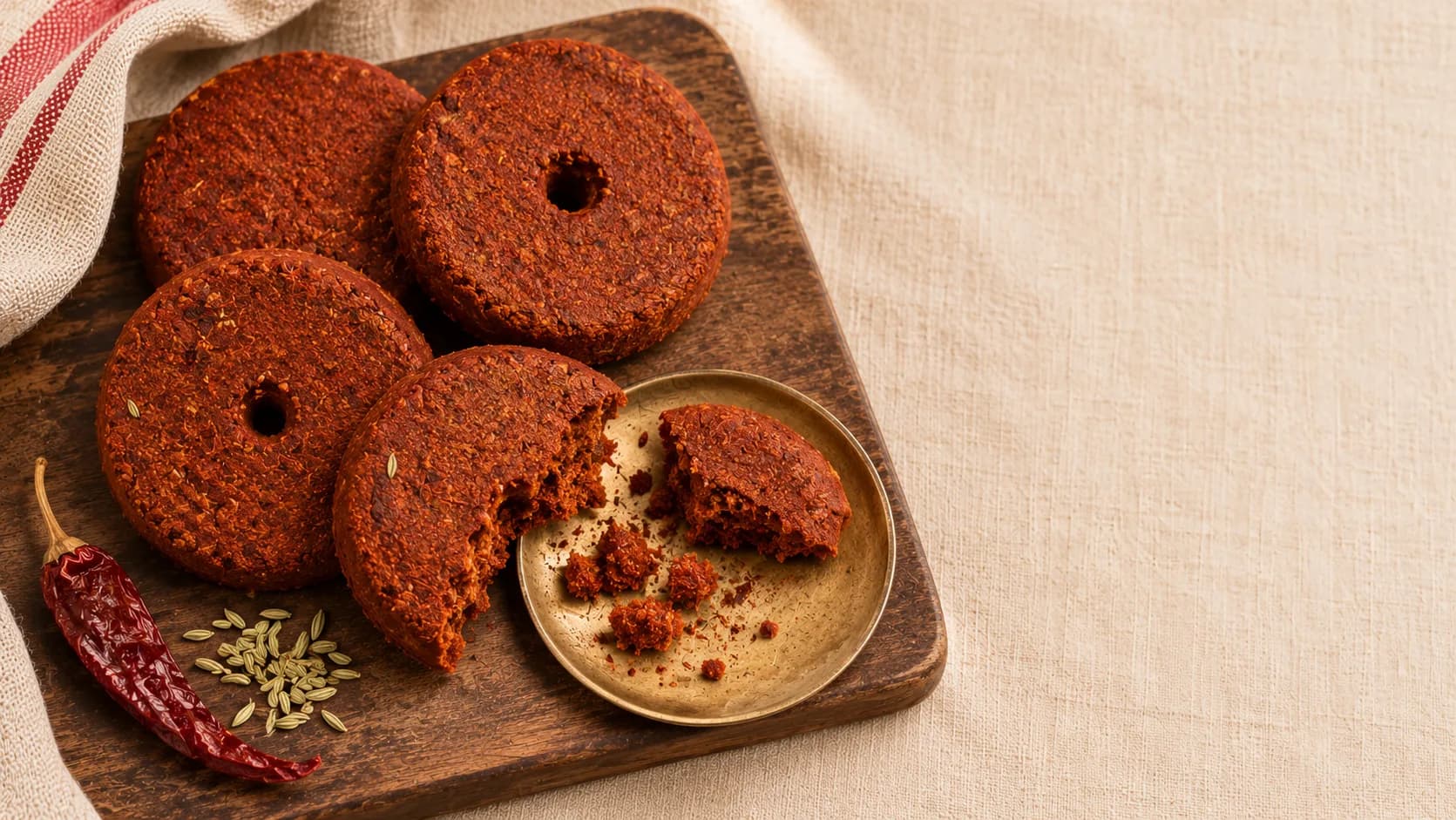
Most people who buy ver masala for the first time treat it like garam masala. They spoon it into the pan at the end, taste, and wonder why the dish smells of chilli dust and nothing else.
Ver doesn't work like a powder. It's a cake, and a cake needs a different hand.
Ver masala, also called ver tikki or Kashmiri masala tikki, is a dried cake of ground spices that Kashmiri kitchens have kept for generations. Below, we'll cover what it's made of, why it's pressed into cakes instead of sold loose, the two family styles you'll come across, and exactly how to crumble it into rogan josh, rajma or haakh so it tastes the way it should.
Here's the simplest definition. Ver is a mix of ground spices bound with oil and water (and, in many homes, a paste of garlic and shallots), shaped into flat rounds, then dried in the sun until hard.
A 2016 paper on Kashmiri food words in the Interdisciplinary Journal of Linguistics, published by the University of Kashmir, describes vari as a "masala cake" that used to be made in every household. That's the key idea. Ver was never a factory product. It was a home pantry habit.
The name shows up in many spellings. Ver, vir, veri, vari, vaer. You'll also see it called koshur masala, Kashmiri for Kashmiri masala, in a Slurrp explainer on the blend. Different spelling, same cake.
The takeaway: if a recipe from Kashmir says "add ver" and you reach for garam masala, you've swapped the dish's base note for a different one.
There's no single official recipe. Each family guards its own ratio, and that's part of the point. Still, the core is consistent across most published versions:
Kashmiri red chilli, for deep colour and gentle heat. It's usually the largest share by weight.
Fennel (saunf), the sweet, warm backbone of Kashmiri cooking.
Dry ginger (sonth), sharper and warmer than fresh ginger.
Black and green cardamom, cloves and cinnamon, used in small amounts for aroma.
Black cumin or cumin, and often a little turmeric.
A binder, which is where the two traditions part ways (more on that below).
One published home version, from the food writer Kavey Eats, uses 200 g Kashmiri chilli powder to 100 g each of ground ginger and ground fennel, plus a paste of 100 g garlic and 100 g shallots. That ratio tells you a lot. Ver is chilli-forward in colour but fennel and ginger in flavour, and the alliums give it a savoury depth a dry powder can't match.
And it gets better. Because the shallots and garlic are ground in raw and then sun-dried, they turn sweet and mellow rather than sharp. That's the taste people try to describe after a meal in Srinagar and can't place.
You might wonder why anyone would go to the trouble. Grinding is work. Kneading and sun-drying is more work.
The answer is the valley's calendar. Kashmir's winters are long and cold, and the old pantry was built around preserving autumn's produce for those months. The same instinct gave the valley hokh syun, its dried winter vegetables. A cake of spices bound with dried alliums is the same idea, applied to flavour.
The cake form does three useful things:
It protects the spice. A dense, dry cake exposes far less surface to air than loose powder, so aroma fades more slowly.
It carries the alliums. You can't keep fresh shallot paste for months. Dried into a cake, it keeps.
It makes measuring tactile. You break off a piece, rub it between your palms, and add it. Kashmiri cooks judge it by feel, not by spoon.
Kashmiri Pandit writer ChandraMukhi Ganju, in a recipe for Shehjar, describes drying the patties in the sun for two to three days and storing them in small amounts through the year. Short sentence, long tradition.
This is where most explainers go quiet, and it matters when you cook.
Kashmir's two great kitchen traditions treat aromatics differently. The De Leij cookbook on ikashmir.net notes that Kashmiri Pandit cooks traditionally avoid onion, garlic and shallot and use asafoetida (heeng) instead, while Kashmiri Muslim cooks rely heavily on onion, garlic and praan, the Kashmiri shallot. The National Virtual Library of India draws the same line: heeng and curd on one side, onion and garlic on the other.
Ver follows that split:
The garlic and shallot style grinds praan and garlic into the dough. It's deeper, more savoury, and the version most people mean when they say "Wazwan flavour".
The heeng style, common in Pandit homes, binds the spices with oil and dissolved asafoetida instead. Ganju's version adds dry fenugreek and coriander, and some families add a little urad flour. It's often shaped with a hole in the centre, like a small doughnut.
Neither is the "real" one. They're two dialects of the same language.
Worth knowing: the ver we make at Zoon Naturals is the garlic and shallot style. If your family cooks without onion and garlic, check the label of any ver before you buy, ours included.
People mix these up all the time, so let's settle it.
Garam masala is a dry, loose blend of mostly whole sweet spices, toasted and ground. It's usually added near the end for aroma. It carries little colour and no allium.
Ver is a moist dough dried into a cake. It's built on Kashmiri chilli, fennel and dry ginger, and in many homes it holds garlic and shallot too. It gives colour, body and a savoury base, not just a top note.
Garam masala perfumes a dish. Ver gives it an accent.
You can use both in one pot. You just can't use one in place of the other and expect the same result.
Here's the thing: ver is concentrated. A piece the size of a large coin goes a long way, and too much turns a gravy bitter.
Follow these steps the first few times:
Break off a small piece. For a dish serving four, start with about 1 to 2 teaspoons once crumbled. Kavey Eats suggests the same range.
Crumble it fine. Rub it between your palms or crush it in a mortar. Big lumps won't dissolve evenly.
Add it to hot oil, or stir it in late. Many Kashmiri cooks bloom it in hot oil before the main ingredient goes in. Others sprinkle it over a gravy near the end. Our product page suggests crumbling it into rogan josh, rajma, haakh or matschgand while the oil is hot.
Taste, then adjust. You can always add more. You can't take it out.
Where it belongs:
Rogan josh and other mutton curries, where it gives that deep red, fennel-sweet base.
Rajma, especially small, dense Bhaderwah beans that take spice well. Our Kashmiri rajma recipe walks through the full method.
Haakh (collard greens), where a pinch of ver lifts plain mustard-oil greens.
Dal, eggs and potatoes, for a weeknight shortcut to Kashmiri flavour.
This is a shorter cousin of our full rajma recipe, built to show what ver does.
You'll need (serves 4):
250 g Bhaderwah rajma, soaked overnight
3 tbsp mustard oil
1 tsp crumbled ver masala
1 tsp Kashmiri red chilli powder (optional, for extra colour)
2 medium tomatoes, puréed
Salt to taste
1 litre water
Method:
Pressure-cook the soaked rajma with 1 litre water and a little salt for 4 to 5 whistles, until soft but whole.
Heat the mustard oil in a heavy kadhai until it just smokes, then let it cool for 30 seconds.
Add the crumbled ver and stir for 20 to 30 seconds. It should darken slightly and smell sweet, not burnt.
Add the tomato purée and chilli powder. Cook for 6 to 8 minutes until the oil starts to separate.
Add the rajma with its cooking water. Simmer uncovered for 15 minutes, mashing a few beans against the side to thicken.
The result? A gravy that tastes of fennel and slow-cooked shallot, with no onion chopped at all.
Dry is everything. Ver is a dried food, and moisture is what spoils it.
Keep cakes in an airtight jar, away from the stove and out of direct light. In humid weather, the fridge is a safer home. Shehjar's Pandit recipe goes further and suggests the freezer for homemade ver. Store-bought ver carries its own date, so check the pack. Ours is best before 9 months from packing, with the month and year of packing printed on it.
If a cake has gone soft, smells musty, or shows any pale fuzz, throw it out. Faded colour with a weak smell isn't unsafe, but it won't do much for your rogan josh.
Most ver sold in India is made in small batches, so quality varies. A few checks help:
Look for an FSSAI licence number on the pack. Packaged spice blends need one, and states are getting stricter. On 15 October 2026, Maharashtra's Food and Drug Administration banned the sale of loose spice powders and mixed spices and called for labels to carry the FSSAI licence number, batch number and dates.
Check the date of packing. Fresher ver smells stronger.
Read the ingredients. That tells you which style you're getting, garlic and shallot or heeng.
Watch for suspiciously bright colour. Good ver is a deep brick red, not neon orange.
Spice regulation in India is still catching up. A July 2026 ICRIER report, covered by ThePrint, found FSSAI has quality standards for only 45 of the roughly 75 spice varieties India grows. So the label and the seller's openness matter more than ever.
Ver isn't a powder you sprinkle. It's a cake you break, crumble and cook in. It isn't garam masala with a Kashmiri name either. It's the savoury base under the dishes that taste unmistakably of the valley.
If you cook rogan josh or rajma and the flavour always falls a little flat, add a teaspoon of ver to the hot oil. If your kitchen avoids onion and garlic, look for the heeng style. If you're trying ver for the first time, start small, taste, and build from there.
If you'd like a garlic and shallot ver, sun-dried and handmade in small batches, explore our Kashmiri ver masala alongside the rest of our Kashmiri saffron and spices. For more on the valley's pantry, read our guide to Kashmiri pantry staples.
Ver masala is usually made from Kashmiri red chilli, fennel and dry ginger, with smaller amounts of cardamom, cloves, cinnamon and cumin. Many homes bind it with garlic and shallot paste, while Kashmiri Pandit homes often use oil and asafoetida instead. The dough is shaped into cakes and sun-dried.
Break off a small piece, crumble it fine, and add about 1 to 2 teaspoons to hot oil or a simmering gravy for a dish that serves four. It works well in rogan josh, rajma, haakh and dal. Start small, because ver is concentrated.
Not as a straight swap. Garam masala is a dry blend added mainly for aroma, while ver is chilli, fennel and ginger based, often with dried shallot and garlic, and gives colour and a savoury base. You can use both in the same dish.
It depends on the style. The garlic and shallot style contains both, and the heeng style made in many Pandit homes contains neither. Always read the ingredient list. The ver sold by Zoon Naturals is the garlic and shallot style.
Stored dry in an airtight jar away from light and heat, ver keeps its aroma for months. Packaged ver carries a best before date, and ours is best before 9 months from packing. Discard any cake that turns soft, musty or mouldy.
Taste the difference yourself.
Mongra saffron and fresh-crop dry fruits, sealed to order in Anantnag.
Shop the harvest