
Loading page
Free delivery on orders over ₹3,000
Free delivery on orders over ₹3,000
Origin & Culture · 28 Oct 2026
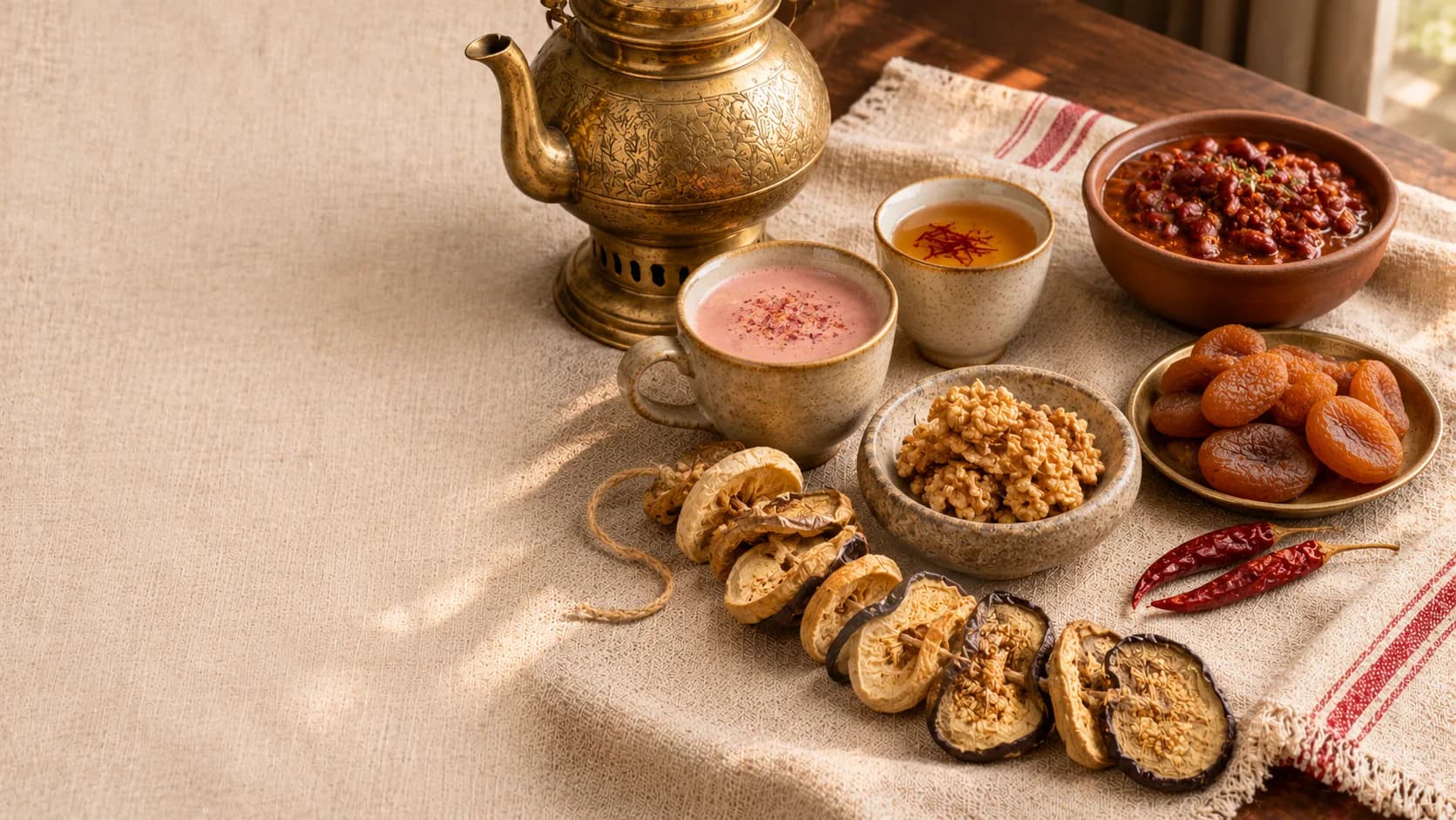
Kashmir eats its summer in winter. The tomatoes, brinjals and turnips that ripen in July are sliced, dried on rooftops in autumn, and cooked in January when the markets thin out and the roads freeze.
That planning is the whole story. Kashmiri winter food isn't a list of comfort dishes. It's a calendar, worked out months ahead for the coldest 40 days of the year.
Below, you'll find the eight foods that carry the Valley through that stretch, what each one actually is, when it's eaten, and which of them you can cook in an Indian kitchen hundreds of kilometres from Srinagar. We'll also point you to the few Kashmiri pantry items worth buying for it, and be clear about the ones we don't sell.
Kashmir splits its winter into three named cold spells. The hardest is Chillai Kalan, a Persian phrase usually translated as "major cold", which begins on 21 December and runs for about 40 days into late January. It's followed by Chillai Khurd, 20 days of "small cold", and then Chillai Bachha, a 10 day "baby cold" that ends in late February.
Here's the thing: for most of history, those 70 days meant isolation. One Srinagar resident told IDR his grandfather remembered snow piling up 10 to 15 feet, blocking the highway for weeks. Fresh vegetables froze. So families stocked up.
The result? A cuisine built on three ideas:
Dry it in autumn. Vegetables, fish and chillies go onto rooftops and strings from September.
Cook it slowly. Long-simmered dishes use less attention and give more warmth per pot.
Drink something hot all day. Salted tea in the morning, spiced tea in the afternoon.
Every dish below fits one of those three.
Hokh syun simply means dried vegetables, and it's the backbone of a Kashmiri winter kitchen. The usual set is turnip (gogji hachi), brinjal (wangan hachi), tomato (ruwangan hachi), bottle gourd (al hachi) and dandelion greens (handh), with dried fish, hokh gaad, alongside.
Most of them are sliced and sun-dried for three to four weeks. Turnips are different. According to IDR's reporting from Srinagar, they can take up to six weeks, dry in the shade, and get threaded with chillies and hung from beams for air.
And the trade is still busy. Kashmir Despatch reported last December that Batamaloo in Srinagar remains the main hub, with stalls in Baramulla, Anantnag and Shopian too. Before cooking, the pieces are soaked, then simmered with meat, fish or pulses.
The flavour is the point. Dried tomato turns sharp and tangy. Dried brinjal goes smoky. Dried turnip tastes earthy, almost meaty. None of it tastes like the fresh version, and that's exactly why people buy it.
One honest note: we don't sell hokh syun. If you're outside Kashmir, a Kashmiri grocer or a trusted family source is your best bet.
If one dish defines Srinagar in winter, it's harissa. Mutton and Kashmiri rice cook together in a copper or clay pot, often sunk into the ground over a wood fire, until the rice breaks down into a smooth paste and the meat falls apart.
It's slow. PARI's profile of a Srinagar harissa maker describes roughly 16 hours of work, much of it overnight, with green and black cardamom, cinnamon, clove and fried shallots doing the seasoning. It's served before dawn on copper plates, with hot oil poured over, and eaten with kandur bread.
It's also seasonal in a strict way. Harissa shops in old Srinagar open roughly from October to March, and at winter weddings the groom's family traditionally sends a pot to the bride's home.
Harissa is a dish you travel for, not one you buy in a jar. Eat it at a shop in Nawakadal if you can.
Noon chai is the drink a Kashmiri morning starts with. It's pink, it's salted, and it's drunk with bread from the local baker.
The colour isn't dye. It comes from special fermented tea leaves boiled with a pinch of baking soda and aerated with a ladle until the brew turns deep red, then softened to rose pink when milk goes in. We explained the chemistry and the full method in why noon chai is pink.
In winter, it's not a once-a-day cup. It's on the stove from early morning, refilled through the day. Our noon chai leaves come with a step-by-step brewing guide in the pack, because the first pot is where most people go wrong.
Noon chai is daily fuel. Kahwa is hospitality. It's a light green tea simmered with saffron, cardamom, cinnamon and crushed almonds, poured when someone walks in from the cold.
Simple ingredients. Easy to get wrong. A rolling boil turns it bitter, and most packaged mixes rely on saffron flavouring instead of threads. Our saffron kehwa blend uses whole green tea leaves, real Mongra saffron strands from Pampore, crushed mamra almonds, cardamom and cinnamon, and one 100g pack brews around 40 cups.
Quick method: simmer a teaspoon in a cup of water for three to four minutes, never boiling hard, then strain. For the full home ritual, see our Kashmiri kahwa recipe.
Kashmiri rajma is a winter pot. Small, thin-skinned beans cook down soft, and in many homes the gravy gets a crumble of ver, the sun-dried spice cake, while the oil is hot. And since hokh syun is often cooked with pulses, as Kashmir Despatch's vendors describe, soaked dried turnip can land in the same pot.
Two things decide whether this dish works. The bean, and the timing of the ver.
Our Bhaderwah rajma is a small-grain variety from the Chenab valley that cooks soft without long soaking. Two to three hours in water is enough, and fresh-season beans need less pressure-cooker time than ordinary store rajma, so check early. For quantities and steps, follow our Kashmiri rajma recipe.
Then there's ver. Our Kashmiri ver masala is made the garlic-and-shallot way, handmade in small batches with no preservatives. Crumble a small piece into the hot oil before the beans go in. Start with less than you think. It's concentrated.
Haakh is Kashmir's collard green, cooked with little more than mustard oil, water, salt and green or dried chilli. It's eaten year round, but winter is when it carries the meal, paired with rice and whatever else the pantry allows.
Here's what most outside recipes miss: the best haakh is barely spiced. The leaf should taste of itself. A small piece of ver, crumbled in at the start, is the one addition many Kashmiri cooks make, and our ver page lists haakh as one of its traditional uses.
It's a five-ingredient dish that teaches you more about Kashmiri cooking than any wazwan recipe.
Winter evenings in Kashmir are spent close to the kangri, the wicker-covered fire pot, and there's usually a bowl within reach. Walnuts. Dried apricots. A handful of almonds for guests.
This isn't a coincidence of taste. Jammu and Kashmir holds the largest share of India's walnut area and production, according to APEDA, so walnuts are the Valley's own winter store. Apricots, mostly dried in the sun with stones in, are the sweet side.
Our Kashmiri walnut kernels are light halves from rain-fed trees, never bleached and hand-sorted. Walnuts are oily, so once the pouch is open, keep it sealed in the fridge. Our sun-dried apricots are dried brown with the stones in, with no sulphur, sugar or dye. If you've only seen bright orange apricots, the colour will surprise you. That's what sun-drying without sulphur looks like.
For more on why rain-fed kernels taste different, read our Kashmiri walnut guide.
Not every winter food is a feast. Kashmir Life's piece on winter cuisine lists makai soutt, a simple corn dish, among the season's staples, eaten with noon chai, alongside winter pickles that sharpen up an otherwise plain plate.
These are the quiet foods. Cheap, filling, and built for a kitchen that has to stretch its stock until March.
You don't need a rooftop or a buried copper pot. You need a plan for three meals and a little patience.
Here's a simple week that works in most Indian kitchens:
Mornings: noon chai two or three times a week, with toasted bread or a girda if you can find one.
Afternoons: a cup of kahwa when guests come, or when the light starts to go.
One slow pot: Bhaderwah rajma with ver on Sunday, which reheats well for two days.
One green: haakh, or any collard-style green cooked plainly in mustard oil.
Evenings: a small bowl of walnuts and dried apricots instead of a packet snack.
And it gets better: none of this needs specialist equipment. A pressure cooker, a saucepan and a strainer cover all of it.
Kashmiri winter food isn't about richness. It's about foresight. The Valley doesn't cook its way out of the cold in December; it prepares in September and lives on that work until March.
If you want the morning ritual, start with noon chai. If you host often, keep kahwa in the cupboard. If you want one dinner that tastes like a Srinagar winter, cook rajma slowly and crumble in ver. And if all you want is a better winter snack, a bowl of rain-fed walnuts and sun-dried apricots does more than any packet.
When you're ready to build that shelf, explore our Kehwa & Teas range, along with the rajma and ver that make the slow pot work.
Chillai Kalan is the harshest 40-day stretch of Kashmiri winter, starting on 21 December and running into late January. It's followed by Chillai Khurd (20 days) and Chillai Bachha (10 days).
The staples are hokh syun (sun-dried vegetables), harissa, noon chai, kahwa, rajma, haakh, walnuts and dried fruit. Most of it is either dried in autumn or cooked slowly to make limited stock go further.
Hokh syun means dried vegetables in Kashmiri. Turnip, brinjal, tomato, bottle gourd and dandelion greens are sliced and sun-dried, then soaked and cooked with meat, fish or pulses through winter.
Harissa shops in Srinagar usually serve it from around October to March. It's cooked overnight and eaten early in the morning with kandur bread.
Yes, most of it. Noon chai, kahwa, rajma with ver and haakh all work in a normal Indian kitchen. Harissa and hokh syun are harder, so they're best bought or eaten in Kashmir.
Taste the difference yourself.
Mongra saffron and fresh-crop dry fruits, sealed to order in Anantnag.
Shop the harvest