
Loading page
Free delivery on orders over ₹3,000
Free delivery on orders over ₹3,000
Kashmir Pantry · 8 Oct 2026
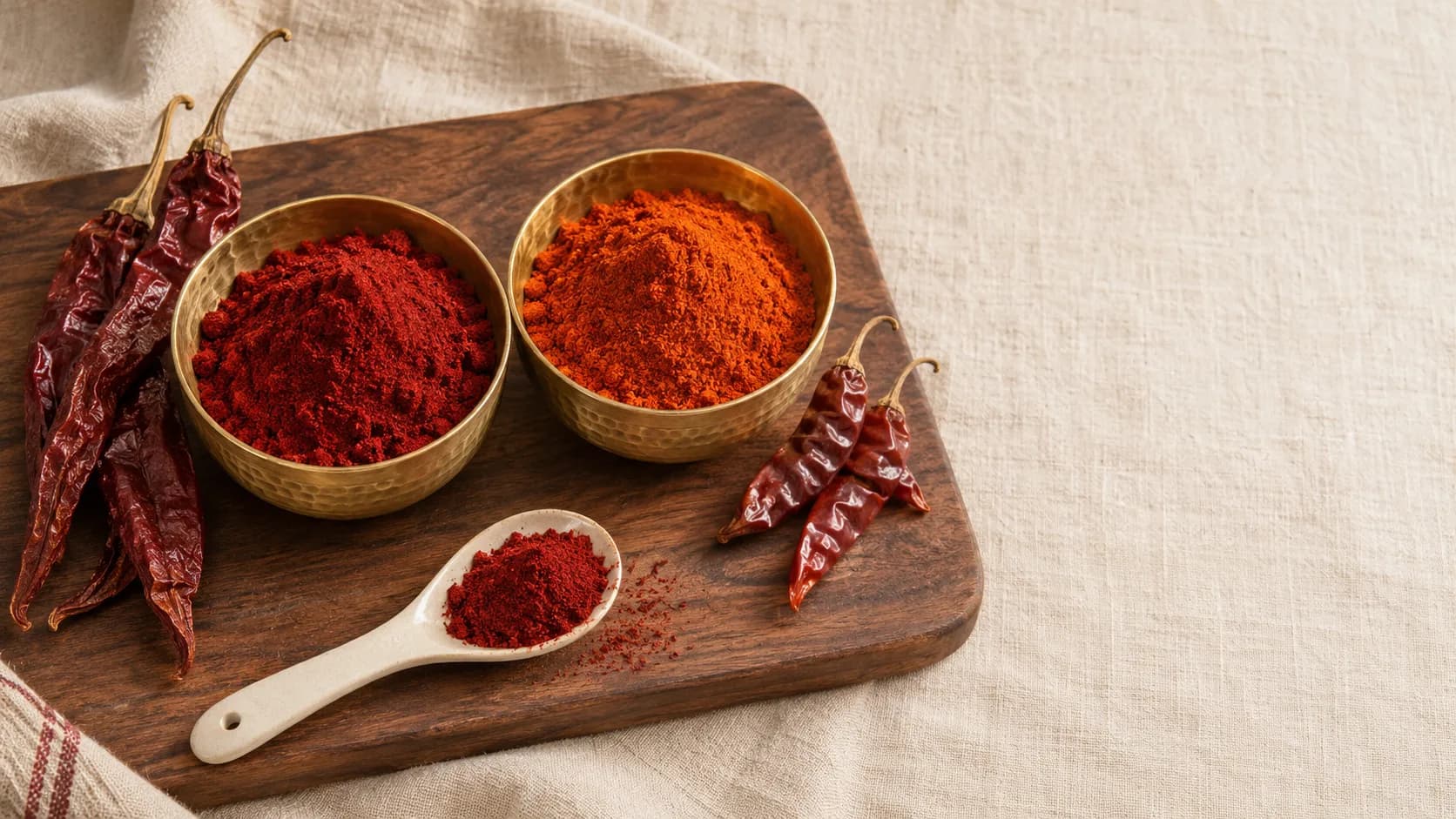
You follow a rogan josh recipe to the gram, add two teaspoons of red chilli powder, and end up with a curry that's brownish and so hot your family reaches for the curd. The restaurant version was deep red and gentle. Same dish. Different chilli.
That's the whole Kashmiri chilli powder vs red chilli powder question in one pot. One is chosen for colour. The other is usually chosen for heat. Swap them without thinking and you cook the wrong dish.
In this guide, you'll see what actually separates the two, why colour and heat come from different compounds, why a "Kashmiri" label doesn't always mean Kashmiri chilli, how to test your powder at home using FSSAI's own method, and when to reach for which.
"Red chilli powder" on an Indian shelf is a broad term. It can be Guntur, Teja, a blend of several varieties, or whatever was cheapest at the mandi that season. It's sold for one main job, heat.
Kashmiri chilli powder is ground from a specific chilli, a Capsicum annuum type grown in cooler regions such as Jammu and Kashmir and Himachal Pradesh. The Spices Board of India's chilli catalogue describes the Kashmir chilli as long, fleshy and deep red, harvested from November to February and traded mainly in North Indian markets.
Here's the thing: cooks don't buy it for fire. They buy it for colour. Kashmiri chilli is the reason a tandoori marinade looks flame red without being punishing to eat.
Here's how the two usually compare in your kitchen:
Colour: Kashmiri chilli powder is deep crimson, almost brick red. Regular red chilli powder is brighter and more orange.
Heat: Kashmiri is mild to moderate. Regular powder bites harder, often at the back of the throat.
Aroma: Kashmiri smells slightly fruity and smoky. Regular powder smells sharper and more pungent.
Job in the dish: Kashmiri makes food look red. Regular powder makes food taste hot.
This is the part most labels skip.
A chilli's red colour comes from carotenoid pigments, mainly capsanthin and capsorubin, according to a 2019 review of Capsicum carotenoids in the journal Antioxidants. Its heat comes from capsaicinoids, a completely separate family of compounds. One paints the dish. The other burns the tongue.
Because the two are governed separately, a chilli can be very red and fairly mild, or pale and fierce. That's why you can't judge heat by looking at a powder, and why a deep colour on its own proves nothing.
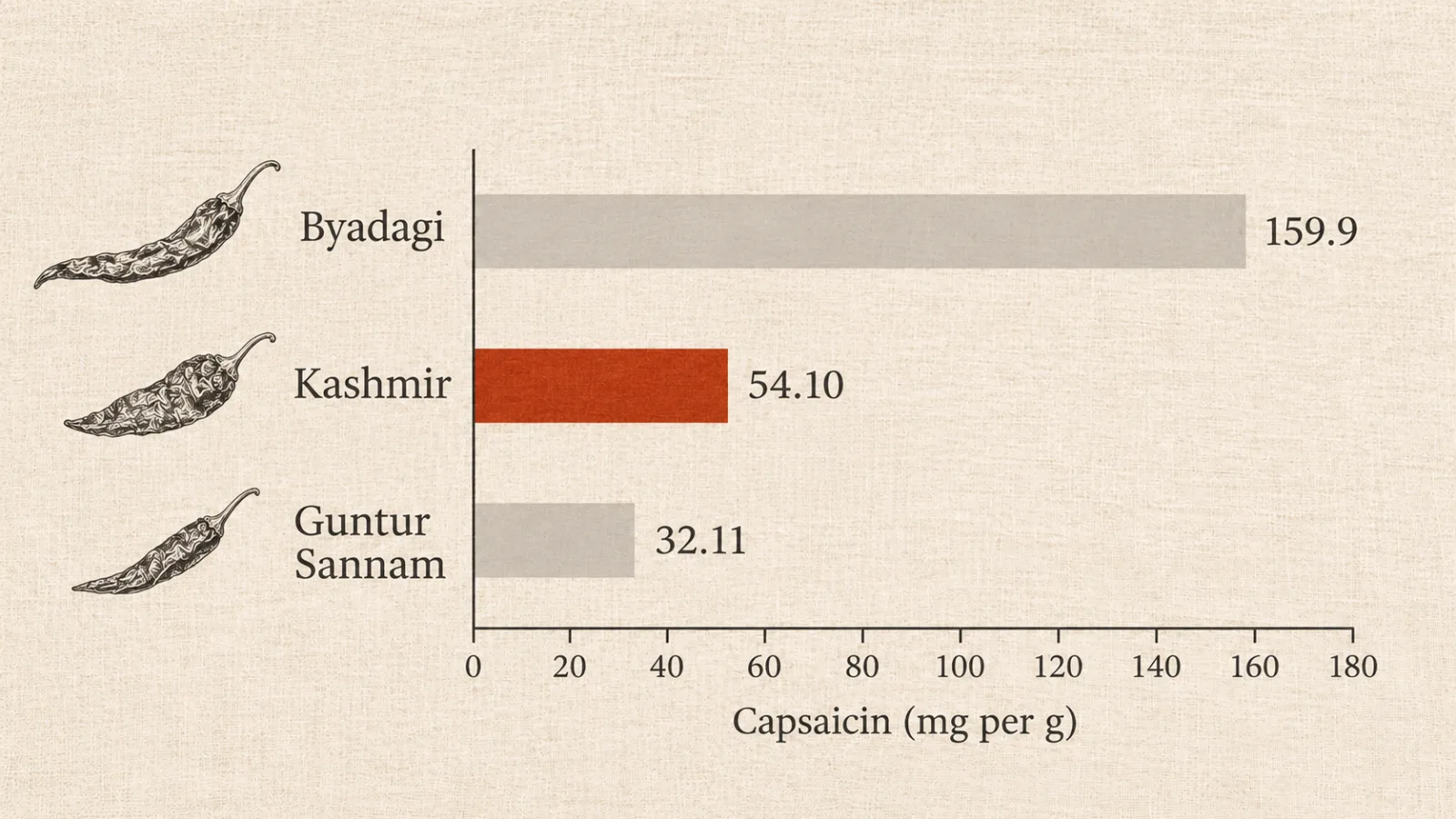
The Spices Board puts numbers on this with the ASTA colour value, a lab measure of how much red colour can be extracted from a chilli. Its catalogue lists:
| Variety | Where it's grown | ASTA colour value | Capsaicin |
|---|---|---|---|
| Byadagi (Kaddi) | Dharwad, Karnataka | 159.9 | Negligible |
| Kashmir | Jammu and Kashmir, Himachal Pradesh | 54.10 | 0.325% |
| Guntur Sannam (S4) | Guntur, Warangal and Khammam districts | 32.11 | 0.226% |
Notice something? On these catalogue figures, the Kashmir chilli isn't the lowest in capsaicin. Lab numbers shift with soil, season, grade and how the pods were dried, so treat them as a snapshot, not a law. What stays consistent is the cooking experience. Food writers commonly rate Kashmiri chilli at roughly 1,000 to 2,000 Scoville heat units, well below the hot powders most of us grew up with, and it gives far more colour per spoonful of heat.
And it gets more interesting, depending on what's sitting in your masala dabba.
Demand for Kashmiri chilli is far larger than the crop actually grown in Kashmir. The local variety has needed active support. In 2021, the Agriculture Department in Kashmir announced an incentive of ₹25,000 per hectare for farmers growing the local lal mirch, Kashmir Reader reported.
That supply gap gets filled. Byadgi chilli from Karnataka, which tops the Spices Board's colour table with negligible capsaicin, is widely used as a stand-in for Kashmiri chilli. Byadgi isn't a bad chilli. It's a good one. It just isn't Kashmiri.
Then there are blends. In a comparative test published by the Consumer Education and Research Centre, two branded powders labelled Kashmiri measured 48,000 and 60,000 Scoville heat units, the same range as the regular hot powders in that test. That's a long way from the mild figure people expect.
The result? The word "Kashmiri" on a pack tells you the intended style. It doesn't always tell you the chilli.
Colour is what sells chilli powder. That's exactly why it gets faked.
Researchers writing in the International Journal of Food Science & Technology in 2007 analysed 800 loose, unbranded chilli powder samples from India. They reported that roughly two thirds were artificially coloured, and that none of the branded samples they tested contained Sudan dyes, a group of industrial colours that aren't permitted in food. Other common fillers include brick powder, sand, salt and talc.
So bright isn't always better. Real chilli colour is deep and slightly dusky, never neon. A powder that glows, stains your fingers in a second, or costs far less than everything around it deserves a second look.
You don't need a lab for the crude fakes. FSSAI's DART guide (Detect Adulteration with Rapid Test) lists simple checks you can run with a glass of water.
Artificial colour test. Fill a clear glass with plain water. Sprinkle a pinch of chilli powder on the surface and don't stir. If coloured streaks start running down through the water straight away, the powder likely contains artificial colour. Pure chilli powder doesn't release streaks like this.
Brick powder and sand test. Stir a teaspoon of chilli powder into a glass of water and let it settle. Take a little of the residue at the bottom and rub it between your fingers. Grittiness points to brick powder or sand.
Soapstone test. Look at that same residue. If there's a white part that feels soapy and smooth when rubbed, it suggests soapstone.
Here's the catch. These tests catch crude adulteration, not mislabelling. They won't tell you whether a powder is Kashmiri, Byadgi or a blend, and they can't measure heat. For that, you're relying on the seller's sourcing and honesty, which is why the label matters as much as the colour.
This is where the comparison earns its keep. Choose by the job, not the label.
Reach for Kashmiri chilli powder when a dish should look red but stay gentle. Think rogan josh, butter chicken, tandoori marinades, pav bhaji, the tadka on a dal, and a slow pot of Kashmiri rajma. In Kashmiri cooking it often works alongside ver masala, the region's spice cake, which we cover in our guide to Kashmiri pantry staples.
Reach for regular red chilli powder when heat is the point. Fiery pickles, chutneys, a sharp everyday sabzi or a spicy egg bhurji all want bite more than colour.
Many home cooks quietly use both. A generous spoon of Kashmiri for colour, a small pinch of hot powder for heat. You control each one separately, which is exactly how the chilli itself works.
Swapping one for the other? Go slowly. If a recipe asks for 2 teaspoons of Kashmiri chilli powder and you only have a hot one, start with about half a teaspoon, taste, and add more only if needed. You'll lose some colour, and that's the honest trade. Going the other way, you can usually use a little more Kashmiri than the hot powder a recipe lists, since you're adding colour faster than heat.
One more kitchen tip. Capsanthin and capsorubin are carotenoids, and carotenoids dissolve in fat, not water. That's why the colour blooms when you add Kashmiri chilli to warm oil or ghee for a few seconds, off high heat so it doesn't scorch. The rogan in rogan josh refers to that red fat.
Start with colour. You want deep crimson with a slightly dusky edge, not fluorescent red. Then smell it. Good Kashmiri chilli smells warm and fruity, not dusty or flat.
Next, read the pack. Look for the brand's FSSAI licence number, the packing date and a best-before date. The ingredient line should be one word long: chilli. Anything else, like "colour" or "oil", tells you what you're really buying.
Price is a clue, not a verdict. A powder far cheaper than everything else on the shelf is often cheap for a reason. Then run the water test from FSSAI at home. It takes two minutes.
At Zoon Naturals, our Kashmiri Red Chilli Powder is made from sun-dried Kashmiri chillies, stone-ground in small batches, with no added colour. Each 250 g pack is ₹299, carries our FSSAI licence and the month and year of packing, and is best used within 12 months of packing. Keep it away from moisture, close the pack tightly after use, and it'll keep its colour far longer.
Kashmiri chilli powder doesn't make food hotter. It makes food redder. Regular red chilli powder doesn't make food prettier. It makes food sharper. Treat them as two different tools and most of your curry problems disappear.
If you want colour without fire, use Kashmiri. If you want heat, use a regular powder. If you want both, use a spoon of one and a pinch of the other. And if a powder looks too bright to be true, put it in a glass of water before it goes in your pot.
If you'd like a chilli powder whose colour is the chilli's own, explore our Kashmiri Red Chilli Powder and the rest of our Saffron & Spices range.
Kashmiri chilli powder is used mainly for its deep red colour and mild heat, while regular red chilli powder is used mainly for heat. Colour comes from carotenoid pigments and heat from capsaicinoids, so the two don't always go together.
It's mild to moderate. Food writers commonly rate it around 1,000 to 2,000 Scoville heat units, but packs labelled "Kashmiri" can be blends and may be much hotter, so taste a pinch first.
Yes, but use far less. Start with about a quarter of the amount the recipe asks for, taste, and adjust. Expect a less red dish.
Use FSSAI's DART water test. Sprinkle a pinch on water; instant coloured streaks suggest artificial colour. Stir a teaspoon into water and rub the residue; grittiness suggests brick powder or sand, and a soapy feel suggests soapstone.
No. Byadgi is grown in Karnataka and Kashmiri chilli in cooler regions such as Jammu and Kashmir and Himachal Pradesh. Byadgi is often used as a substitute because it's very red and mild, but it's a different chilli.
Taste the difference yourself.
Mongra saffron and fresh-crop dry fruits, sealed to order in Anantnag.
Shop the harvest