


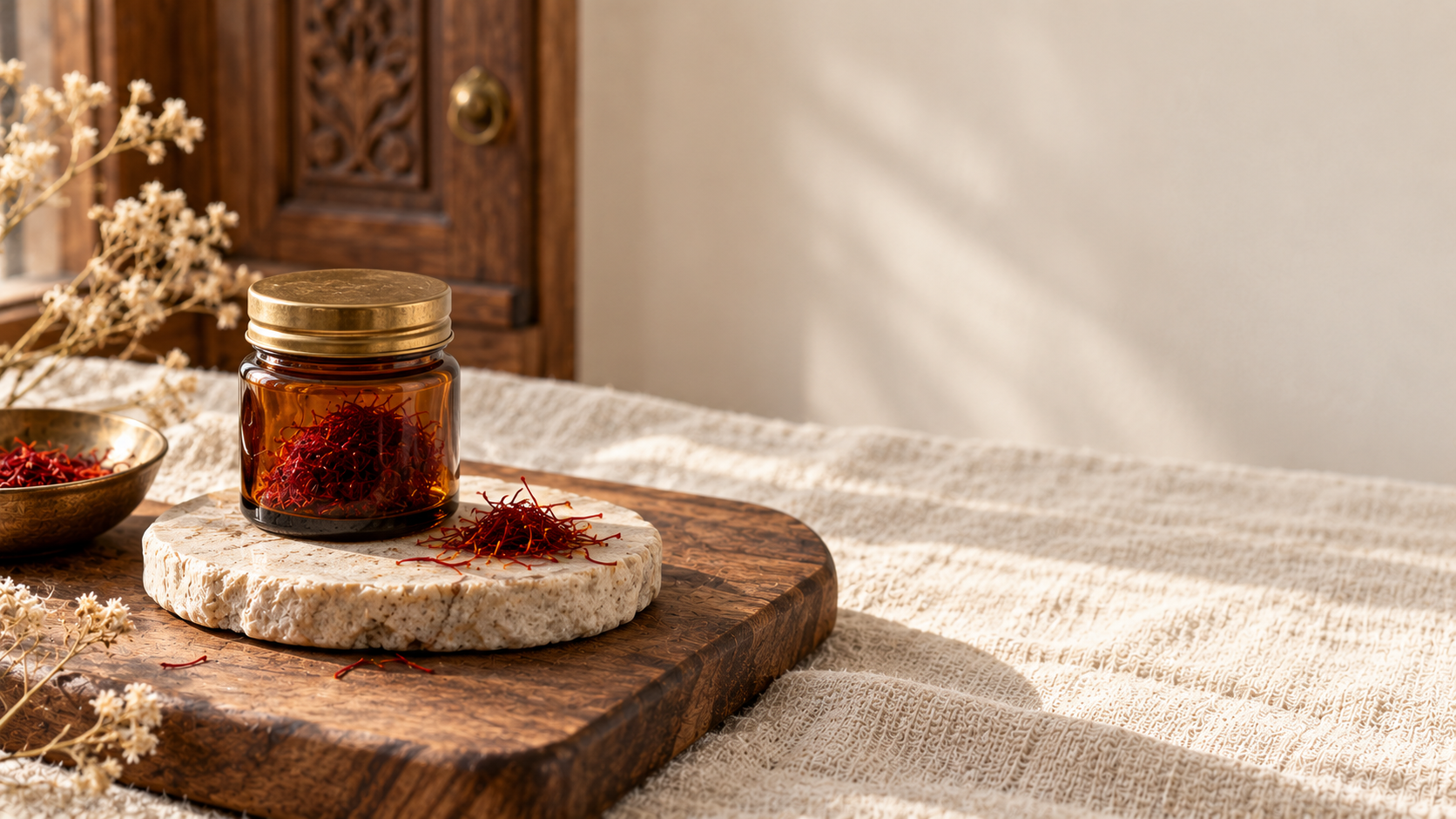
Picture this: you bought a good gram of kesar last winter for a wedding biryani. You open the box today, drop a pinch into warm milk, and wait. The colour comes, but slowly and pale. The aroma you remember, that honeyed, hay-like warmth, is barely there.
Nothing was wrong with the saffron. Something was wrong with where it lived.
Saffron doesn’t go “bad” the way milk does. It fades. Light, air, moisture and heat quietly break down the compounds that give it colour, taste and smell. In this guide, you’ll learn how to store saffron in an Indian kitchen, which container to use, whether the fridge helps or hurts, how long kesar really lasts, and how to check if yours is still worth using.
Why how you store saffron matters more than you think
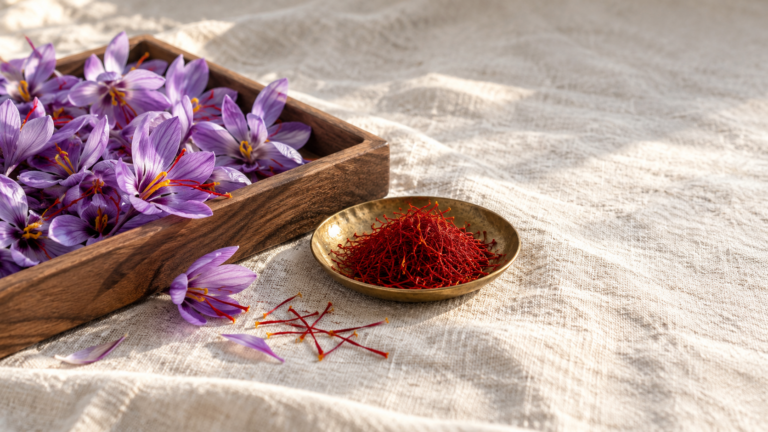
Every red thread carries three working compounds. Crocin gives the colour. Picrocrocin gives the bitter-sweet taste. Safranal gives the aroma. (We break these down in our guide to crocin, safranal and picrocrocin.)
Here’s the thing: all three are fragile.
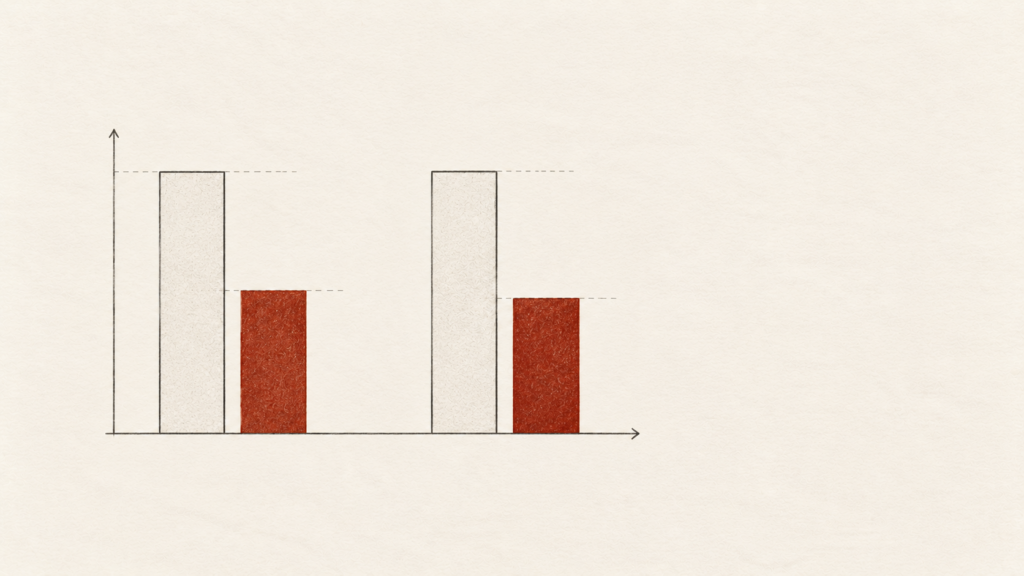
A study of saffron samples stored over 15 years, published in Pharmacognosy Magazine, reported that crocetin esters (the colour compounds) and picrocrocin dropped by about 52 and 54 per cent after one year of storage. Losses slowed after that first year. That study looked at Chinese saffron under its own storage conditions, so your jar won’t follow those numbers exactly. The direction is the point.
Saffron is at its best early. Your storage decides how slowly it declines.
That’s why the price you pay per gram only makes sense if the gram still performs when you use it. Poor storage turns ₹560 of saffron into something closer to coloured hay.
The four things that quietly drain your kesar
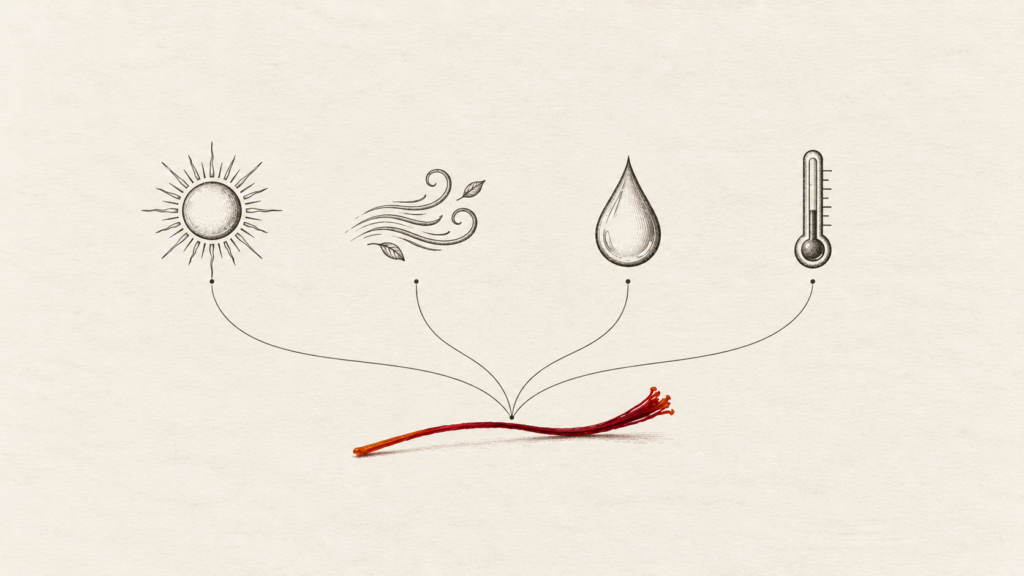
Our own saffron usage guide puts it simply: light, air and humidity are saffron’s enemies, in that order. Heat sits right beside them. Let’s take each one.
- Light. Saffron’s pigments break down when exposed to light. The German insurers’ cargo handbook TIS lists light protection as a basic requirement for shipping saffron. A clear jar on a sunny shelf is the fastest way to bleach it.
- Air. Oxygen slowly oxidises the colour and aroma compounds. An open box or a loosely folded pouch lets air in every day.
- Humidity. Saffron is hygroscopic, which means it pulls moisture out of the air. The same TIS guidance notes this and recommends a relative humidity of no more than 70 per cent during transport.
- Heat. TIS also warns that above 25°C, saffron’s essential oils may be lost. That matters in most Indian kitchens for much of the year.
The result? A shelf beside the gas stove is the worst address in your house. It’s bright, warm and steamy, all at once.
Moisture is the enemy you don’t see
Light and heat are easy to spot. Moisture isn’t.
Saffron is dried after picking for a reason. Guidance from the University of Vermont’s saffron programme says dried saffron should hold less than 12 per cent water, and a 2025 study on Kashmiri saffron in Scientific Reports used that same 12 per cent ceiling from ISO 3632 as the benchmark for quality. Properly dried threads snap cleanly. Damp ones bend.
And it gets worse in our climate. The UVM factsheet notes that in humid weather, dried saffron can soak moisture back from the air if it’s left exposed. Think of a Mumbai monsoon, a Chennai summer, or a steaming kitchen anywhere.
Research backs this up. A kinetic study by Tsimidou and Biliaderis in the Journal of Agricultural and Food Chemistry found that the rate at which saffron loses its colour depends strongly on both temperature and water activity, a measure of how much free moisture is available. More warmth and more moisture meant faster colour loss.
Dry saffron keeps. Damp saffron fades, and in the worst case, it can grow mould.
How to store saffron at home, step by step
This is the practical part. You don’t need special equipment. You need a little discipline.
Step 1: Pick the right container
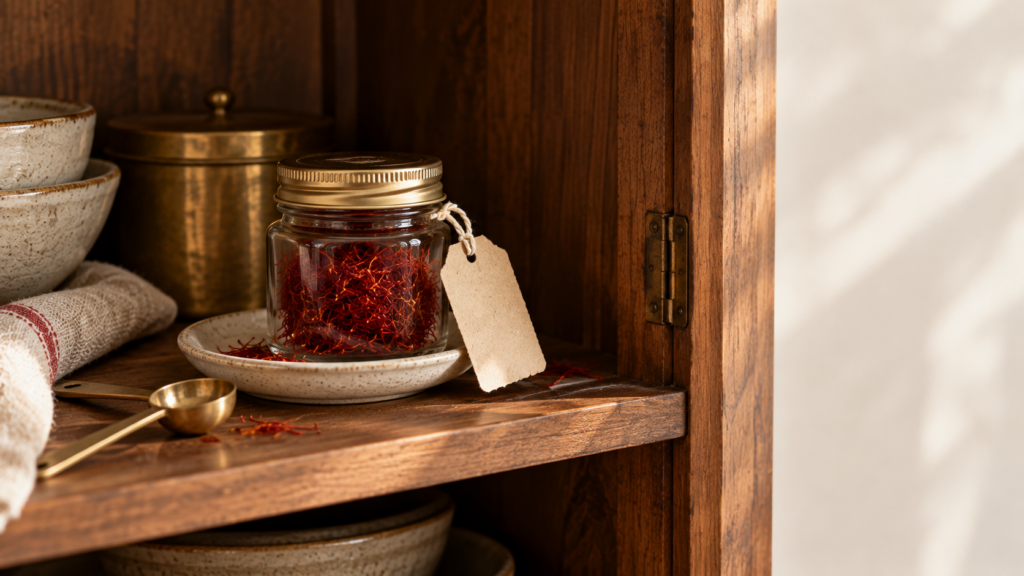
The UVM guidance prefers airtight, screw-top glass jars or snap-top vials, and advises against plastic and paper bags. Glass doesn’t absorb aroma or leak anything into the threads. If your glass is clear, keep it somewhere dark, or use amber or opaque glass.
Size matters too. A small jar holds less trapped air than a big one. If you buy 5g, a jar that fits 5g is better than an empty pickle bottle.
Step 2: Keep it dark and cool
Put the jar in a closed cupboard, away from the stove, the oven, the chimney and any sunny window. An inside wall works better than an outside one in summer. Our own product pages carry a simple line: keep it closed, away from light and heat.
Step 3: Keep it sealed and dry
Close the lid straight after you take a pinch. Never use a wet spoon or damp fingers. Don’t store it near the kettle, the pressure cooker or the sink, where steam drifts.
Step 4: Keep it apart from strong smells
Saffron absorbs odours, and TIS notes that airtight packaging protects it from picking up smells around it. So don’t keep it in the same tin as hing, garam masala or whole cardamom.
Step 5: Label it and use the oldest first
Write the date you opened it on the jar. If you buy more than one pack, finish the older one first. Simple. Effective.
Should saffron go in the fridge?
This is the question most people in India ask, and the honest answer is: usually not.
A cool, dark cupboard does the job for most homes. The trouble with the fridge is condensation. Every time you take a cold jar out into a warm kitchen, moisture can settle on the glass and, if you open it straight away, on the threads. Given what we know about saffron and moisture, that’s a risk you don’t need.
There’s a reasonable exception. If your kitchen stays well above 25°C for months and you’re holding a larger stock you won’t touch for a while, a fully sealed jar at the back of the fridge or freezer can make sense. Follow two rules if you do this:
- Let the sealed jar come to room temperature before you open it, so no moisture condenses on the threads.
- Keep a small “daily” jar in the cupboard, and refill it from the cold stock only occasionally.
The fridge isn’t the enemy. Opening a cold jar in a warm kitchen is.
How long does saffron last?
Saffron doesn’t really expire. It weakens.
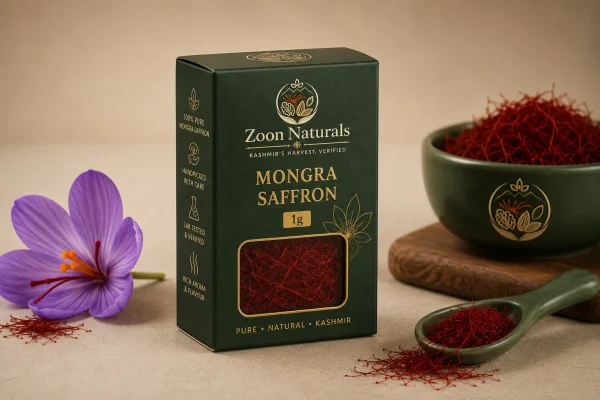
UVM’s guidance says properly stored saffron can retain its quality for at least two years. At Zoon Naturals, our Mongra saffron packs carry a best before of 24 months from packing, with the month and year of packing printed on the pack. So you always know where you stand on the calendar.
Here’s what that means in practice. Buy what you’ll use in a season or two, not a decade’s supply. A 1g pack goes a long way, because a biryani for six needs only about 25 to 30 threads. (Our saffron dosage guide shows how much to use by dish.)
There’s also a nice detail from the same UVM factsheet: some growers like to rest saffron for about a month before use, because the flavour and aroma develop. That’s one reason freshly harvested saffron from the Kashmir harvest isn’t always at its peak on day one.
How to tell if your stored saffron has lost its strength
Your senses do most of the work here. Try these quick checks:
- Smell. Open the jar and breathe in. Good saffron smells sweet, floral and a little like dry hay. Faded saffron smells flat, dusty or of nothing.
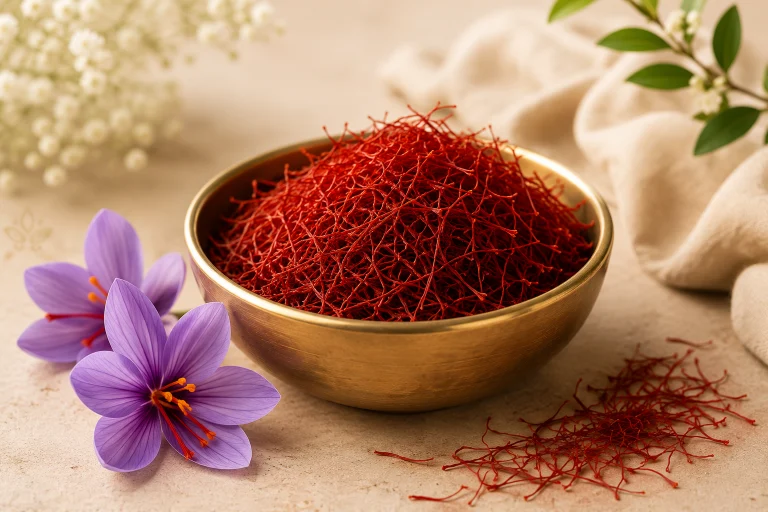
- Colour of the threads. Look for a deep red. Threads that have turned dull brick or brownish have usually lost colour strength.
- The water test. Drop three or four threads into a small bowl of warm water. Good saffron releases a golden-yellow colour slowly over several minutes. Weak saffron gives a pale, thin wash. Real saffron doesn’t bleed red. It releases gold, slowly.
- The snap. Dry threads should break cleanly. Soft, bendy threads have picked up moisture.
If the colour is still good but the aroma is gone, the saffron is still safe to use in rice or sweets. You’ll just need a bit more. If you see mould, a musty smell or clumping, throw it out.
These tests also overlap with checking whether saffron is real. For that, see our guide on how to identify real Kashmiri saffron.
Small habits that make your kesar go further
Storage is half the story. How you use saffron decides how much you need.
Crush the threads lightly between your fingers, then steep them in a little warm milk or water for 15 to 20 minutes before adding to your dish. This pulls out more colour and aroma from each thread. It’s exactly how we suggest making kesar doodh.
Never store saffron already soaked. Bloomed saffron is for today’s cooking, not next week’s. And don’t buy powdered saffron to “save time”. Powder has more surface exposed to air and light, so it fades faster and is far harder to check for purity.
The bottom line on how to store saffron
Saffron doesn’t spoil overnight. It fades, quietly, every day it sits in the wrong place.
Keep it whole, keep it dry, keep it dark. That’s most of the job. If your kitchen is cool, a small airtight glass jar in a closed cupboard is all you need. If your kitchen runs hot and humid, keep a small daily jar and store the rest sealed and cold, letting it warm up before you open it. If you use saffron only for festivals, buy smaller packs more often instead of one big pack a year.
If you want saffron that tells you its packing month and has a clear best before date, explore our Kashmiri Mongra saffron and the rest of our saffron and spices range.
FAQ
Q: How do I store saffron at home in India? A: Keep saffron threads in a small airtight glass jar, in a closed cupboard away from the stove, sunlight and steam. Close the lid right after use and use a dry spoon.
Q: Should saffron be kept in the fridge? A: Usually not. A cool, dark cupboard works for most homes. If you do refrigerate a sealed stock jar in a very hot kitchen, let it reach room temperature before opening so moisture doesn’t settle on the threads.
Q: Does saffron expire? A: Saffron doesn’t spoil quickly, but it slowly loses colour, aroma and taste. Guidance from the University of Vermont says properly stored saffron can keep its quality for at least two years. Check the best before date on your pack.
Q: Can I store saffron in a plastic box or its paper sachet? A: It’s better not to for long-term storage. Airtight glass jars or snap-top vials are preferred, because plastic and paper protect less well against air, moisture and smells.
Q: How can I tell if old kesar is still good? A: Smell it, look at the colour, and do a warm-water test. Good saffron smells sweet and hay-like and slowly releases a golden colour. Flat smell, dull brown threads or a pale wash mean it has faded.
Q: Is saffron powder easier to store than threads? A: No. Powder has more surface exposed to air and light, so it fades faster. Whole threads store better and are easier to check.