
Picture this: it’s March, and a listing online promises “fresh Kashmiri saffron, new crop.” It sounds reassuring. But the Kashmir saffron harvest ended months earlier, in a window that lasts about three weeks, and growers have called the last few seasons some of the thinnest they remember.
The problem isn’t the label. It’s that most of us buy saffron without knowing its calendar.
Once you know when the flowers open, how the threads are pulled and dried, and what a bad year looks like, you read every saffron listing differently. This guide covers when the harvest happens, why it only works on one stretch of land, how a flower becomes a thread, what the weather is doing to the crop right now, and how to use all of it when you buy.
When the Kashmir saffron harvest happens, and why it’s so short
The saffron crocus flowers once a year. In Kashmir, that’s late autumn. According to the FAO report on the Pampore saffron heritage site, flowering starts in the second fortnight of October and lasts up to the first week of November.
That’s it. Roughly three weeks for an entire year’s crop.
Each flower stays fresh for only a day or two. So picking happens every morning, early, while the flowers are still closed and the stigmas inside are protected from sun and wind. Miss a morning and those flowers are lost.
Here’s the thing: the rest of the year matters just as much. The corms, the bulb-like roots that carry the plant from one season to the next, sit in the soil all summer and need moisture before autumn to push up flowers. Dry ground in September can mean a bare field in November.
So think of the Kashmir saffron harvest as a year of waiting for a three-week payout.
Why the karewas of Pampore grow saffron so well
Saffron grows in several countries. In Kashmir, though, it clusters on one landscape.
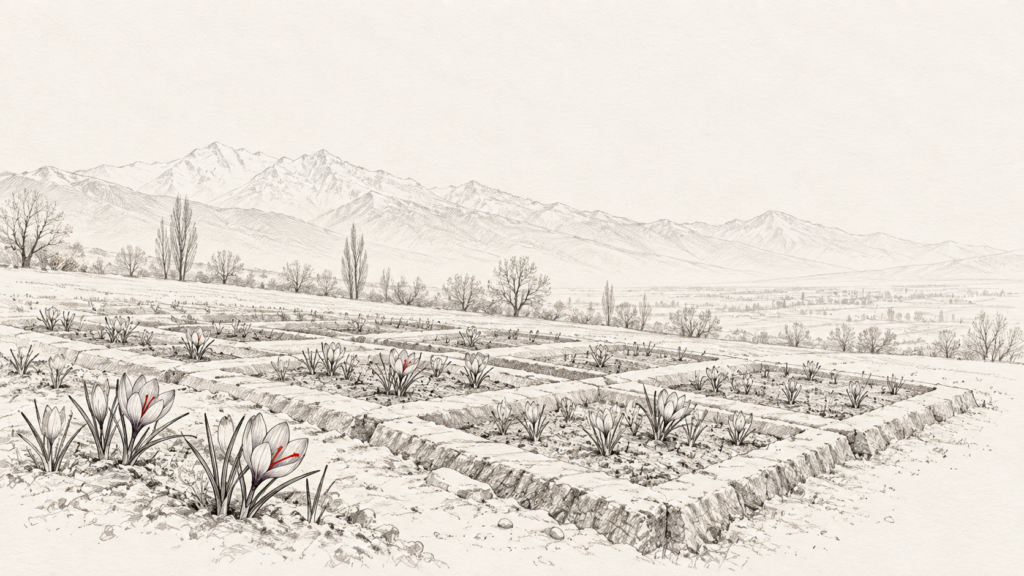
The karewas, flat-topped plateaus of old lake sediment, rise above the Jhelum floodplain around Pampore. The same FAO report puts Pampore at an average elevation of about 1,574 metres, roughly 25 km south-east of Srinagar. The soil drains fast. That matters, because a saffron corm left sitting in wet ground rots.
Farmers work with the land, not against it. The report describes fields laid out as square beds about 1.5 metres across, with trenches between them so water never pools. It’s an old system, and it’s part of why FAO documented the area as a globally important agricultural heritage site.
It’s also a human system. The report estimates around 3,200 hectares under saffron at the time of writing, supporting more than 17,000 farm families. It credits Kashmiri women with much of the work: tilling, picking, and the slow, careful drying.
Cold, dry air. Fast-draining soil. Family plots worked for generations. That’s what the word “Pampore” is shorthand for. Our page on where our saffron comes from walks through the same landscape.
How a flower becomes a thread, in a single day
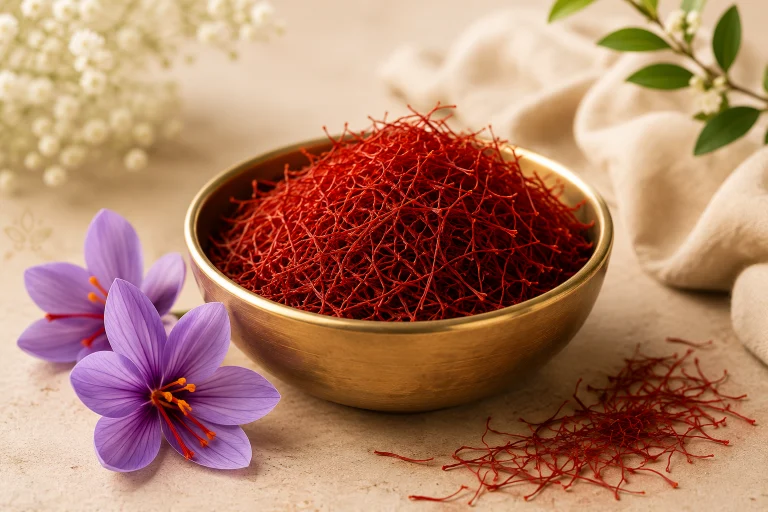
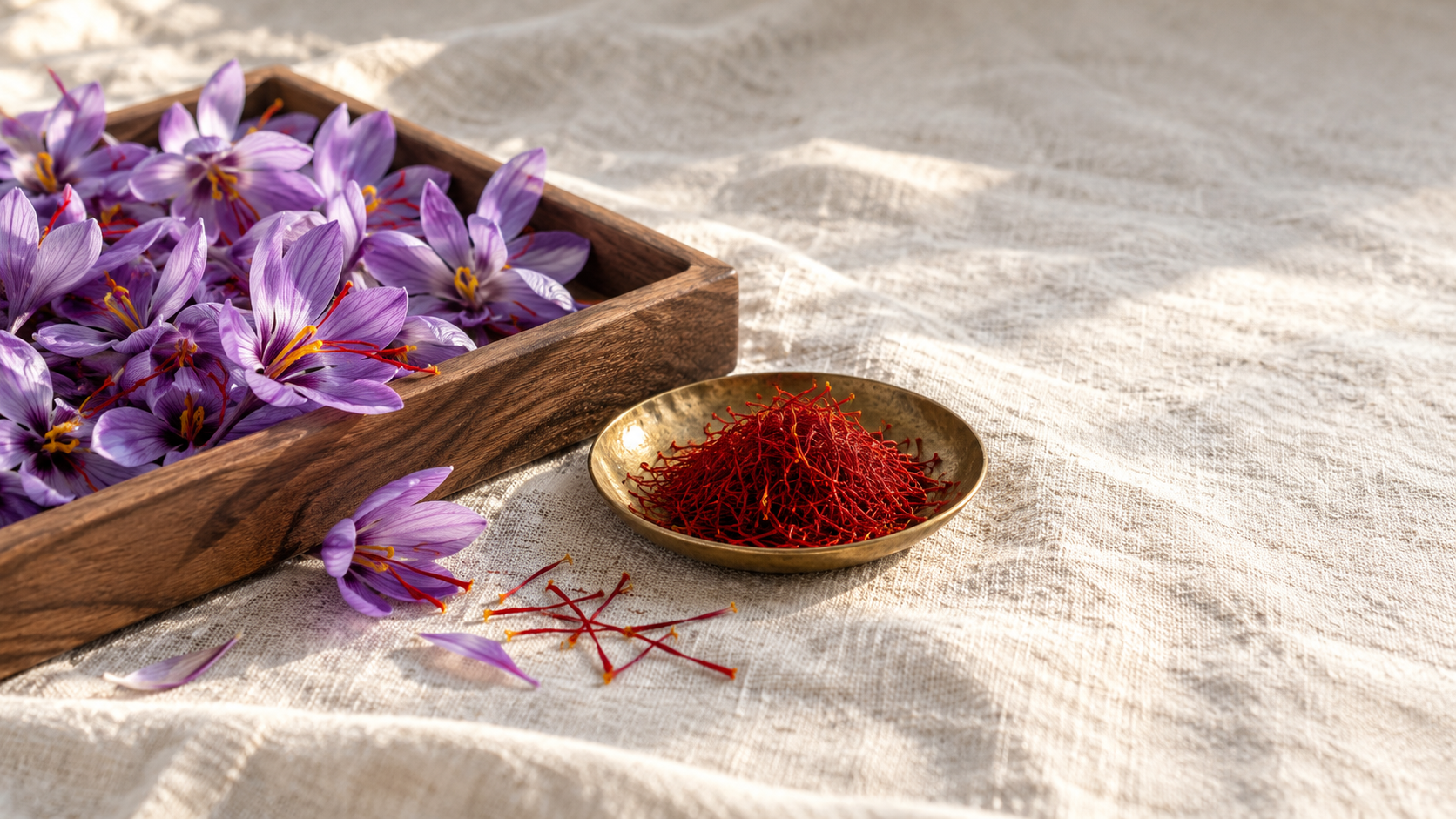
A purple crocus and a gram of red threads look nothing alike. The path between them is short, manual and unforgiving.
Here’s how it usually goes:
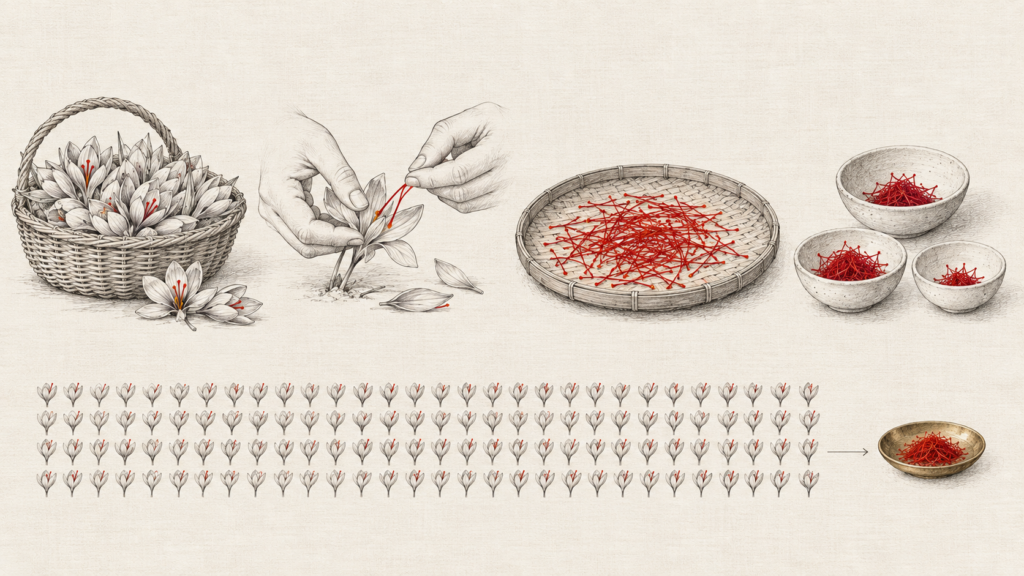
- Picking at first light. Whole flowers are pulled while still closed and carried off the field in baskets.
- Separating the same day. Each flower holds exactly three red stigmas. They’re pinched out by hand, because a stigma left inside a wilting flower loses colour and aroma by the hour.
- Drying gently. Fresh stigmas are mostly water. Dried too slowly, they dull. Dried too hot, the aroma cooks off before it forms.
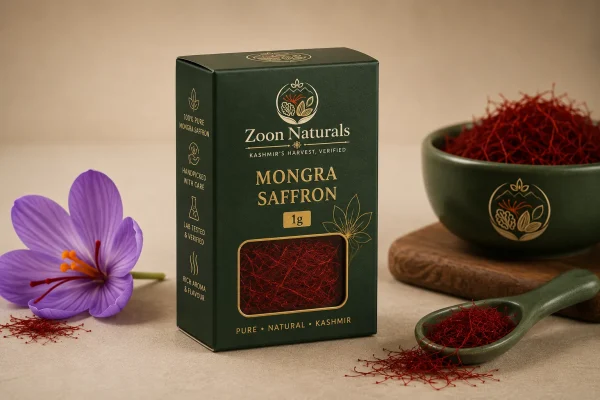
- Sorting into grades. Mongra is the deep red tip, cut free of the pale yellow style. Lacha keeps a little of that style. Guchhi is the whole thread, bundled as it came. Our guide to Mongra, Lacha and Guchhi explains the difference.
Now the numbers. Britannica notes that a pound of saffron represents about 75,000 blossoms. Do the maths and that’s roughly 165 flowers for every gram.
One gram of saffron is a morning of picking and an afternoon of separating, all by hand.
That’s why the price never looks “normal.” It isn’t a normal crop.
Why this year’s harvest is a weather story
The 2026 season is starting the way recent ones have: with growers watching the sky.
In early October, the Kashmir Observer reported that dry weather and high temperatures had left saffron fields short of soil moisture just before flowering. Abdul Majeed Wani, president of the Saffron Growers Association, told the paper that when corms don’t get favourable conditions and enough moisture, the number of flowers drops.
That worry isn’t new. Last November, Kashmir Reader quoted Wani saying the 2025 crop was “hardly 15 per cent” of normal, and that the 2024 crop had itself been only about 30 per cent.
And here’s where it gets interesting. Official figures tell a different story.
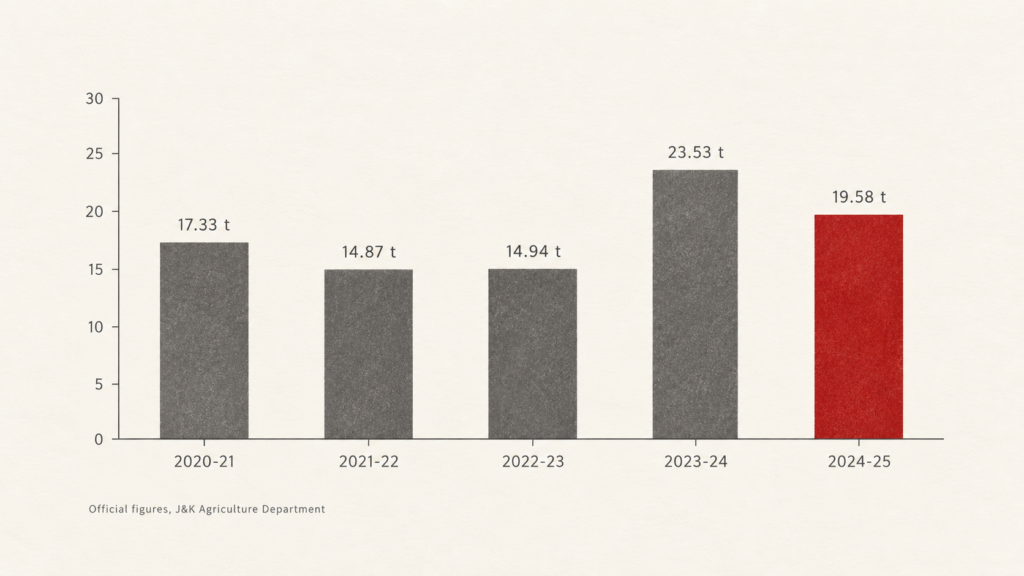
In February 2026, Agriculture Minister Javid Ahmad Dar put Jammu and Kashmir’s output at 23.53 metric tonnes in 2023-24 and 19.58 metric tonnes in 2024-25, according to Greater Kashmir. The same statement put the area under saffron at about 3,715 hectares, down from 5,707 hectares in the past.
Even the official yields are small. The same statement put average productivity between 4 and 6.33 kg per hectare across 2021 to 2025. Picture a field the size of a football pitch giving you a few kilos of dry threads for a whole year of work.
Two sources. Two very different pictures.
We won’t pick a side on numbers we can’t check ourselves. The honest takeaway is simpler. The land under saffron has shrunk sharply, yields swing with the weather, and growers have described several recent seasons as poor. Genuine Kashmiri saffron is a small crop that’s getting harder to grow.
The result? Supply stays tight, and tight supply is exactly when mislabelled saffron finds buyers.
What the GI tag protects, and what it doesn’t
You’ll see “GI tagged” on plenty of saffron listings. It’s worth knowing what that means.
Kashmir Saffron is a registered Geographical Indication. The official GI registry record lists it under application number 635, registered on 1 May 2020, with the Agriculture Production Department of Jammu and Kashmir as the applicant.
A GI ties a name to a place. It’s meant to stop saffron grown elsewhere from being sold as Kashmir saffron.
But a GI protects a name. It isn’t a lab test of the jar in your hand. It won’t tell you the grade, the harvest year, or whether the threads were bulked up with yellow style or dye.
That’s why, at Zoon Naturals, we don’t lean on certification language we don’t hold. We’d rather point you to what you can check: where the saffron was grown, what grade it is, and how it was tested. Every saffron batch we pack is tested for crocin, safranal and picrocrocin, the three measures ISO 3632 grades saffron on, and every pack carries the code of the batch it was filled from. If those three words are new to you, our explainer on crocin, safranal and picrocrocin breaks them down.
How the harvest calendar helps you buy better saffron
Knowing the harvest turns vague labels into questions you can ask. A few practical rules:
If a seller says “new crop” in spring or summer, ask which harvest. The flowers open in late October and early November, so genuine Kashmiri saffron on sale in April came from the previous autumn at the earliest. That’s normal, since saffron keeps well. It’s the vague “fresh” promise that should make you pause.
If the price looks too good after a poor season, treat it as a warning, not a bargain. When growers describe harvests at a fraction of normal, cheap “Kashmiri” saffron sold by the kilo doesn’t add up.
If a listing only says “premium” or “A++,” ask for the grade by name. Mongra, Lacha and Guchhi mean something specific. Premium doesn’t.
If you’re buying for festive cooking or gifts in November, don’t wait for the new crop to land. Freshly picked threads still need drying and grading before they’re packed, so buy from a seller you trust and check the grade, not the date.
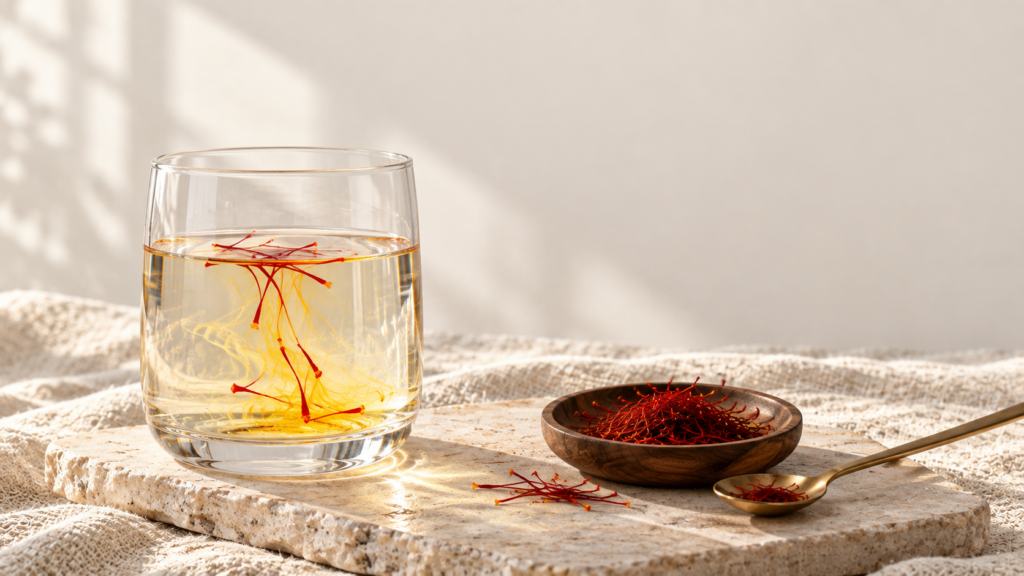
If you want a home check, try cold water. Real saffron releases its colour slowly, a golden yellow spreading over several minutes. Dye lets go almost at once. It isn’t conclusive alone, and our guide on how to identify real saffron covers the other checks.
And it gets better once it’s home. Saffron doesn’t spoil. It fades. Keep it sealed, dark and away from the stove, and a small pack bought after the harvest will carry you through a winter of Kashmiri kahwa and kesar doodh.
The bottom line on the Kashmir saffron harvest
The Kashmir saffron harvest isn’t a season. It’s a few weeks of cold mornings, after a year of waiting on rain.
Real saffron doesn’t arrive as a “fresh crop” every month. It comes from one short autumn window, on one stretch of karewa soil, picked by hand one flower at a time.
So use the calendar. If someone promises a new harvest out of season, ask which one. If the price ignores a poor year, ask why. If the grade is only “premium,” ask for the real name.
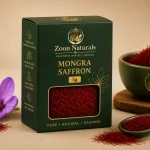
If you want saffron with a known origin and a named grade, explore our Mongra saffron from Pampore, or browse the full saffron and spices range.
FAQ
Q: When is saffron harvested in Kashmir? A: Flowering usually starts in the second half of October and runs to about the first week of November, according to FAO’s report on the Pampore saffron heritage site. Flowers are picked each morning during that short window.
Q: Where is saffron grown in Kashmir? A: Mostly on the karewa plateaus around Pampore, south-east of Srinagar, with a small area in Kishtwar. Official figures put the total at about 3,715 hectares.
Q: How many flowers does it take to make one gram of saffron? A: Roughly 165. Britannica puts it at about 75,000 blossoms per pound, and each flower gives only three stigmas.
Q: Why is Kashmir saffron production falling? A: Growers point to long dry spells, weak irrigation and poor-quality corms, on land that has shrunk sharply over the decades. Official and grower estimates of recent output differ, but both show far less land under saffron than before.
Q: Does the Kashmir saffron GI tag guarantee purity? A: No. The GI protects the name “Kashmir Saffron” and ties it to its region. Grade and adulteration still need a lab test or careful checks at home.
Q: Is new-season Kashmiri saffron better than last year’s? A: Not automatically. Well-dried saffron kept sealed, dark and cool holds its colour and aroma for a long time. Grade and storage matter more than the date alone.