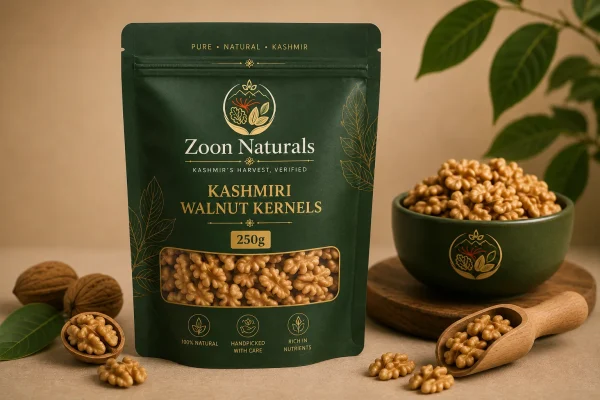



Put a Kashmiri walnut kernel next to an imported one and most people cannot tell you why one costs more. They look similar. They are not remotely the same product, and the difference starts with rain.
Rain-fed versus irrigated
Most of the world’s walnuts come from irrigated commercial orchards, harvested young and processed fast. Kashmir’s walnuts grow differently. The trees are old, often decades old, scattered across village land in Anantnag, Kupwara, and Shopian, and they are almost entirely rain fed. No drip lines, no schedule, just snowmelt and season.
Slower, harder growing conditions concentrate oil in the kernel. That is why a good Kashmiri walnut tastes rich and almost sweet, while a mass-market kernel can taste like cardboard with a bitter finish. India grows the overwhelming majority of its walnuts in Jammu and Kashmir, and the crop is a serious pillar of the valley’s horticulture economy alongside apples and saffron.
What “snow white” kernels really mean
Walnut kernels are graded by color and completeness. The palest, unbroken halves get called snow white, and they command the top price. Light color signals a fresh harvest, careful drying, and kernels from the current season. As kernels age or take heat, they darken and the oil starts turning.
Two catches you should know:
- Bleaching exists. Some traders chemically bleach dark, older kernels to fake the snow white grade. A bleached kernel often looks unnaturally uniform, and the taste gives it away: flat, sometimes faintly soapy. We sell our kernels unbleached, graded by hand, and say so in writing.
- Color is cosmetic beyond freshness. A light amber kernel from this season is a perfectly good nut. Pay for freshness and intactness, not for pallor alone.
The nutrition case, kept honest
Walnuts are the only common nut with a meaningful amount of plant omega-3 (ALA), and the research base is deep: large cohort studies and trials, many indexed on PubMed, associate regular walnut eating with better heart health markers, particularly cholesterol profiles. A 28 gram handful, about 7 halves, is the serving most studies use.
The brain-shape-helps-brain claim is coincidence, but the omega-3 connection to the brain is being studied seriously. As always: food, not medicine.
How to store walnut kernels in Indian weather
The oil that makes walnuts great also makes them fragile. Heat and light turn walnut oil rancid, and an Indian summer is exactly that. Rules:
- Airtight container, always. Kernels absorb kitchen smells.
- Fridge, not the shelf, once the pack opens. Cold storage roughly doubles their life.
- Buy quantities you will finish in two to three months. A 250 gram pack that stays fresh beats a kilo that goes bitter.
- Smell before you eat. Rancid walnut smells like old paint. Trust your nose over any label.
Beyond snacking
Kashmiris crush walnuts into the chutney served with kebabs, thicken harissa with them, and drop them into noon chai. The classic home use across India is soaked overnight, two halves with breakfast, often next to soaked almonds. Walnut oil, cold pressed from these same kernels, is its own story and joins our oils and wellness line soon.
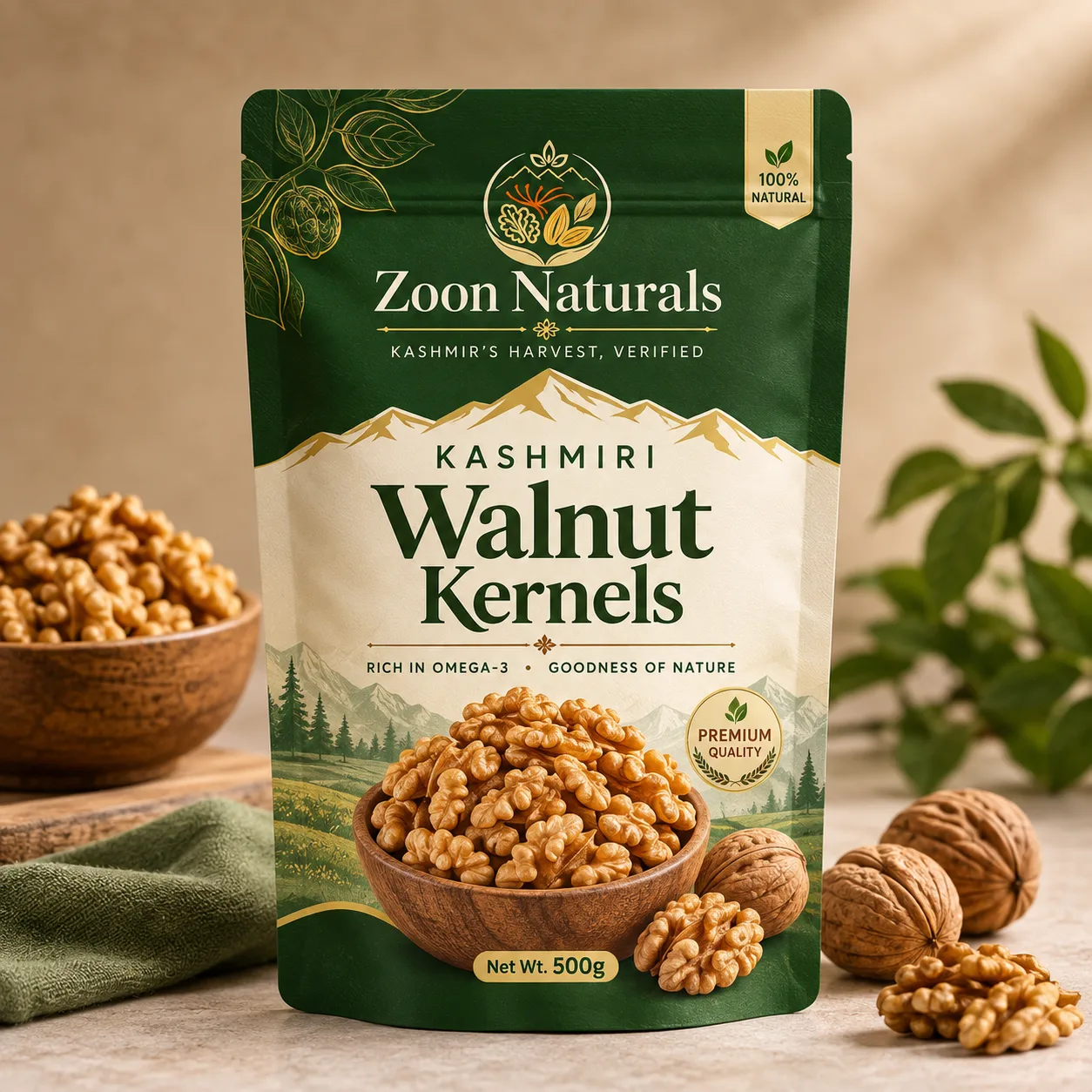
If you want to taste what a rain-fed tree does differently, our snow white kernels ship across India, packed fresh after shelling, with a batch code on the pack you can look up. One handful and the cardboard comparison will make sense.