
Loading page
We are not taking orders right now. Back soon.
We are not taking orders right now. Back soon.
Kashmir Pantry · 4 Nov 2026
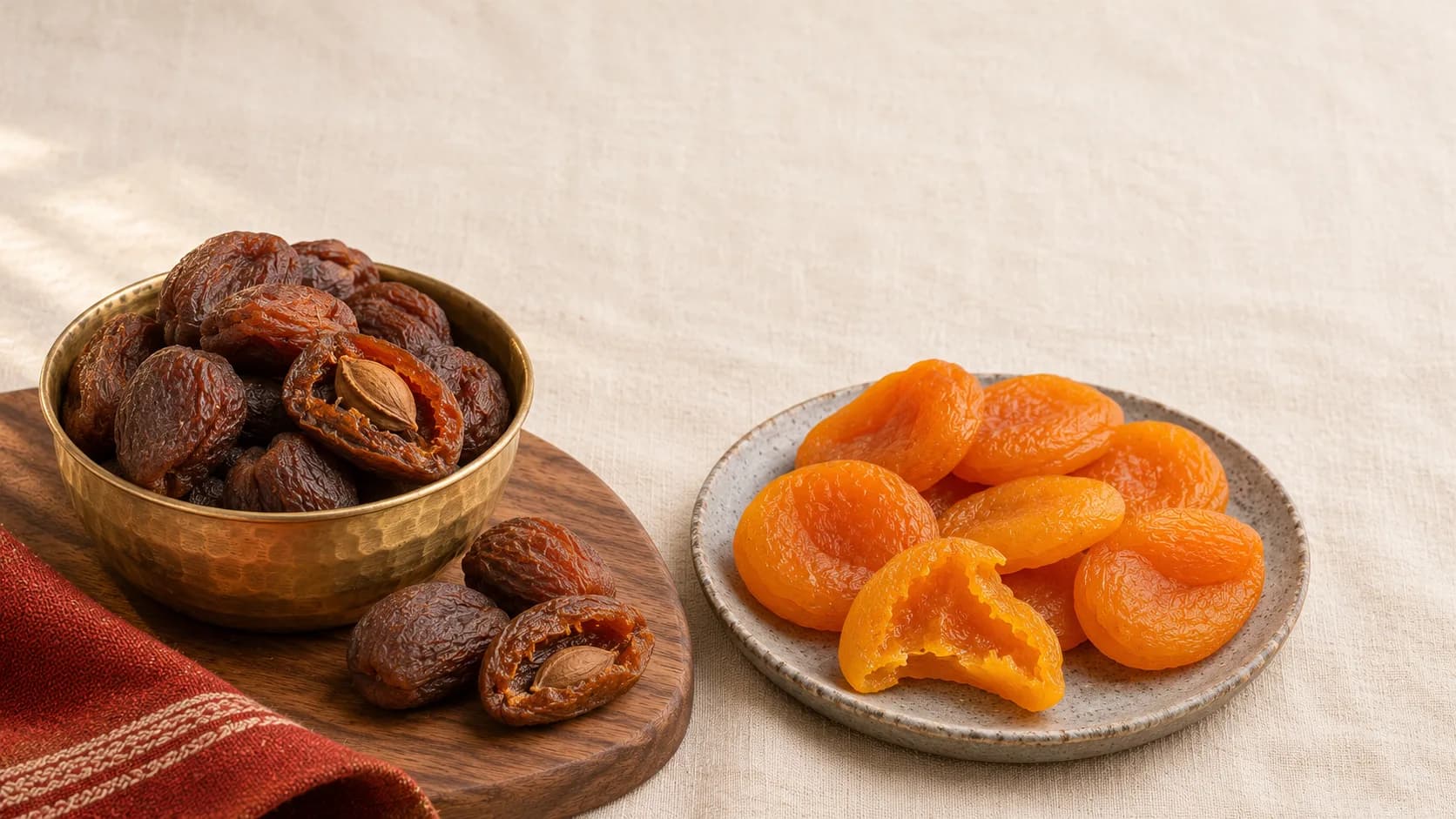
Two bowls of khubani sit on the same shelf. One is bright orange, plump and almost glossy. The other is brown, wrinkled and a little sticky, and it looks like it's been left out too long.
Most people reach for the orange one. That's the bowl that's been treated.
The colour gap between brown vs orange dried apricots isn't about ripeness, freshness or quality of fruit. It mostly comes down to one preservative, sulphur dioxide, and whether the drier used it. Below, we'll walk through what that preservative does, what Indian food rules allow, how to read a pack in ten seconds, how the two taste side by side, and which one makes sense for your kitchen.
A fresh apricot is orange because of its carotenoids, the same family of pigments that colours carrots and mangoes. Cut one open and leave it on the counter, and the cut face starts to darken within the hour.
Here's the thing: drying is that same browning, stretched over days.
Two processes do the work. Enzymes in the fruit react with oxygen and turn pale compounds into brown ones, and as the fruit loses water, sugars and proteins slowly brown too. That second reaction is the one that gives toast and roasted coffee their colour. Neither is a fault. It's simply what fruit does when sun and air take the water out of it.
So an apricot dried with nothing added will come out somewhere between amber and dark brown. That's the colour the fruit chooses on its own.
To stop the browning, commercial driers expose the cut fruit to sulphur dioxide before drying, either by burning sulphur in a closed chamber or by dipping the fruit in a sulphite solution. The sulphur blocks the browning enzymes, and the fruit holds on to its bright colour for months.
The effect is large and well measured. A 2017 study in the Turkish Journal of Agriculture and Forestry dried the same apricot variety both ways and found browning was clearly higher in the unsulphured fruit. That's expected. The more interesting finding was about smell.
The sulphured apricots had significantly lower levels of aroma compounds overall. The unsulphured ones were richer in lactones, esters and other compounds linked to fruity, caramel-like notes, and some aroma compounds turned up only in the unsulphured fruit.
Sulphur dioxide is a permitted preservative in India, so an orange apricot isn't illegal or unsafe for most people. It's a choice the drier made.
FSSAI's published additive table for dry fruits and nuts lists sulphur dioxide and sulphites, expressed as SO2, at up to 2.0 g per kg. That's a ceiling, not a typical level, and real amounts vary from batch to batch.
The label rule is the part you can use in a shop. Under the FSSAI Labelling and Display Regulations, sulphite present at 10 mg per kg or more has to be declared, in the words of the regulation, as "sulphite." That threshold is two hundred times lower than the permitted ceiling, so a pack of properly sulphured apricots should say so.
And it gets better. You don't need a lab to check any of this, only the back of the pack.
Colour gets you most of the way, but a few other signs help, especially with loose khubani sold by weight in a market where there's no label at all.
Look at the colour, then look again. Bright, even orange almost always means sulphur. Untreated fruit is amber to dark brown, and the shade varies from piece to piece.
Read the ingredients line. Look for the word "sulphite" or the additive codes for sulphur dioxide and sulphites, such as INS 220, 223 or 224. If you see one, the fruit was treated.
Check the shape. Many orange apricots are halved or pitted and pressed flat. Whole apricots dried with the stone still in are more often the traditional, untreated kind.
Smell the open pack. Sulphured fruit can carry a faint sharp, matchstick note. Brown fruit smells more like honey, caramel and dried apricot jam.
Ask the seller directly. A seller who knows their stock will tell you whether it was sulphured. A vague answer is an answer too.
One caution. Brown doesn't automatically mean good. Fruit that's dark because it's old, mouldy or badly stored is still bad fruit, so check for a clean smell, no white fuzz, and no sour or fermented note.
Put one of each on your tongue and the difference is obvious within a few chews.
Orange apricots are softer and moister, with a bright, sharp sweetness and a slightly candied feel. They're the ones you see chopped into muesli and baked goods, partly because they look good doing it.
Brown apricots are chewier and denser. The sweetness is deeper, closer to dates or jaggery, with a gentle sourness underneath. They taste less uniformly sweet, and more like fruit that's been concentrated than fruit that's been preserved.
Neither is wrong. They're two different ingredients.
If you eat apricots on their own, by the handful, brown usually wins on flavour. If you're baking something where colour matters, orange looks better on the plate.
For most people, sulphites in dried fruit are a matter of taste and preference. For a small group, they matter more.
A review in Gastroenterology and Hepatology from Bed to Bench reports that most studies put sulphite sensitivity at 3 to 10 percent of people with asthma who eat these additives, with reactions ranging from wheezing to skin flushing, and that people with severe or steroid-dependent asthma appear to be at higher risk. An earlier challenge study in the American Journal of Medicine estimated prevalence among asthmatic patients at under 4 percent.
The result? If you or someone at home has asthma or has reacted to sulphites before, reading the label is worth the extra five seconds, and the right person to ask about your own risk is your doctor.
This is general food information, not medical advice.
At Zoon Naturals, our sun-dried apricots come from Ganderbal and are dried whole in open mountain air, with no sulphur, no added sugar and no dye. They come out brown, chewy and intensely sweet, and they're sold as they come off the racks.
The stones stay in because the fruit keeps better that way. Crack one open and there's a kernel inside, edible and faintly bitter, which many Kashmiris treat as the best part.
A sensible note on that kernel. Bitter apricot kernels naturally contain amygdalin, which the body can break down into cyanide. The European Food Safety Authority estimates that an adult could eat about three small raw kernels in one sitting without going over its safe level, while for a toddler even one small kernel may be too much. So treat the kernel as a nibble, not a snack, and keep the stones away from small children.
Each 250 g pouch carries a best-before of 12 months from packing, with the month and year of packing printed on the pack.
Brown khubani rewards a little patience. Because it's drier and denser, it benefits from a soak more than the soft orange kind.
For snacking: eat them as they are, or pair one with a Kashmiri walnut kernel for a sweet and bitter bite.
For softer fruit: soak in warm water for a few hours or overnight. The fruit plumps up and the soaking water turns into a light, sweet syrup you can drink or cook with.
For desserts: simmer soaked apricots with a little sugar until they collapse into a thick, jammy compote, the base of dishes like khubani ka meetha. Serve with cream or a spoon of yogurt.
For cooking: chop a few into pulao or a winter stew for pockets of sweetness against spice.
Storage matters as much as treatment. Untreated fruit has no preservative to lean on, so keep it airtight, cool and dry. Our guide to storing dry fruits at home covers jars, fridges and humid-weather tricks in detail.
Orange apricots aren't fresher. They're treated. Brown apricots aren't spoiled. They're simply dried the way fruit dries when nothing is added.
So the choice is about what you want from the fruit:
If you want bright colour for baking or a festive platter, orange works, and the label will tell you it contains sulphite.
If you want the deepest flavour and nothing added, choose brown, ideally whole and with a clean, honeyed smell.
If someone at home is sensitive to sulphites, read every label, and buy brown fruit that states no sulphur.
If you're buying loose khubani with no label, ask the seller, and let colour and smell guide you.
If you'd like apricots that taste the way they did before anyone tried to keep them orange, explore our sun-dried apricots, or browse the rest of our Kashmiri dry fruits and nuts.
Brown apricots are usually dried with nothing added, so natural browning darkens them. Orange apricots are usually treated with sulphur dioxide before drying, which blocks that browning and keeps the colour bright.
No. Brown is the natural colour of apricots dried without sulphur. Do check for a clean smell and no mould, because fruit that's dark from age or poor storage is a different problem.
Read the ingredients line. Under FSSAI labelling rules, sulphite at 10 mg per kg or more has to be declared as "sulphite," and you may also see additive codes such as INS 220, 223 or 224.
Sulphur dioxide is a permitted preservative in India within FSSAI limits, and most people eat it without trouble. A small share of people with asthma are sensitive to sulphites, so anyone with concerns should check with their doctor. This is not medical advice.
You don't have to, but soaking for a few hours or overnight softens the denser brown fruit, makes it juicier, and gives you a sweet soaking liquid to use in desserts.
Many Kashmiris do, in small amounts. Bitter kernels contain amygdalin, and EFSA estimates about three small raw kernels is the most an adult should eat at once, with young children kept away from them entirely.
Taste the difference yourself.
Mongra saffron and fresh-crop dry fruits, sealed to order in Anantnag.
Shop the harvest