
Loading page
We are not taking orders right now. Back soon.
We are not taking orders right now. Back soon.
Buying Guides · 5 Nov 2026
Some Kashmiri beekeepers collected a tenth of their usual honey this year. One beekeeper near Balhama went from 300 buckets to 30, and an entomologist told Down To Earth the valley saw close to a 90 percent drop after rain and cold spells hit the spring bloom.
That bloom is where the acacia vs multiflora question starts. Both are honey. Both can be raw. But they come from different flowers at different times, and that changes the colour, the texture, the taste and the price you see on the shelf.
Below, we compare acacia honey vs multiflora honey on the points that matter when you're standing in front of two jars: what each one is, how it looks and sets, how it tastes, what it costs, and which one fits the way you actually use honey at home.
Start with the definitions, because they're more precise than most people expect.
India's food regulator sets them out in the FSSAI standards for honey. Honey counts as monofloral when pollen from one plant species makes up at least 45 percent of the total pollen. Multifloral honey is honey where no single species crosses that 45 percent line.
So "multiflora" isn't a lesser grade. It's a description of where the bees went.
Acacia honey is a monofloral honey. In Kashmir, the tree behind it is Robinia pseudoacacia, the black locust, known locally as kikar. According to Down To Earth, it was introduced to the valley in 1919, and its flowering window in April and May is the make-or-break period for the harvest.
Multiflora honey, which many brands call wildflower honey, comes from whatever is blooming across a meadow, orchard or hillside. Clover, mustard, fruit blossom, wild herbs. The mix changes from place to place and season to season.
Here's the thing: neither word tells you whether a honey is raw, heated or blended. Those are separate questions, and we'll come back to them.
This is the difference you'll notice first, usually in the first cold week of winter.
Honey is a supersaturated sugar solution. It holds more sugar than its water can keep dissolved, so sooner or later some of it comes out as crystals. As an explainer from the EU's research service CORDIS puts it, glucose is the sugar that drops out, while fructose slows the whole process down. More glucose, faster setting. More fructose, a honey that stays runny.
Acacia sits at the fructose-heavy end. A review of black locust honey by researchers at the University of Agricultural Sciences and Veterinary Medicine in Cluj-Napoca reports average values of about 42.7 g of fructose and 26.5 g of glucose per 100 g, and rates its crystallisation as slow. The same CORDIS piece notes that acacia honey almost never crystallises.
Multiflora honey has no fixed ratio. If mustard or other fast-setting nectar dominated the season, the jar can turn thick and creamy within weeks. If not, it may take months.
Key takeaway: crystallisation is about sugar balance, not quality. A set wildflower honey isn't spoiled, and a runny acacia honey isn't fake. If you want the full story on why raw honey sets, our post on why raw honey crystallizes covers it in detail.
Hold the two jars up to a window.
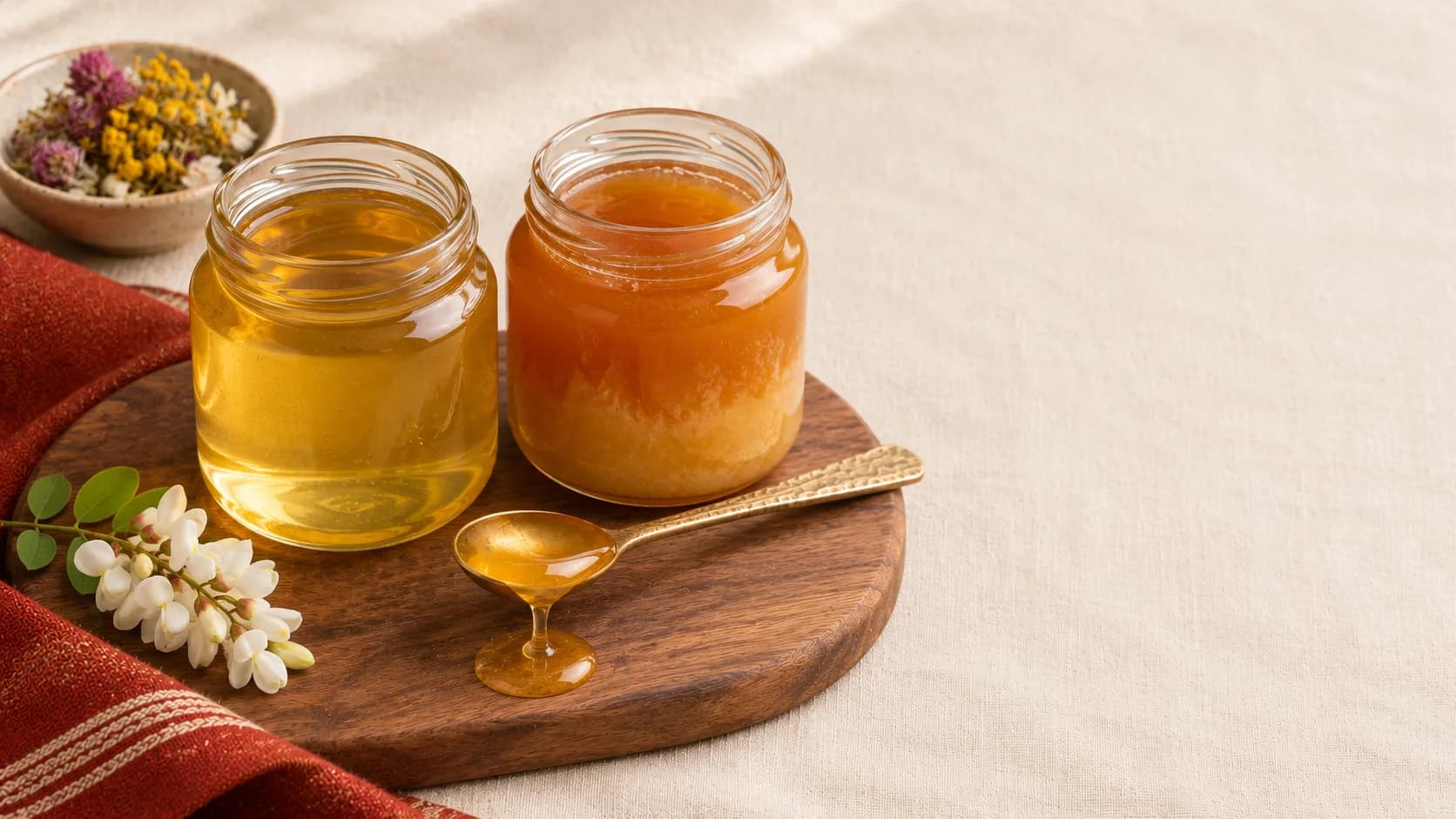
Acacia is pale. The Cluj-Napoca review describes it as very light in colour, with a bright yellow tone, and that matches what you'll see in a good jar: clear, straw-gold, almost glassy. The flavour follows the colour. It's mild, clean and gently floral, with very little aftertaste.
Multiflora honey is harder to pin down, and that's the point. A wildflower harvest can be light gold one year and deep amber the next. The taste moves with it, from soft and fruity to rich, slightly caramel and a touch herbal.
Some buyers read darker honey as "stronger" in every sense. There's a little research behind that. A study of Italian honeys published in the Journal of Life Sciences found that the darkest honeys, such as chestnut, had the highest polyphenol content and antioxidant activity, with colour and polyphenols moving together. That's one study on specific Italian honeys, though, so treat it as a pattern worth knowing, not a rule you can apply to every jar.
The practical takeaway is simpler. If you want honey to sweeten without changing a dish, acacia is the quieter choice. If you want honey you can actually taste, multiflora brings more personality.
Acacia usually costs more per kilo. The reason is supply.
Kashmir's acacia window is short, and this year showed how fragile it is. Down To Earth reported that Kashmiri acacia honey sells for roughly ₹1,000 to ₹1,200 per kg, against about ₹500 per kg for honey collected outside the valley. The same report puts the valley's normal output at more than 1,200 metric tonnes a year, with nearly 90 percent of its 2,120 registered beekeepers moving hives to warmer states every winter.
For scale, India as a whole produced around 1.4 lakh metric tonnes of natural honey in 2024, according to a Government of India note on the National Beekeeping and Honey Mission. Kashmir's acacia is a small, seasonal slice of that.
Multiflora pricing swings more widely. A cheap supermarket "multiflora" and a raw wildflower honey from a single meadow can share a name and almost nothing else.
At Zoon Naturals, our Acacia Honey, 500g is ₹999, and our Kashmir Wildflower Honey is ₹580 for 350g or ₹1,100 for 500g. The wildflower 500g costing more than the acacia surprises people. It shouldn't. Price follows the harvest, not the label.
Here's the comparison in one place.
Source. Acacia comes mainly from black locust blossom in April and May. Multiflora comes from many flowers, with no single one above 45 percent of the pollen under FSSAI's definition.
Colour. Acacia is pale and clear. Multiflora ranges from light gold to deep amber.
Texture over time. Acacia stays liquid for a long time. Multiflora usually sets, sometimes within weeks in a cold kitchen.
Taste. Acacia is mild and clean. Multiflora is fuller, and it changes from harvest to harvest.
Price. Acacia is usually dearer per kilo because the window is short. Multiflora varies with the source.
Best at home. Acacia suits tea, kahwa and anything where you want sweetness without a strong honey note. Multiflora suits toast, curd, marinades and anywhere the honey's own flavour should show.
And it gets better, or worse, depending on which jar you're holding.
Because acacia rarely crystallises, some buyers treat a runny jar as proof that it's acacia. It isn't. Heated and pressure-filtered honey also stays liquid for a long time, and so do sugar syrups. Runny tells you about sugar balance and processing. It can't tell you about origin.
The same goes in reverse. A set multiflora honey is behaving normally, but crystals alone don't certify purity either.
What actually defines honey in India is the lab standard. FSSAI caps moisture at 20 percent, sucrose at 5 percent in most honey, and HMF (a marker that rises with heat and age) at 80 mg per kg, and it requires at least 5,000 pollen and plant elements per gram, per the FSSAI honey standard. None of that can be checked in a kitchen.
What you can do is buy from a source that tells you where the hives were, whether the honey was heated, and how it was filtered. For the home checks that help and the myths that don't, read our guide on how to check honey purity at home.
Think about how a spoon of honey actually gets used in your house. That answers most of it.
If you drink honey in tea or kahwa, acacia is the easy pick. It dissolves without fuss and doesn't fight the saffron or cardamom. Stir it in once the cup has cooled a little, never into boiling liquid, because heat flattens what makes raw honey worth buying. Our Kashmiri kahwa recipe shows where it goes.
If you eat honey on toast, curd or fruit, multiflora gives you more to taste. Set wildflower honey spreads like soft butter and won't drip off the bread.
If you cook with honey, in a glaze, a dressing or a marinade, multiflora's fuller flavour holds up better against garlic, chilli and vinegar.
If you hate a jar that turns solid, go acacia. If you've got a set wildflower jar, stand it in warm water for a few minutes. Don't microwave it.
A few rules apply whichever you choose:
Read the label for "raw" or "unheated," and for where the honey was collected.
Store it closed, at room temperature, away from the stove.
Use a dry spoon, since water speeds up fermentation.
Never give honey of any kind to a child under 12 months. Honey can carry botulism spores that a baby's gut can't handle, as America's Poison Centers explains.
This article is general food information, not medical advice. If you're managing a health condition, talk to your doctor about whether and how much honey fits your diet.
Acacia isn't better honey. It's a different honey, mild, pale and slow to set, from one tree's short spring bloom. Multiflora isn't a compromise. It's the whole meadow in a jar, and it changes because the flowers do.
So keep it practical. If you want quiet sweetness in tea and a jar that stays pourable, choose acacia. If you want flavour on your plate and don't mind a jar that sets, choose multiflora. If you use honey both ways, keep one of each. Whichever you pick, ask whether it's raw and where the hives were before you ask what it's called.
If you'd like to taste the difference side by side, explore our Kashmiri honey and shilajit range, where the acacia and wildflower jars sit next to each other.
Acacia honey comes mainly from black locust (acacia) blossom, so it's pale, mild and slow to crystallise. Multiflora honey comes from many flowers, so its colour, taste and setting speed change with each harvest.
Neither is better overall. Acacia suits tea and anyone who wants a runny, mild honey. Multiflora suits toast, curd and cooking where you want more honey flavour.
Acacia honey is high in fructose and low in glucose, and glucose is the sugar that forms crystals. That balance keeps it liquid far longer than most honeys.
No. Crystallisation is a natural process driven by sugar balance and temperature. It doesn't prove purity either, so buy from a source that tells you where and how the honey was collected.
The black locust flowers only in a short April to May window, and bad weather can wipe out much of the harvest. Down To Earth reported Kashmiri acacia honey selling for about ₹1,000 to ₹1,200 per kg.
No. Honey of any kind shouldn't be given to children under 12 months because it can carry botulism spores. For any other health question, talk to your doctor.
Taste the difference yourself.
Mongra saffron and fresh-crop dry fruits, sealed to order in Anantnag.
Shop the harvest