
Loading page
Free delivery on orders over ₹3,000
Free delivery on orders over ₹3,000
Buying Guides · 16 Oct 2026
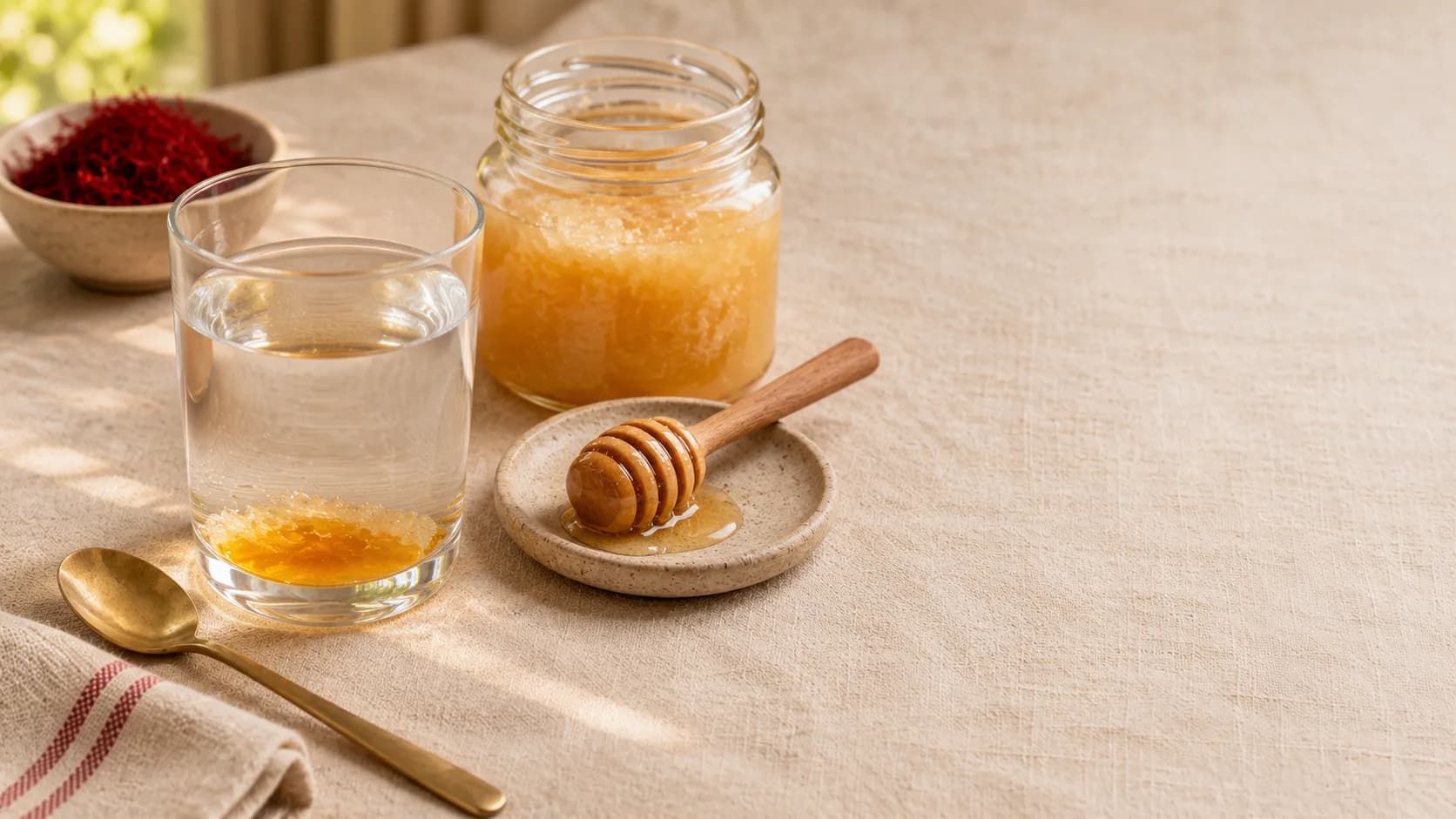
The water test is the first thing most of us try. A spoon of honey goes into a glass, sinks in one neat lump, and we relax. Pure, surely. Then you learn that most of the big brands which failed India's toughest honey test in 2020 would probably have sunk just as neatly.
Your glass of water did its job. Modern honey fraud is simply built to pass it.
So in this guide, you'll learn how to check honey purity at home with the tests that are worth doing, what each one can and can't catch, which lab numbers really settle the question, and a short checklist for your next jar.
Here's the thing: the old kind of fake honey was easy to spot. Thin, watery, overly sweet, sometimes cloudy with sugar. The new kind is engineered.
In December 2020, the Centre for Science and Environment (CSE), a Delhi research body, tested 22 samples from 13 Indian brands. According to CSE, 17 of the 22 samples failed purity testing, and only three brands passed every test. The samples that failed had largely cleared the basic Indian lab checks. They were caught only by advanced tests, including nuclear magnetic resonance (NMR) profiling at a lab in Germany, as reported in summaries of the study.
CSE also traced the syrup trade. Its investigators described a product sold in India as "all pass" syrup, named for exactly what it promised.
And it isn't only an Indian problem. In an EU coordinated action, 147 of 320 imported honey samples (46%) were flagged as suspected of containing added sugar syrups. The same report notes that older isotope tests for cane and maize syrup are being sidestepped with rice, wheat and beet syrups.
The takeaway: a syrup designed to fool a lab will fool your kitchen too. That doesn't make home tests useless. It changes what you use them for.
Think of home tests as a sieve, not a verdict. They're good at catching crude fraud, mainly added water and cheap sugar solution stirred in. Run all five on the same jar, because one result means little on its own.
The Food Safety and Standards Authority of India includes this one in its DART booklet for detecting common adulterants, as summarised by Down To Earth.
Fill a clear glass with room-temperature water.
Let a teaspoon of honey drop in without stirring.
Watch for 30 seconds.
Pure honey sinks and holds together. It doesn't dissolve instantly. Honey that spreads, streaks or clouds the water right away suggests added sugar solution or water.
How reliable is it? A small study published in UBC's undergraduate journal put the water test under a scale. Honey diluted with water lost about 64% of its weight when stirred in water. Pure honey lost almost nothing. Honey mixed with corn syrup lost only 5%, which made it hard to tell apart. So the test is good at catching water. It's weak at catching syrup.
Put a small drop on your thumbnail. Good honey sits as a rounded bead and stays put. Honey that runs off or spreads thin is carrying extra water.
There's a real standard behind this rough check. FSSAI sets a maximum of 20% moisture for honey. A watery jar fails that line long before it fails your thumb.
Drip a little honey onto a folded tissue or blotting paper. Wait a minute. Real honey sits on top. A wet ring spreading outward points, again, to added water.
This is the slowest test and one of the most useful. Most raw honey crystallises over weeks or months, faster in a cold room, because glucose comes out of solution. We explain the chemistry in why raw honey crystallizes.
Here's the nuance most guides miss. Some honeys, like acacia, are naturally high in fructose and stay liquid for a long time. So a jar that never sets isn't automatically fake, and a jar that sets isn't automatically pure. Know which honey you bought before you judge it.
Real honey smells like something. Flowers, wax, a little earth. On the tongue it's layered, sweet first, then floral, sometimes with a faint warmth at the back of the throat. Syrup tastes of sweetness and nothing else.
This one is subjective, and that's fine. Over a few jars, your palate becomes a surprisingly good filter.
The internet loves three more tests. None of them earns a place in your kitchen.
The flame test. You dip a matchstick or cotton wick in honey and try to light it. The idea is that water stops it burning. At best, it tells you about moisture, which the thumb test already does without a fire. It says nothing about a dry, well-made syrup.
The ant test. Ants supposedly ignore pure honey. They don't. Ants like sugar, and both honey and syrup are sugar.
The iodine test. Iodine turns blue in the presence of starch. Finished syrups made from rice or wheat have already been broken down into sugars, so there may be little starch left to react. A clean result proves very little.
The pattern is clear. Each of these tests checks one crude property. Engineered syrup is made to pass crude checks.
This is where the honest answer lives. Indian honey has a detailed legal standard, and the numbers that catch syrup are in it. Under FSSAI's standard for honey, a jar must meet limits such as these:
Moisture: 20% maximum.
Sucrose: 5% maximum for most honeys.
C4 sugar (cane or maize syrup marker): 7% maximum.
Foreign oligosaccharides (a marker for starch-based syrups like rice syrup): 0.7% peak area maximum.
2-AFGP (a specific rice syrup marker): absent.
Pollen count: at least 5,000 plant elements per gram.
HMF (a marker of heating or age): 80 mg/kg maximum.
Look at that list again. Three of those lines exist only to catch syrup. None of them can be measured with a glass of water.
FSSAI publishes the lab methods in its manual for honey and other bee hive products. And the testing net is widening. According to a Government of India factsheet from November 2025, the National Beekeeping and Honey Mission had sanctioned 6 large honey testing labs and 47 mini labs by March 2025. The same document says India produced about 1.4 lakh tonnes of honey in 2024.
So if a seller tells you their honey is pure, the fair question is simple. Which of these parameters did you test, and when?
You can't run an NMR scan in your kitchen. You can buy smarter. Before you pay, run through this:
Read the label like an inspector. Look for the FSSAI licence number, the name and address of the packer, net quantity, and a best before date. A jar with a vague label has already told you something.
Look for a real origin. "Multifloral honey from Budgam meadows" is a claim someone can stand behind. "Natural forest honey" with no place name is a mood.
Match the jar to the flower. Wildflower and mustard honeys usually crystallise. Acacia usually stays liquid. Behaviour that fits the floral source is a good sign.
Run the five home tests. If a jar fails the water or thumb test, stop there.
Ask for test results. A serious seller should be able to say which FSSAI parameters were tested. Ask specifically about C4 sugar and foreign oligosaccharides.
Be wary of the impossible bargain. Raw, single-origin honey costs real money to produce. A price far below the shelf average is a question, not a deal.
One safety line belongs in every honey guide. Never give honey to a child under 12 months, because of the risk of infant botulism, as extension specialists at Michigan State University explain. This guide is about food quality and isn't medical advice.
The same thinking works for other high-value foods. It's the approach we took in our guide to testing shilajit purity at home.
We'd rather show you the process than describe a feeling.
Our Kashmir Wildflower Honey is raw multifloral honey from wildflower meadows in Budgam. It's strained through mesh to remove wax and bee parts, then bottled. Never heated, never pressure-filtered. Because it's multifloral, the flavour shifts a little between harvests. It will crystallise, especially in a cold kitchen, and that's expected behaviour, not a fault. It comes in 350g (₹580) and 500g (₹1,100).
Our Acacia Honey is a single-origin spring harvest from hives in Kashmir's acacia belt, extracted cold and bottled raw. It's light, mild and slow to crystallise, which is exactly what acacia should do. The 500g jar is ₹999.
Both honeys are packed under our FSSAI licence (21026010000356), with the month and year of packing printed on the pack and a best before of 24 months from packing. Stir either one into warm, not boiling, Kashmiri kahwa, and taste the difference between honey and sweetness.
Pure honey doesn't prove itself in a glass of water. It proves itself through origin, behaviour and lab numbers, together.
If a jar fails the water, thumb or blotting paper test, don't buy it again. If it passes, treat that as a first pass, not a certificate. If it crystallises in winter and matches its floral source, that's a good sign. If you need certainty, ask the seller which FSSAI parameters were tested, starting with C4 sugar and foreign oligosaccharides.
If you want raw honey with a named origin and a process you can read on the label, explore our Honey & Shilajit collection.
Drop a teaspoon of honey into a glass of room-temperature water without stirring. Pure honey sinks and holds together, while honey that spreads or clouds the water right away likely contains added water or sugar solution. Follow it with the thumb test for a second opinion.
It's good at catching honey diluted with water and weak at catching syrup. A small study found syrup-adulterated honey behaved much like pure honey in water, so a pass is a first filter, not proof.
Not on its own. Crystallisation is normal for many raw honeys, especially wildflower and mustard, but high-fructose honeys like acacia can stay liquid for a long time. Judge the jar against its floral source.
Not reliably. At best it reflects water content. A well-made syrup with low moisture can pass it, so it adds nothing the thumb test doesn't already tell you.
No single home test can. Labs check FSSAI parameters such as C4 sugar, foreign oligosaccharides and the rice syrup marker 2-AFGP, and advanced methods like NMR profiling. Ask your seller which of these were tested.
The same steps apply: check the label for an FSSAI licence and a named origin, run the water and thumb tests, watch how it crystallises, and ask the seller for test results on syrup markers.
Taste the difference yourself.
Mongra saffron and fresh-crop dry fruits, sealed to order in Anantnag.
Shop the harvest