
Loading page
Free delivery on orders over ₹3,000
Free delivery on orders over ₹3,000
Recipes · 26 Oct 2026
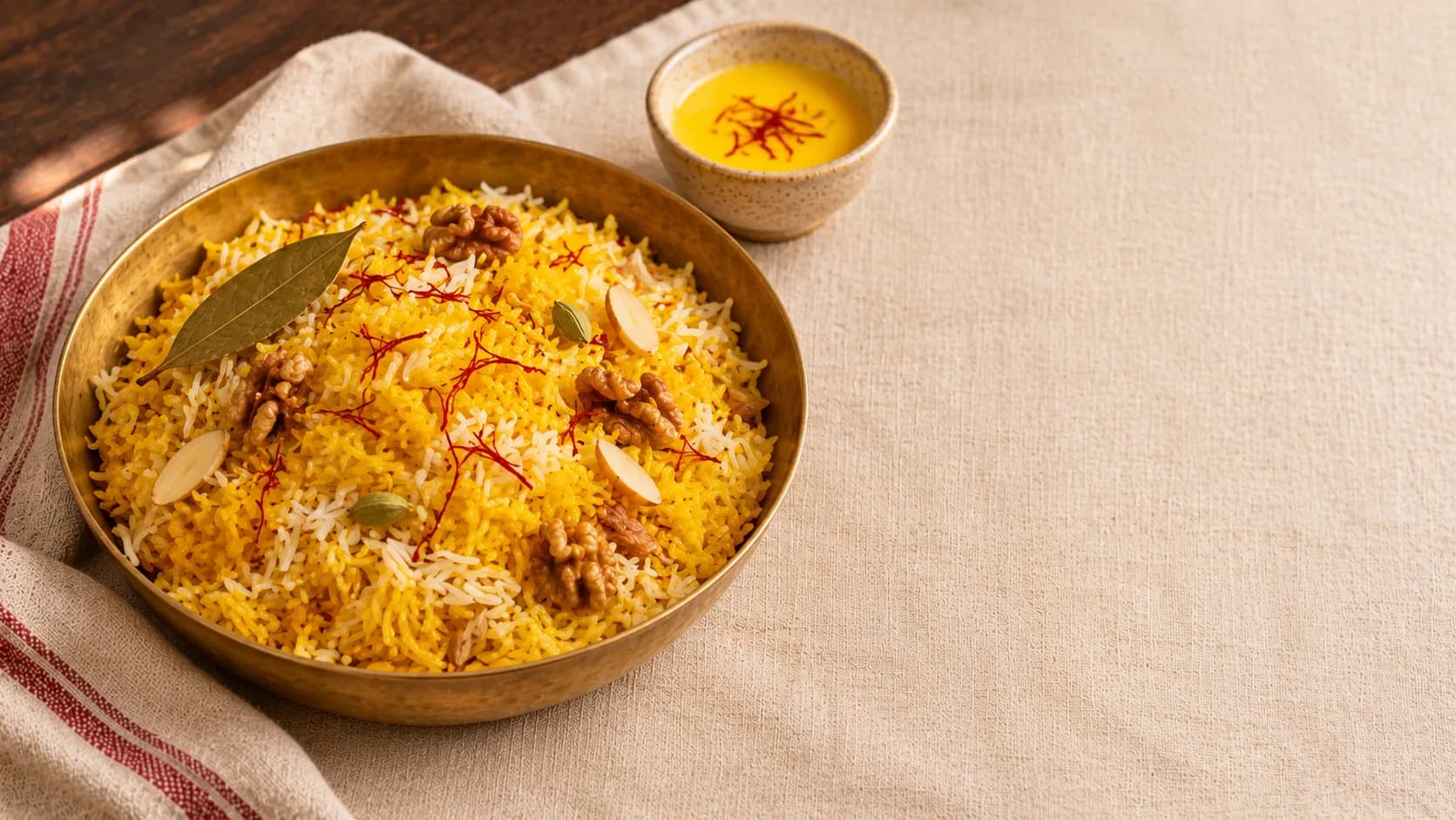
Pampore's fields turned purple again last week. Growers there told Greater Kashmir that flowers had started to show after a long dry spell, and that picking would begin within days.
That's the season this rice belongs to. Weddings, winter guests, a Sunday lunch that runs long. And yet most home versions of zafrani pulao come out the same way: a few orange streaks, a lot of plain white rice, and a vague sweetness that tastes of sugar more than saffron.
The fix is almost never more kesar. It's timing. Below you'll find a tested zafrani pulao recipe for four, the Kashmiri modur pulao style it comes from, why saffron goes in at the end, and the small mistakes that keep the colour from spreading.
Zafrani simply means "of saffron". Across North India the name covers any pulao coloured and scented with kesar, from mildly savoury to properly sweet.
In Kashmir, the sweet version has its own name, modur pulao. India's official tourism site describes it as standing out in the wazwan, Kashmir's 36-dish multi-course meal, for its sweet undertones. Think ghee, whole spices, sugar, dry fruits and saffron. Not dessert. Not plain rice either.
This recipe stays moderate on sugar, so it works beside a rogan josh or a simple dal. Want it wedding sweet? There's a note below.
Measure the rice by weight if you can. It keeps the water ratio honest.
Basmati rice: 2 cups, about 400 g, aged long-grain
Saffron: 20 to 25 threads (a pinch, roughly 30 mg) of Mongra saffron
Warm milk: 3 tablespoons, for steeping
Ghee: 4 tablespoons
Sugar: ¾ cup, about 150 g (go up to 1 cup for a sweeter, festive version)
Whole spices: 2 bay leaves, 4 green cardamom pods (lightly cracked), 4 cloves, a 1 inch stick of cinnamon
Almonds: 12 to 15 Mamra almonds, soaked, peeled and halved
Walnuts: 8 halves of Kashmiri walnut kernels, broken into large pieces
Cashews and raisins: 2 tablespoons each
Salt: a small pinch, about ¼ teaspoon
Water: 3 cups for the rice, plus ½ cup for the syrup
The saffron count is a touch above what our guide to how much saffron to use suggests for an everyday pulao. That's deliberate. In this dish, saffron isn't a background note. It's the point.
Here's the thing: saffron holds two very different kinds of value, and they don't behave the same way in a hot pot.
The colour comes from crocins, which dissolve in water. The aroma comes mostly from safranal, which leans towards fat. A 2024 study in the journal Molecules tested saffron infusions at 60, 80 and 100°C in water, oil and a water and oil mix. Crocins came out best in plain water at the lower temperature. Safranal moved into the oil, again at lower temperatures.
So the kitchen lesson is simple. Steep the threads in warm milk first, and keep them away from frying ghee and a rolling boil. Then add that gold liquid to rice that's already cooked, where it meets the ghee gently and spreads.
Steep the saffron. Never fry it. That one rule fixes more pale pulao than any extra pinch.
Allow about 1 hour 15 minutes, mostly hands-off.
Steep the saffron. Warm 3 tablespoons of milk until you can comfortably hold a finger in it. Crush the threads lightly between your fingers, drop them in, and leave for at least 20 minutes. The milk should turn deep gold.
Wash and soak the rice. Rinse the basmati in a bowl of water, swirling gently, until the water runs mostly clear (three or four changes). Soak for 30 minutes, then drain well in a sieve.
Make the syrup. In a small pan, warm the sugar with ½ cup water and stir until dissolved. Simmer for 2 minutes, then take it off the heat. You want a thin syrup, not a sticky one.
Toast the dry fruits. Heat the ghee in a heavy, wide pot on medium-low. Fry the cashews and almonds for a minute until pale gold, add the walnuts and raisins for 20 seconds, then lift everything out with a slotted spoon. Walnuts scorch fast, so don't walk away.
Bloom the spices. In the same ghee, add the bay leaves, cardamom, cloves and cinnamon. Let them sizzle for 30 seconds, until fragrant.
Coat the rice. Add the drained rice and stir gently for a minute so every grain is glossed with ghee. Stirring hard breaks soaked grains.
Cook the rice. Pour in 3 cups of water and the salt. Bring to a boil, then lower the heat, cover, and cook for 8 to 10 minutes until most of the water is absorbed and small steam holes appear on the surface.
Add syrup and saffron. Drizzle the syrup evenly over the rice. Then spoon the saffron milk over it in lines rather than one spot, so you get that mix of gold and ivory grains. Scatter half the dry fruits on top.
Put it on dum. Seal the pot with a tight lid (a clean cloth under the lid helps). Cook on the lowest flame for 12 to 15 minutes, ideally on a tawa placed under the pot to soften the heat.
Rest and fluff. Turn off the heat and leave it covered for 5 minutes. Fluff gently with a fork from the sides, and finish with the rest of the dry fruits.
The result? Separate grains, a gold that varies from deep to pale, and a scent that reaches the next room before the rice does.
Sugar is the part people argue about. Some published Kashmiri-style recipes, this modur pulao from Archana's Kitchen for one, use a cup of sugar for every cup of rice. That gives you the rich, almost candied pulao of a wedding spread. Our ¾ cup for 2 cups of rice is gentler. It's sweet enough to notice, light enough to eat beside a curry.
If you're cooking for a festive table, go up to a full cup. If you're serving it as a side with savoury dishes, you can drop to ½ cup.
The rice matters as much as the sugar. Aged basmati absorbs water evenly and stays in long, separate grains. Newer rice turns soft and clumpy under the extra moisture from the syrup, so if your rice is fresh, cut the water by ¼ cup.
And it gets better: once you've made this twice, you'll judge doneness by sound. A soft crackle at the base during dum means the water's gone. Silence means wait. Smoke means you waited too long.
Most pale or bitter pulao comes down to a few habits.
Throwing dry threads straight into the pot. They release a fraction of their colour and end up as red flecks on the plate.
Frying saffron in ghee. The heat burns off much of the aroma you paid for.
Using food colour as a shortcut. It gives an even, flat orange. Real saffron gives uneven gold, and that unevenness is the look you want.
Doubling the saffron to fix a bland batch. Past a point, saffron turns bitter and medicinal. A bland pulao usually needs longer steeping or stronger saffron, not more threads.
Weak or old saffron. If 25 threads barely tint your milk in 20 minutes, the saffron is tired or isn't what it claims. Our guide on how to identify real saffron walks through simple home checks.
Saffron also fades with light, heat and air, so if your jar lives beside the stove, read how to store saffron.
Saffron from Kashmir isn't a crop with room to spare. Official figures given in the Jammu and Kashmir Assembly, reported by PTI via Outlook Business, put output at 23.53 tonnes in 2023-24 and 19.58 tonnes in 2024-25, from an area that has held at about 1,116 hectares.
Growers are more worried than those numbers suggest. Farmers told Greater Kashmir that last season's output fell by nearly 95 percent by their own estimate, blaming weather and the loss of saffron land, and that this autumn's dry spell had them anxious before the rains arrived.
That's why a pinch counts. At Zoon Naturals, our saffron comes from the karewa plateaus of Pampore. It's hand-picked, shade-dried and graded by hand, and our Mongra grade is the red tip only, with no yellow style. If you want to see how picking and drying actually work, our piece on the Kashmir saffron harvest covers it.
Serve zafrani pulao warm, straight from the pot. In a wazwan-style meal it sits beside rich meat dishes. At home, try it with dum aloo, plain dal or a cucumber raita. A cup of Kashmiri kahwa after the meal fits the mood.
Leftovers keep in a closed container in the fridge for up to two days. To reheat, sprinkle a tablespoon of water over the rice, cover, and warm on low heat or in short bursts in the microwave. The grains firm up in the fridge but soften again with steam.
Great zafrani pulao isn't about how much saffron you use. It's about when and how it goes in. Steeped kesar, added late, beats a heavy hand every time.
If your pulao comes out pale, steep longer and add the saffron milk after the rice is cooked. If it tastes bitter, cut back the threads. If it's too sweet for a weekday, drop the sugar to ½ cup. And if a full pinch barely colours the milk, the saffron is the problem, not you.
If you want saffron that gilds a pot with a single pinch, explore our Kashmiri saffron and spices.
Zafrani pulao is a broad name for any saffron-coloured pulao, sweet or mildly savoury. Modur pulao is the Kashmiri sweet version, cooked with ghee, sugar, whole spices, dry fruits and saffron, and served as part of the wazwan.
About 20 to 25 threads, roughly 30 mg, steeped in 3 tablespoons of warm milk for at least 20 minutes. With a strong grade like Mongra, that's enough for 2 cups of basmati.
Yes. Skip the syrup and add ½ cup of extra water to the rice instead. You'll get a fragrant, savoury saffron rice that suits biryani-style meals, though it won't taste like Kashmiri modur pulao.
Usually the threads went in dry, or too early into boiling water. Steep them first, add the liquid after the rice is mostly cooked, and check that your saffron colours warm milk deep gold within 20 minutes.
Yes. Warm water works just as well for colour, since saffron's crocins dissolve readily in water. Milk adds a little richness, which suits the sweet style.
Almonds, walnuts, cashews and raisins are the classic mix. Toast them lightly in ghee first and add half before dum and half at the end, so some stay crisp.
Taste the difference yourself.
Mongra saffron and fresh-crop dry fruits, sealed to order in Anantnag.
Shop the harvest