
Loading page
Free delivery on orders over ₹3,000
Free delivery on orders over ₹3,000
Gifting & Festivals · 1 Nov 2026
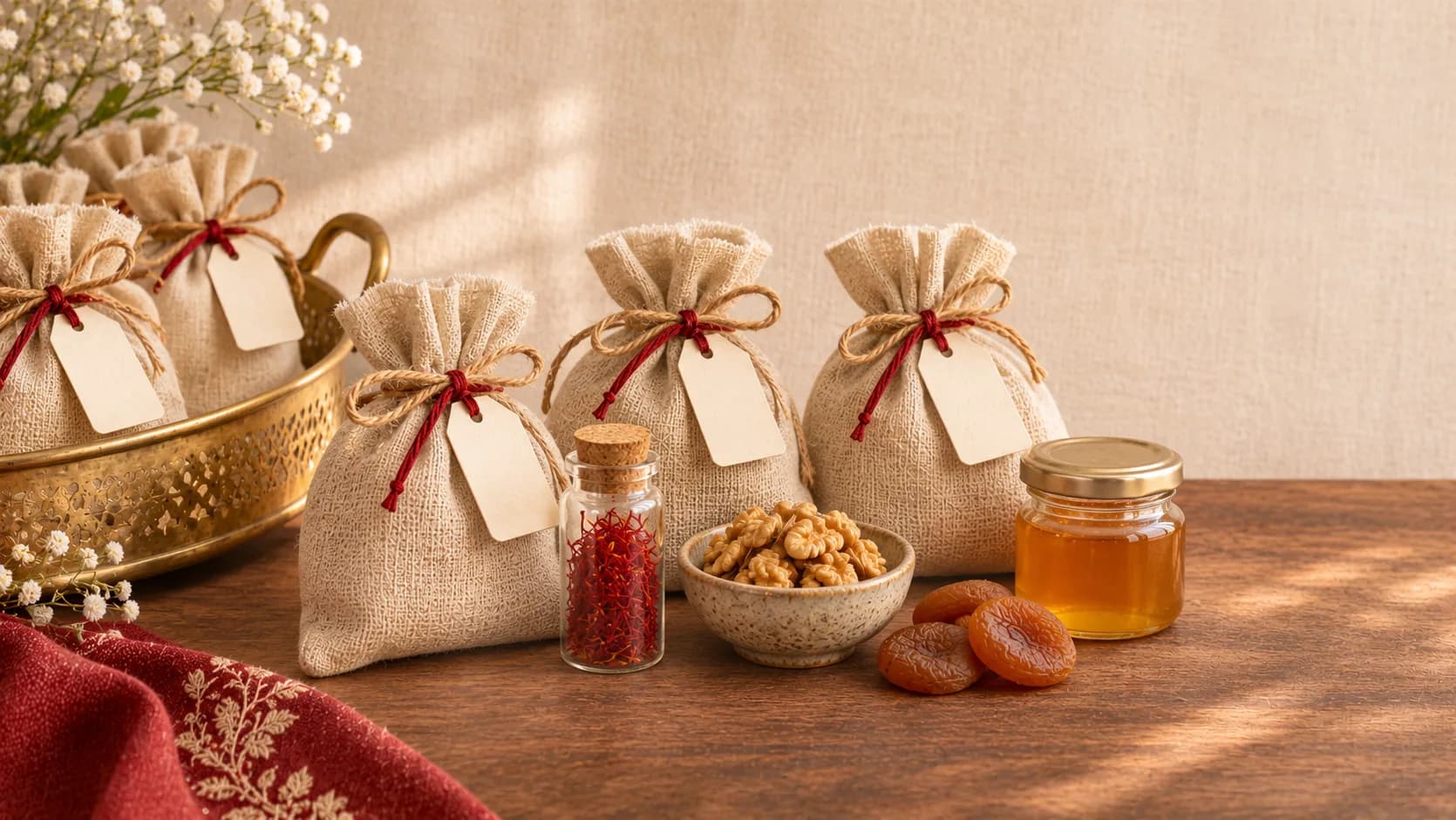
The most common mistake with wedding return gifts is choosing them for the photo instead of the kitchen. A glossy box looks perfect on the gift table. Then it goes home, sits in a cupboard, and gets passed on at the next function.
The cause is simple. We pick return gifts in a rush, in bulk, and for the wrong person, which is us.
Expect the same rush this season. The Confederation of All India Traders estimated that about 46 lakh weddings would take place between 1 November and 14 December 2025, as reported by BW Businessworld. Below, we'll walk through what makes a return gift worth carrying home, a list of Kashmiri ideas sorted by budget, the timing that keeps you out of trouble, and the label checks that matter when your gift is food.
Here's the thing: a guest's home already has enough decor. What it doesn't have enough of is good food that's ready to use.
An edible gift asks for nothing. Nobody has to find a shelf for it or pretend to like its colour. A pouch of walnuts gets opened on a Sunday. A gram of kesar goes into milk for a child's exam week. A jar of honey sits next to the tea.
There's a second reason. Edible gifts carry a story without a speech. When the gift comes from Kashmir, the story is already there in the colour of the saffron and the pale skin of a fresh walnut.
The test is easy. If a guest would buy it for their own kitchen, it's a good return gift.
Before you pick anything, run your idea through these five checks. They'll save you from the cupboard problem.
Light and small. Guests travel. A 250 g pouch fits in a handbag. A steel dinner set doesn't.
Shelf-stable for months. Weddings run late, and gifts sit in cars and bags. Pick things that keep well at room temperature, at least until they're opened.
Useful across ages. Dry fruits, saffron and tea work for a grandmother and a college student alike.
Clearly labelled. Food gifts should carry the packing date and a best-before or expiry date. More on that below.
Priced for the guest list. Your list sets the budget, not your heart. That's why tiers help.
The result? A gift guests open within the month, not one they forget about until next Diwali.
These are the products we sell at Zoon Naturals that travel well and suit a guest list. Prices are the current selling prices on our shop, inclusive of taxes. Pick one tier for most guests, and a higher tier for close family.
Kashmiri Red Chilli Powder, 250 g, ₹299. It's an unusual pick, and that's the point. Ours is stone-ground from sun-dried Kashmiri chillies with no added colour. It gives deep red colour with gentle heat, which is exactly why cooks reach for it. A guest who cooks will thank you every time the tadka turns red.
Kashmiri Walnut Kernels, 250 g, ₹340. Light halves from rain-fed Kashmiri trees, never bleached, sorted by hand. Walnuts are the classic Kashmiri gift for a reason. Our guide to Kashmiri walnut kernels explains why the colour of the kernel matters.
Sun-dried Apricots, 250 g, ₹420. These are dried brown the old way, with no sulphur, sugar or dye. They look humbler than the bright orange kind. They taste better.
Kashmiri Ver Masala, 200 g, ₹470. A sun-dried cake of ground spices, garlic and shallots, made in small batches. It's the gift for the guest who collects spices. Add a small card that says, "Crumble a little into hot oil for rajma or rogan josh."
Mongra Saffron, 1 g, ₹560. If you want one gift that says Kashmir, this is it. Our Mongra is red tip only, from Pampore, with no yellow style and no added colour. One gram goes a long way in kheer, milk or pulao. Guests who want to check what they've received can use our guide on how to identify real saffron.
Kashmir Wildflower Honey, 350 g, ₹580. Raw multifloral honey, strained through mesh and never heated. It will crystallise over time, which is normal for raw honey, and our post on why raw honey crystallises explains why. One note for families with babies: raw honey must not be given to children under twelve months, a rule that Michigan State University Extension also stresses because of the risk of infant botulism.
Saffron Kehwa Blend, 100 g, ₹599. Green tea leaves, Mongra saffron strands, crushed mamra almonds, cardamom and cinnamon. A 100 g pack brews about 40 cups. For winter weddings, it's hard to beat. Tuck in a slip with our Kashmiri kahwa recipe.
Kehwa Lover's Gift Set, ₹1,449. A magnetic-lid box with 100 g of saffron kehwa blend, a 0.5 g vial of Mongra saffron, two hand-painted paper-mache coasters and a brewing guide card. It's the right gift for the mamis and chachas who made the wedding happen.
Kashmir Heritage Gift Box, ₹2,899. A rigid keepsake box with a chinar leaf motif, holding Mongra saffron 1 g, saffron kehwa 50 g, mamra almonds 100 g, walnut kernels 100 g and acacia honey 250 g, finished with a jute ribbon and a message card. Save it for grandparents, your pandit ji or maulvi sahab, and the friends who flew in.
You don't need one gift for everyone. Splitting your list into two or three groups works better, and it's kinder to your budget.
Say you have 200 guests. You might give walnut kernels to most of them, saffron to 40 close relatives, and the Heritage Gift Box to 10 elders. That's three tiers, one theme, and nobody feels short-changed.
And it gets better: a shared theme makes even the smallest gift feel part of a set. Use the same pouch colour, the same ribbon and the same card across every tier. Guests notice the care, not the price.
Keep the theme fixed and let the contents change. That one rule does most of the work.
Timing is where good plans fall apart. Food gifts need to arrive, get packed, and get labelled before the first function.
The Hindu wedding season reopens after Dev Uthani Ekadashi, which falls on 20 November 2026 in the Smarta reckoning, according to AstroSight's muhurat calendar. Popular dates follow fast. SmartPuja's 2026 vivah muhurat list names 21, 24, 25 and 26 November, then 2 to 6 December and 11 to 12 December. Kharmas begins around 16 December and runs to mid-January, a stretch many families avoid for weddings. Exact dates vary by panchang and city, so check with your family pandit.
Here's a simple working plan:
Four weeks out: fix your guest count and tiers.
Three weeks out: place your order and confirm quantities.
Ten days out: receive the stock and check every pack.
One week out: pack pouches, tie ribbons, write cards.
For larger quantities, write to us early. Our bulk and corporate page explains that for weddings we work to your date, not ours, and that we'll tell you honestly what lead time a given quantity needs. We can also add a card in your name.
A food gift carries your family's name. So the label matters more than the ribbon.
India's food labelling rules are clear here. Under the FSSAI Labelling and Display Regulations, pre-packaged food must show the date of manufacture or packing and an expiry or use-by date, grouped together, along with the FSSAI logo and licence number. Storage conditions must be stated when the shelf life depends on them.
Before you repack anything, check three things:
The dates. Keep the original label, or copy the packing and best-before dates onto your own tag.
The licence. Look for the FSSAI logo and licence number on the pack. Ours is 21026010000356.
The storage note. Walnuts, for example, are best kept sealed in the fridge once opened. Add a line to your card so guests know.
A pretty pouch can't replace a proper label. If you decant into fabric or jute bags, slip the original packet inside.
You don't need an expensive box to make a gift memorable. A few small choices do it.
Write one line on each card about how to use what's inside. "Soak four threads in warm milk for ten minutes" turns saffron from a luxury into a habit. Pair items that belong together, like kehwa with a few walnut halves, or ver masala with a note about rajma. Choose jute or cotton over plastic, and keep the card in your own words.
Once guests open their saffron, they'll want it to last. Our post on how to store saffron is worth printing as a QR code on the card. If you're also building hampers for family, our guide to choosing a dry fruit gift hamper covers that side.
A good return gift isn't the biggest one on the table. It's the one that gets opened.
If most of your guests are travelling, pick light pouches like walnuts or saffron. If your list is long and your budget is fixed, choose one hero item and keep the theme consistent across tiers. If you're gifting elders and close family, a boxed set says thank you without needing words. And whatever you choose, keep the label intact.
If you'd like gifts that carry Kashmir home in a small, honest pack, explore our Kashmiri gift boxes, or write to us through the bulk and corporate page with your date and guest count.
Kashmiri walnut kernels (250 g, ₹340), sun-dried apricots (250 g, ₹420), Kashmiri red chilli powder (250 g, ₹299) and ver masala (200 g, ₹470) all fall under ₹500 on our shop. They're light, keep well, and get used.
Yes. They suit every age, travel well and don't need space on a shelf. Choose packs with a clear packing date and best-before date, and add a storage note for walnuts, which keep best sealed in the fridge once opened.
Saffron makes a memorable return gift for close relatives because a single gram goes a long way in milk, kheer or pulao. Pick whole threads rather than powder, so guests can see what they're getting.
Aim for about three weeks before the first function. That leaves time for delivery, checking every pack, and packing pouches with cards a week ahead.
Yes, raw honey is a thoughtful gift. Add a line on the card that raw honey must not be given to children under twelve months.
Taste the difference yourself.
Mongra saffron and fresh-crop dry fruits, sealed to order in Anantnag.
Shop the harvest