
Loading page
Free delivery on orders over ₹3,000
Free delivery on orders over ₹3,000
Saffron Guides · 31 Oct 2026
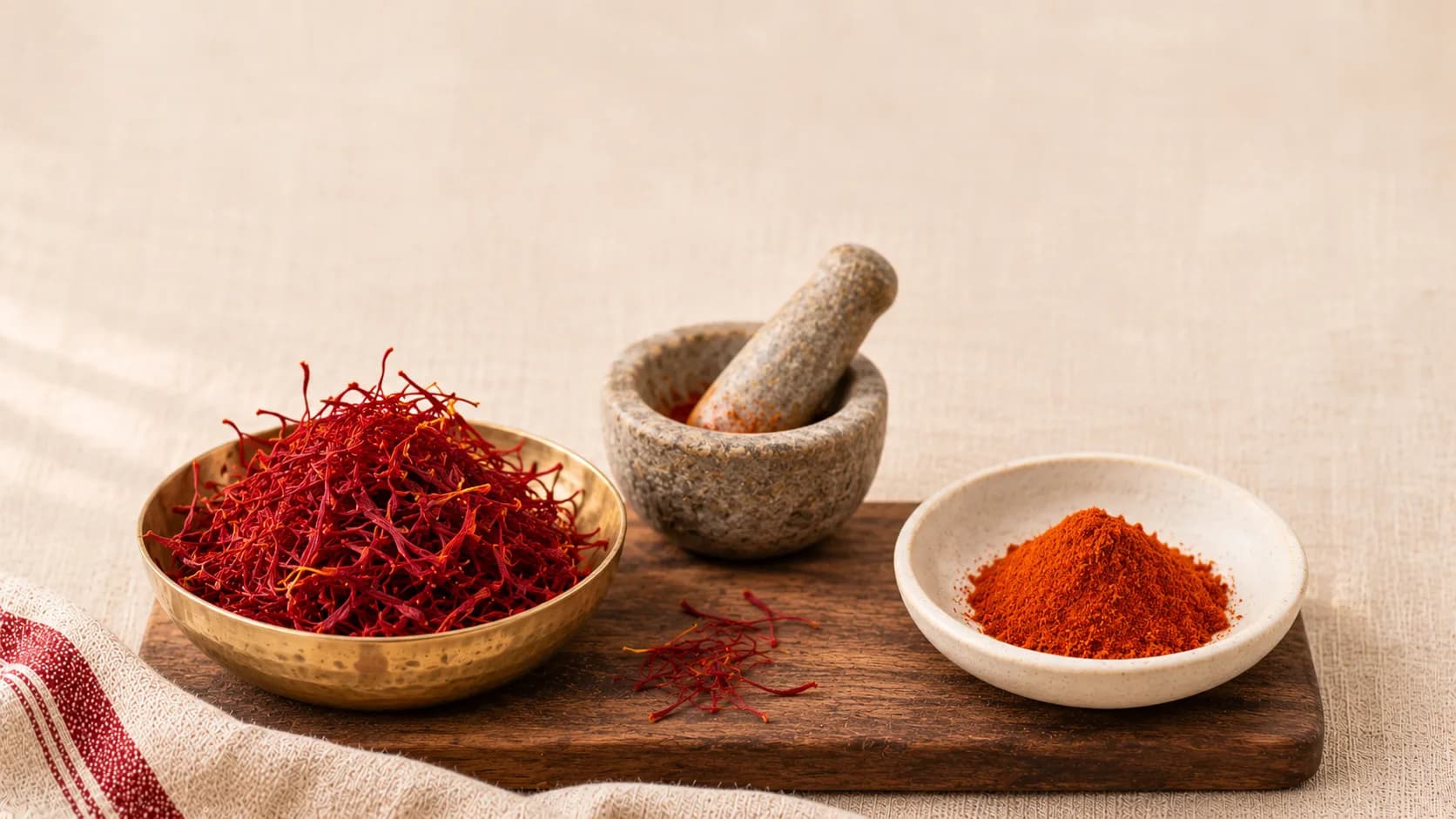
Up to 20 percent turmeric or safflower can sit inside a jar of saffron powder without standard lab tests catching it. That's the finding of a 2024 study in the journal Foods, which noted that existing methods, ISO standards included, often miss adulteration at that level.
Once kesar is ground, your eyes stop being useful.
So the saffron threads vs powder question isn't really about convenience. It's about how much you can check before you pay. Below, we compare the two on purity, flavour, shelf life and kitchen use, show you what Indian food law says about each, and walk you through grinding your own powder from threads in about five minutes.
Buy threads. Grind them yourself when a recipe needs powder.
Here's the thing: both forms come from the same plant part. India's food regulator, FSSAI, defines saffron as the dried stigmas of Crocus sativus, and saffron powder as the powder obtained by crushing those same dried stigmas, according to the FSSAI standards for spices (clause 2.9.17). Chemically, good powder and good threads start out identical.
The difference is everything that happens after grinding. A thread carries its own proof. Powder carries a label and nothing else.
Saffron sells for more per gram than almost any food in your kitchen, so cheaper fillers are tempting. A bulletin from the Botanical Adulterants Prevention Program, summarised by Nutraceuticals World, lists the usual suspects: safflower, calendula, dyed corn silk, pomegranate fibres and even dyed paper strips. For powdered saffron specifically, it notes that ground turmeric and paprika have been mixed in as undisclosed bulking agents.
Think about what that means at home.
With threads, many of those fakes give themselves away. Corn silk is too thin and uniform. Safflower petals are flat and tubular, not trumpet-shaped. Dyed threads bleed colour into water in seconds. Our guide on how to identify real saffron walks through each of these checks.
With powder, none of that works. Turmeric, paprika and real saffron are all orange-red dust once ground. You can't see the trumpet shape, you can't count yellow styles, and a water test only tells you the powder colours water, which turmeric also does. The result? You're trusting the seller completely, with no way to check.
And it gets worse: the 2024 Foods study found that even lab methods can miss safflower or turmeric at up to 20 percent. If a lab can struggle, a kitchen test has no chance.
Indian law holds both forms to quality limits, which is useful context when you compare labels. Under FSSAI clause 2.9.17, whole saffron and saffron powder share most of the same chemical floors:
Colouring strength (absorbance at 440 nm, linked to crocin): not less than 80
Bitterness (picrocrocin, at about 257 nm): not less than 30
Safranal (aroma, at 330 nm): between 20 and 50
Total ash: not more than 8 percent, with acid-insoluble ash not more than 1.5 percent
Moisture: not more than 12 percent for whole saffron, and not more than 10 percent for powder
Whole saffron also has limits on floral waste (not more than 10 percent) and extraneous matter (not more than 1 percent). Those two lines matter. They're the parts of quality you can partly judge with your own eyes on threads, by spotting pale yellow styles and bits of petal. On powder, that waste is invisible.
If those three numbers, colour, bitterness and aroma, sound unfamiliar, our explainer on crocin, safranal and picrocrocin breaks them down in plain language.
Internationally, the reference is ISO 3632. Its third edition, ISO 3632-1:2025, replaced the 2011 version and added a new "extra class" category to its grading tables. Both the FSSAI and ISO frameworks rely on lab readings. Neither replaces a buyer's own look at the threads.
Saffron doesn't spoil. It fades.
Its colour, bitterness and aroma all come from compounds that break down over time. A 15-year storage study published in Pharmacognosy Magazine tracked saffron kept sealed at room temperature and found that crocetin esters, the colour compounds, dropped by about 52 percent in the first year, and picrocrocin, the bitter flavour compound, by about 54 percent. Losses kept going after that, just more slowly. The authors suggested storing saffron for no more than two years.
That study didn't compare threads with powder. But the logic is simple. Grinding multiplies the surface area exposed to air, light and moisture, which are the very things that degrade saffron. A whole thread keeps most of its compounds tucked inside. Powder has nowhere to hide them.
Here's what that looks like in your kitchen:
Threads bought fresh and stored well keep a strong honeyed, hay-like aroma for many months.
Powder that sat on a shop shelf before you bought it may already smell flat when you open it.
Grinding just before cooking gives you powder at full strength, every single time.
For the full storage routine, see our guide on how to store saffron.
We're not saying powder is useless. It has real advantages in a few situations.
Powder dissolves almost instantly, so it suits batters, doughs and dry rubs where there's no liquid to steep threads in. It spreads colour evenly, without the occasional red streak. And it's easy to measure in tiny amounts for baking.
But notice something: every one of those benefits comes from the grinding, not from buying it pre-ground. You get the same results when you grind threads yourself. You also get proof of what went into the mortar.
Threads, on the other hand, are better for most Indian cooking. Kesar doodh, biryani, zarda, phirni and kahwa all have liquid you can steep in, and steeping is the step that pulls out colour and flavour. Our page on how much saffron to use, by dish gives working amounts for each.
This is the best of both forms. You buy threads you can inspect, then turn them into fresh powder when a recipe calls for it.
You'll need: a pinch of saffron threads (our dosage guide gives amounts by dish), a small mortar and pestle, a pinch of sugar or coarse salt, and 2 to 3 tablespoons of warm water or milk.
Dry the threads. If the threads feel soft, place them on a small plate near (not on) a warm tawa for 30 to 60 seconds. Dry threads crush cleanly. Damp ones smear.
Add a grit. Drop the threads into the mortar with a pinch of sugar for sweets or coarse salt for savoury dishes. The grains act like sandpaper, so you lose less saffron to the pestle.
Grind gently. Use small circular strokes for about a minute until you have a fine, even powder.
Bloom it. Pour in the warm liquid and let it sit for 10 to 20 minutes. It should turn a deep gold.
Rinse the mortar. Swirl a spoonful of the same liquid around the mortar and add it to your dish. That last rinse holds more colour than you'd expect.
Our own guide recommends exactly this: crush threads lightly or grind them with a grain of sugar for stronger extraction, and never fry saffron in oil or roast it in a dry pan.
Threads only give you an advantage if you know what to look for. Here's a quick buyer's checklist:
Colour: Deep crimson, all red, with little or no pale yellow at the base. Yellow styles add weight but not much colour or aroma.
Shape: Each thread should flare slightly at one end, like a tiny trumpet.
Aroma: Honeyed and hay-like, never musty or perfumed.
Water test: Real threads release gold slowly over several minutes. A red cloud in seconds points to dye.
Packing date: Since compounds fade, a printed month and year of packing matters more than most labels.
Grade makes a big difference too. Mongra, the top grade of Kashmiri saffron, is the red stigma alone, with the yellow style removed. Our saffron grades guide explains how Mongra compares with Lacha and Guchhi.
At Zoon Naturals, we only sell saffron as whole threads, and only as Mongra. It's hand-picked on the karewa fields of Pampore, shade-dried and graded by hand. Every batch is tested for crocin, safranal and picrocrocin against ISO 3632, and every pack carries the code of the batch it was filled from, along with the month and year of packing. We don't sell saffron powder. That's a deliberate choice, for all the reasons above.
Powder hides what threads reveal. A thread shows you its colour, its shape and its yellow waste before you ever pay. A spoon of powder shows you nothing but colour, and turmeric can fake that.
So keep it simple. If a recipe has liquid, steep whole threads. If it needs dry powder, grind your threads just before cooking. If you must buy powder, buy small amounts from a seller you already trust, check the packing date, and use it quickly. And if you want saffron you can inspect at home and trust in the kitchen, explore our Mongra Kashmiri saffron, available in 1g, 3g and 5g packs, or browse the full saffron and spices range.
For most home cooks, threads are better. You can check their colour, shape and aroma before using them, and they hold their compounds longer than powder. When a recipe needs powder, grind threads yourself just before cooking.
It can be. FSSAI defines saffron powder as crushed dried saffron stigmas. The problem is that cheaper powders like turmeric and paprika look the same once ground, and a 2024 study found that even standard lab methods can miss some fillers at up to 20 percent.
Yes, but you'll get the best colour by grinding fresh threads, blooming the powder in a few tablespoons of warm milk for 10 to 20 minutes, and adding it near the end of cooking. Avoid frying saffron in hot oil.
Dry the threads briefly, add a pinch of sugar or coarse salt, grind in a mortar for about a minute, then bloom the powder in warm water or milk. Rinse the mortar with a spoonful of the same liquid so no colour is wasted.
Both fade over time. One study found saffron lost about half its colour and bitterness compounds in its first year at room temperature. Powder exposes more surface to air and light, so buy small amounts and use them quickly, while sealed threads stored away from light and heat keep better.
No. We sell Mongra saffron from Pampore as whole threads only, in 1g, 3g and 5g packs, so you can inspect it yourself and grind fresh when a recipe calls for powder.
Taste the difference yourself.
Mongra saffron and fresh-crop dry fruits, sealed to order in Anantnag.
Shop the harvest