
Buying Guides · 7 Oct 2026
Saffron Price Per Gram in India: What a Fair Price Looks Like
Two packets of kesar sit side by side in your cart. One says ₹150 for a gram. The other says ₹560. Same red threads in the photo, same "pure Kashmiri" on the label. So you pick the cheaper one, and you're left wondering why the biryani tastes of nothing.
Your recipe was fine. The price was the clue you skipped.
Saffron price per gram is one of the most useful quality signals you have, because real saffron has a cost floor that no seller can wish away. In this guide, you'll see what saffron costs in India right now, why a gram can't be cheap, what moves the price up or down, and a simple five-step check you can run before you pay for any pack.
What saffron price per gram looks like in India right now
Let's start with the numbers that have actually been reported.
In July 2023, Business Standard reported that Kashmiri saffron was selling at ₹3,250 for 10 grams, or about ₹325 a gram, up from roughly ₹2 lakh a kilo a year earlier. Growers credited the GI tag for part of that jump.
Then supply got tighter. In April 2025, after the Attari-Wagah border closure cut off a key import route, the Economic Times reported that retail saffron had crossed ₹5 lakh a kilo, which works out to ₹500 a gram. Wholesale at the India International Kashmir Saffron Trading Centre was around ₹3 lakh a kilo, according to the same report as summarised by Vision IAS.
Here's the thing: those two figures tell you different stories. Wholesale is what loose saffron fetches in bulk, before grading, testing, packing and delivery. Retail is what you pay for a sealed, sorted gram at your door.
Key takeaway: for genuine Kashmiri saffron sold in small retail packs, prices in the ₹300 to ₹600 a gram range line up with what's been reported. Anything far below that deserves a second look.
Why a gram of real Kashmiri saffron can't be cheap
Saffron is the dried stigma of the Crocus sativus flower. Each flower gives you three thin red threads. That's it.
The same Economic Times report notes that one gram takes 160 to 180 flowers. Every one of them is picked by hand during a short window from mid-October into November, and every thread is separated by hand. You can read more about that rhythm in our piece on the Kashmir saffron harvest.
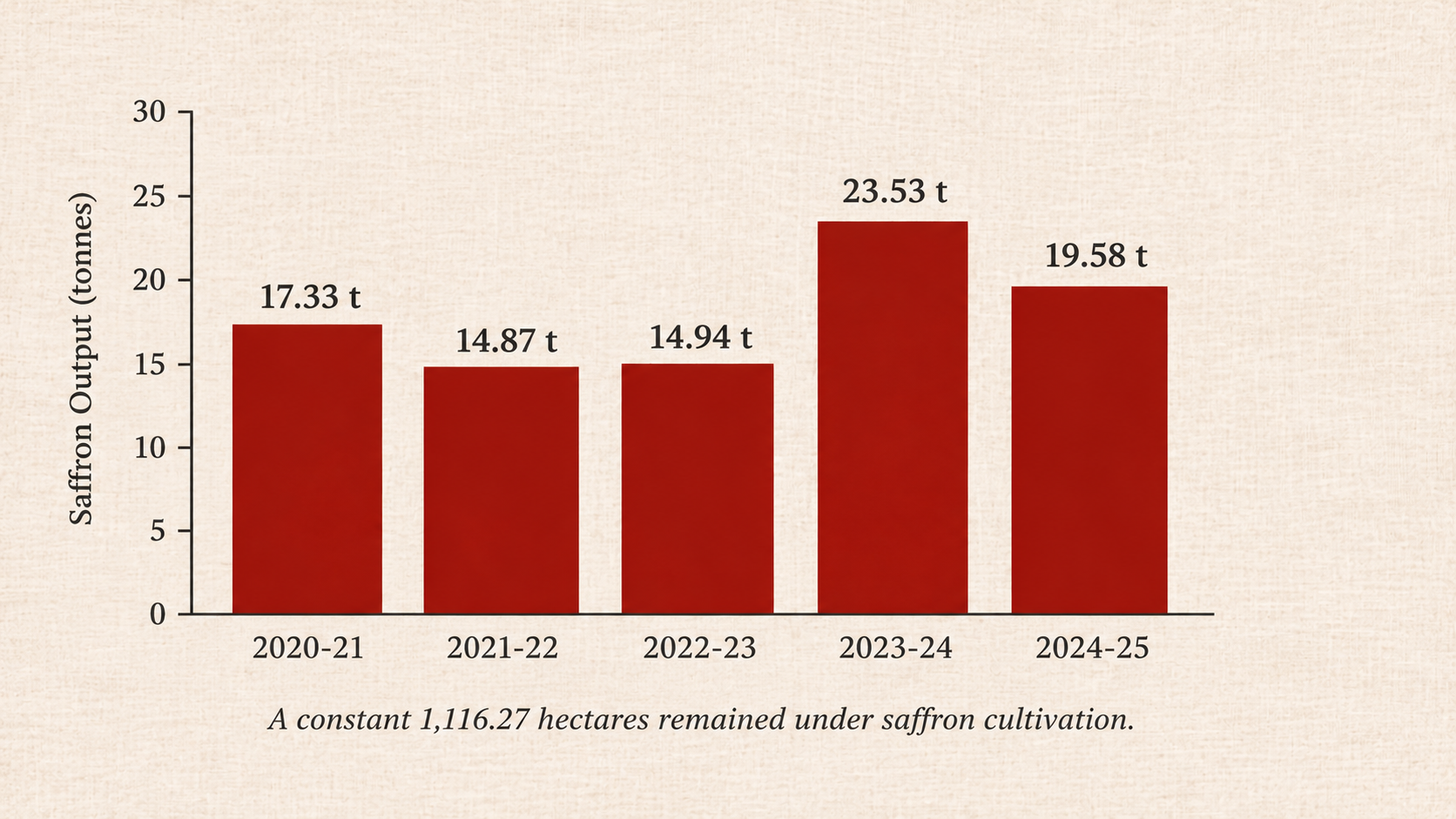
And it gets tighter. In a written reply to the Jammu and Kashmir Assembly in February 2026, the government put saffron output at 19.58 tonnes in 2024-25, down from 23.53 tonnes the year before, grown on a fixed 1,116.27 hectares, as reported by Outlook Business. The same reply valued that crop at ₹534.53 crore. Divide one by the other and you get roughly ₹2.73 lakh a kilo, or about ₹273 a gram, as an average value at the farm-gate end of the chain.
That's before anyone grades, tests, seals or ships it.
Meanwhile, India's demand is about 55 tonnes a year, according to the 2025 Economic Times report. Supply is small. Demand is large. The gap is filled by imports and, sadly, by fakes.
What actually pushes the price up or down
Not every gram of saffron should cost the same. Four things make a fair difference.
Grade. Mongra is the red tip of the stigma only, with no yellow style attached. Lacha keeps some of the yellow part, which adds weight but little colour. So a gram of Mongra holds more of what you're paying for. Our saffron grades guide explains the trade names in detail.
Origin. Kashmir saffron earned a Geographical Indication tag in 2020. The GI Journal entry describes longer, thicker stigmas, a natural deep red colour and a high crocin content, according to Kashmir Life's report on the GI listing. Iranian saffron is grown at a far larger scale, which usually means a lower price. We compare the two fairly in Kashmiri vs Iranian saffron.
Supply shocks. A weak harvest, a snowfall at the wrong time or a closed border can move prices within weeks, as 2025 showed.
Pack size. Smaller packs cost more per gram because packing, testing and delivery costs don't shrink with the weight. A 1 g pouch almost always works out dearer per gram than a 5 g pack of the same saffron.
What doesn't justify a higher price? Fancy boxes, vague words like "premium" or "royal", and claims you can't check.
Why a suspiciously low saffron price is a warning sign
Cheap saffron isn't a bargain. It's a question.
Fake and diluted saffron is a known problem. A 2022 study in the journal Foods, Determination of Saffron Quality through a Multi-Analytical Approach, lists what adulterated saffron has been found to contain: older or exhausted saffron, artificial dyes, other parts of the saffron flower, parts of other plants, and weight boosters like syrup, honey or glycerine. The authors also found silica sand and inorganic salts in some samples.
Every one of those tricks does the same job. It makes a gram weigh a gram while holding less real saffron.
So when you see kesar priced well below the ₹273 a gram average crop value we worked out above, ask yourself a simple question. How is the seller covering the cost of the flowers, let alone the grading and the packing?
The result? A low saffron price per gram often means you need more threads for the same colour, which wipes out the saving.

How to tell if a saffron price per gram is fair: a 5-step check
You don't need a lab to make a smarter call. Run any pack through these five checks before you pay.
Work out the real per-gram price. Divide the price by the weight in grams, and add delivery if it isn't free. A ₹1,510 pack of 3 g is about ₹503 a gram. Compare like with like.
Check the grade name. If the label says Mongra, the threads should be fully red with no yellow tails. If no grade is named, assume you're paying Mongra money for a mixed grade.
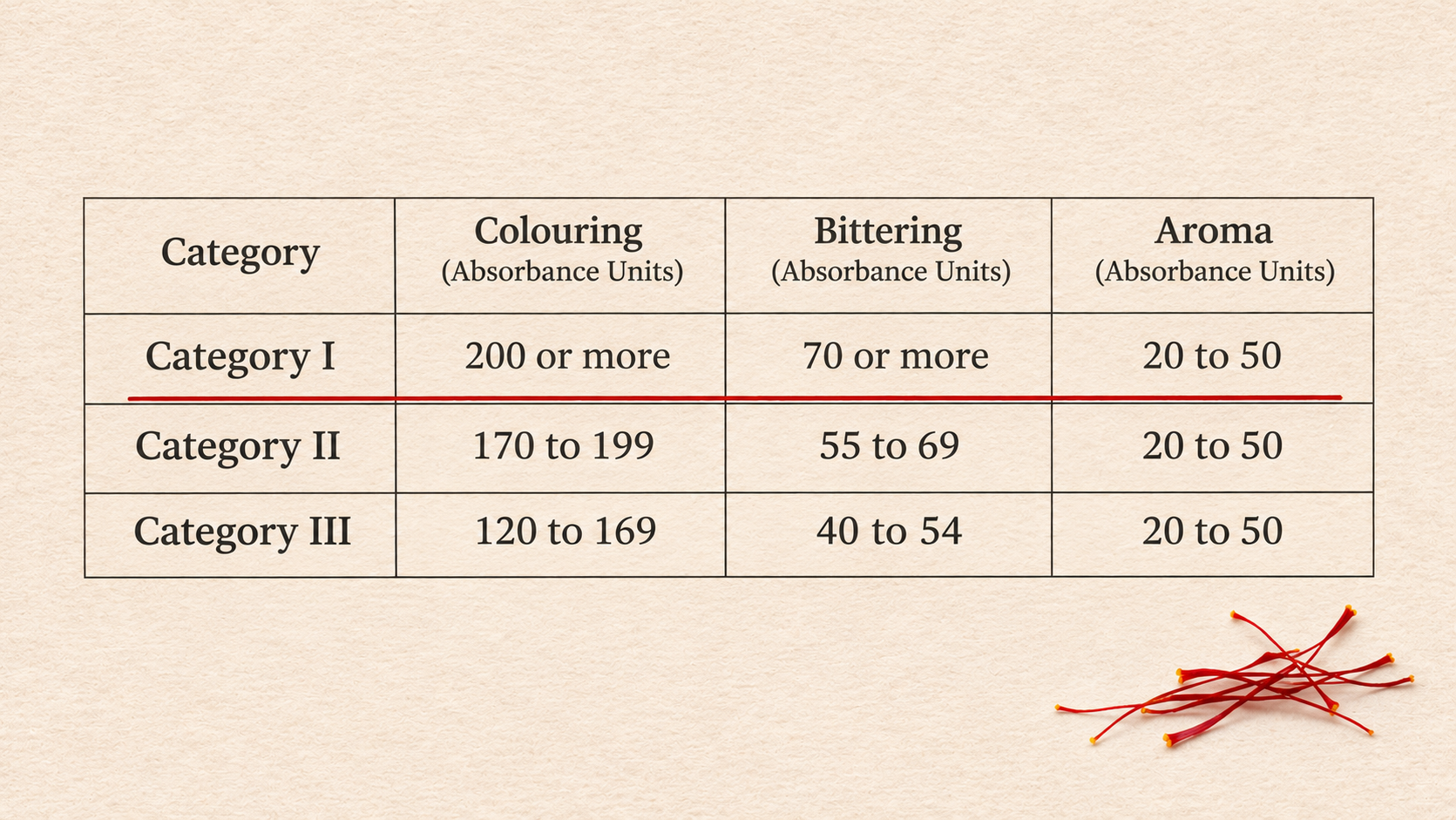
Look for the testing standard. Serious sellers test against ISO 3632, which grades saffron by colouring strength (crocin), bitterness (picrocrocin) and aroma (safranal). Category I needs a colouring strength of at least 200, according to the Foods study linked above. Our explainer on crocin, safranal and picrocrocin breaks down what those numbers mean in your kitchen.
Check the pack details. You want a packing month and year, a best-before date, a batch code and an FSSAI licence number on the pack or listing.
Do the water test at home. Drop two or three threads in a little warm water. Real saffron doesn't bleed red. It releases gold, slowly, and the thread stays red. Our guide on how to identify real saffron walks through more home checks.
If a pack fails two of these, the price doesn't matter. Walk away.
Where our Mongra saffron sits on price, and why
We'd rather show you our numbers than ask you to trust a word like "premium".
At Zoon Naturals, we sell one grade of saffron, Mongra, sourced from the karewa plateaus of Pampore, hand-picked, shade-dried and graded by hand. It comes in three sizes:
Mongra Saffron, 1 g at ₹560
Mongra Saffron, 3 g at ₹1,510, about ₹503 a gram
Mongra Saffron, 5 g at ₹2,520, about ₹504 a gram
Prices include all taxes. Delivery is free across India on orders above ₹3,000.
That places us near the ₹500 a gram retail level reported in 2025, not below it. Every batch is tested for crocin, safranal and picrocrocin against ISO 3632, and every pack carries the code of the batch it was filled from. Each pack shows its month and year of packing and a best-before of 24 months from packing.
If you cook with saffron every week, the 3 g or 5 g pack saves you about ₹56 a gram over the 1 g pouch. If you only need it for a festival kheer, the 1 g pouch is the sensible pick.
What a gram of saffron really costs you per dish
Here's where the maths gets friendlier.
You rarely use a whole gram at once. If a dish calls for a tenth of a gram, then at about ₹504 a gram that's roughly ₹50 of saffron for the whole pot. Spread across six plates of biryani or a family pot of kesar doodh, the per-serving cost is smaller than most people expect.
Our guide on how much saffron to use gives thread counts by dish, so you don't overspend or underflavour. And because saffron loses aroma to light, heat and air, good storage protects the money you've spent. Our post on how to store saffron covers that step by step.
Key takeaway: a fair price paired with the right dose and good storage beats a cheap price that needs twice the threads.
The bottom line on saffron price per gram
A low saffron price doesn't save you money. It moves the cost into weaker colour, flat aroma and more threads per dish.
So keep it simple. If a pack of "Kashmiri Mongra" sits far below the market range, check it with the five steps before you trust it. If a seller names the grade, the origin, the testing standard and the batch, the price has something behind it. If you cook with saffron often, buy a bigger pack and store it well. If you need it once a year, buy the smallest sealed pack you can find.
If you want saffron you can test at home and trust in the kitchen, explore our Kashmiri saffron and spices.
Frequently asked questions
What is the price of 1 gram of Kashmiri saffron in India?
Reported market levels put genuine Kashmiri saffron at roughly ₹300 to ₹500 a gram in recent years, and small retail packs often cost more per gram. Our 1 g Mongra pouch is ₹560 including taxes.
Why is kesar so expensive per gram?
One gram needs about 160 to 180 hand-picked flowers, the harvest window is only a few weeks long, and Jammu and Kashmir produced 19.58 tonnes in 2024-25 against Indian demand of about 55 tonnes a year.
Is cheap saffron always fake?
Not always, but a price far below the market range is a strong reason to check. Cheap saffron is often a lower grade, older stock, or bulked up with dyes, other flower parts or weight boosters.
What is the saffron price per kg in India?
In April 2025, retail prices crossed ₹5 lakh a kilo and wholesale was around ₹3 lakh a kilo, according to an Economic Times report. Prices move with each harvest and with import supply.
Does buying a bigger pack lower the saffron price per gram?
Usually, yes. Our 3 g and 5 g Mongra packs work out to about ₹503 to ₹504 a gram, compared with ₹560 for the 1 g pouch.
Taste the difference yourself.
Mongra saffron and fresh-crop dry fruits, sealed to order in Anantnag.
Shop the harvest