
Loading page
Free delivery on orders over ₹3,000
Free delivery on orders over ₹3,000
Recipes · 11 Oct 2026
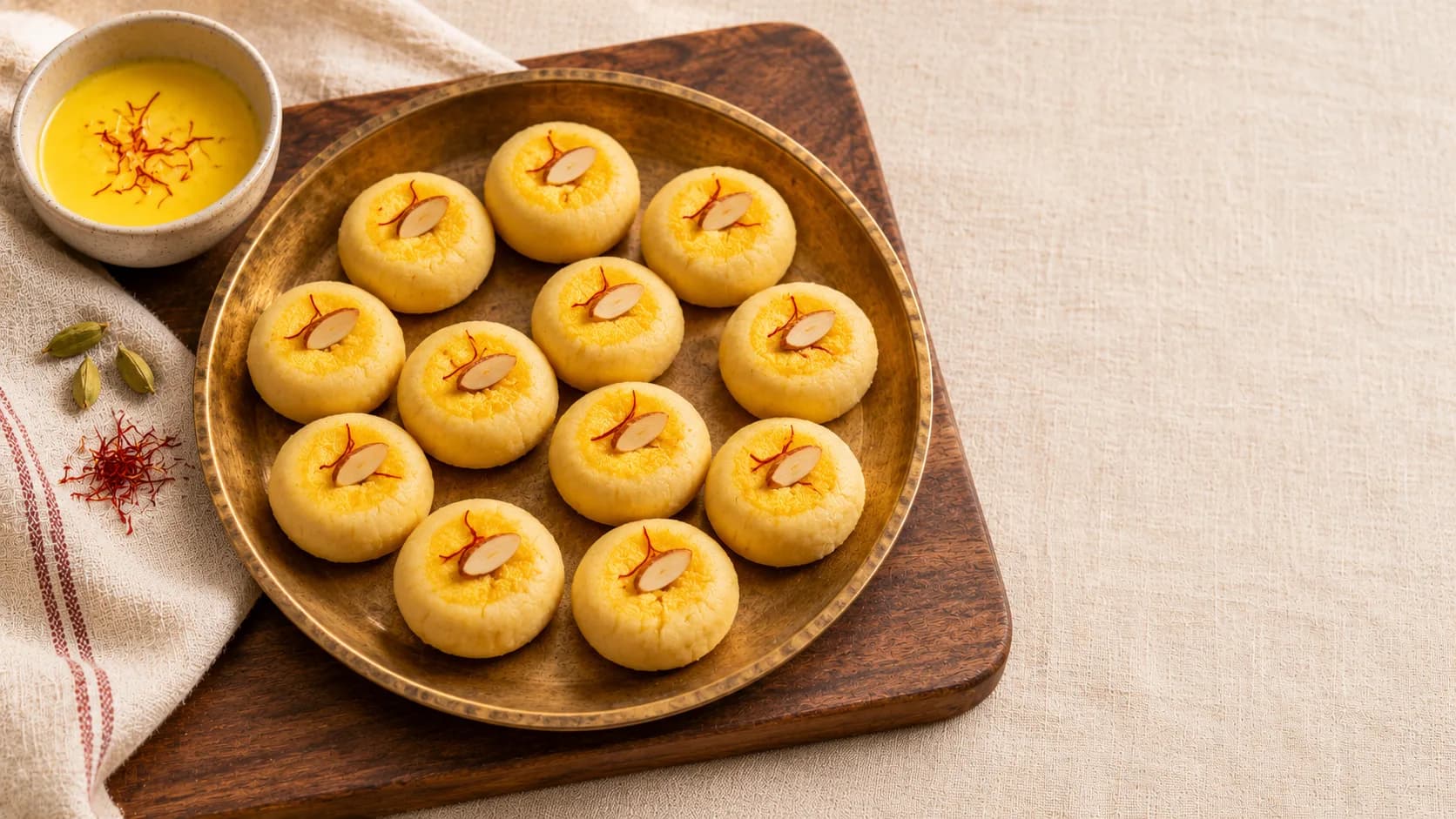
The week before Diwali, the queue at the sweet shop runs out the door, and the box of kesar peda you finally carry home is a suspiciously bright orange. It tastes of sugar and not much else. The saffron, if there ever was any, got lost somewhere between the colour and the price.
You can't see what went into the khoya or the kesar, and that's the real issue.
Here's the good news. A kesar peda recipe is one of the simplest Indian sweets to get right at home. You need five ingredients, one heavy pan and about 45 minutes. In this guide, we'll walk you through exact quantities, the steeping step most recipes skip, how to rescue a dough that's too soft or too dry, and how long your pedas will actually keep.
Here's the thing: festive demand puts pressure on two ingredients at once, khoya and saffron.
Khoya, also called mawa (milk simmered slowly until it turns into a soft, grainy solid), gets extra scrutiny every festive season. In 2020, FSSAI launched a nationwide khoya quality survey timed to the festive season, after a Delhi pilot found some samples failing, as Business Standard reported. Testers checked for added starch, added sugar and acidity.
Saffron has its own problem. A 2025 paper in the journal Metabolites notes that about 150,000 stigmas go into a single kilogram of saffron, which is exactly why it's such a target for fraud (Monaci et al., 2025). The same paper says powdered saffron is more at risk than whole threads. It also cites a European Joint Research Centre campaign that flagged fraud in 11% of the saffron it covered.
Make peda at home and both questions go away. You choose the khoya. You see the threads.
Keep the list short. Every ingredient has a job.
250 g fresh, unsweetened khoya, crumbled or grated. Soft, moist khoya, often sold as chikna khoya, gives the smoothest peda.
100 g powdered sugar (about ¾ cup). Use powdered, not granulated, so it melts into the dough instead of staying gritty.
15 to 20 saffron threads, roughly one pinch. Our guide to how much saffron to use defines a pinch as 20 to 25 threads, about 30 milligrams.
2 tablespoons warm milk, for steeping the saffron.
½ teaspoon cardamom powder, from 4 to 5 green pods, freshly ground.
1 teaspoon ghee, for the pan and your palms.
For the top: a few extra saffron threads, plus slivered pistachios or thinly sliced almonds.
A quick word on the saffron. Use whole threads, never kesar powder or a bottle of "saffron colour". Threads let you check what you're buying. Powder doesn't.
At Zoon Naturals we sell one grade, Mongra, the all-red tip of the stigma with no yellow style attached, sourced from Pampore. A 1 g pack of Mongra saffron covers this recipe many times over, since a gram holds roughly 450 to 500 threads.
This is the step most kesar peda recipes skip. It's also the one that decides whether your peda tastes of saffron or only looks yellow.
Saffron's colour comes from crocin, a pigment that dissolves in water and milk. Toss dry threads into hot khoya and they release only a fraction of what they hold. Steep them first, and the colour spreads evenly through the dough.
Here's how to do it:
Warm 2 tablespoons of milk until it's comfortable to touch, not hot.
Crush the threads lightly between your fingers and drop them in.
Leave them for at least 20 minutes. The milk should turn a deep, clear gold.
Why not boiling milk? Heat breaks crocin down.
A study in the Journal of Food Measurement and Characterization found that crocin degraded faster at higher temperatures across a 60 to 90 °C range (Springer, 2019). Warm is enough. Patience does the rest.
Key takeaway: steep the saffron in warm milk for 20 minutes before it ever touches the pan.
Start the steeping first. Cooking takes about 20 minutes, plus an hour for the pedas to set.
Grease a heavy-bottomed kadhai or non-stick pan with the ghee. Add the crumbled khoya and keep the flame low.
Stir constantly for 5 to 7 minutes. The khoya will melt, loosen and turn slightly glossy. It should stay pale cream, because brown khoya means the heat is too high.
Pour in the saffron threads along with their milk. Keep stirring for another 2 to 3 minutes.
You're watching for one sign. The mixture pulls away from the sides and gathers into a soft mass that follows your spatula. That's your cue to stop.
Tip the mixture onto a plate and let it cool for about 10 minutes, until it's warm but easy to handle.
Add sugar to very hot khoya and it melts into syrup, leaving a sticky, runny dough. Add it to warm khoya and it binds.
Sprinkle in the powdered sugar and cardamom. Knead with your palms for 1 to 2 minutes until the dough is smooth and holds together without cracking.
Grease your palms lightly with ghee. Divide the dough into 14 to 16 equal portions, about 22 g each, and roll each one into a smooth ball.
Flatten each ball gently into a thick disc and press a thumbprint into the centre, or use a peda mould if you have one. Top with one saffron thread and a sliver of pistachio or almond.
Leave the pedas on a plate for about an hour at room temperature. They'll firm up and the surface will dry slightly.
The result? A dense, fudgy peda, cream at the edges and gold through the middle, with saffron you can actually taste.
Most peda problems come down to moisture.
Dough soft or sticky? The khoya was cooked too briefly, or the sugar went in while it was hot. Return it to a low flame for 1 to 2 minutes, stirring, then cool and knead again.
Dough cracking or crumbly? It was cooked too long and lost too much moisture. Knead in warm milk one teaspoon at a time until it comes together.
Colour too pale? The saffron needed longer to steep, or it isn't very strong. Good saffron gilds the milk within 20 minutes without help. If the milk turns red the instant the threads touch it, treat that as a warning sign and read our guide on how to identify real saffron.
Taste slightly bitter or medicinal? You used too much saffron. More threads don't mean more flavour, and past a point the bitterness takes over.
Not as long as you'd think. Peda is a fresh milk sweet, not a dry one.
FSSAI's indicative shelf-life list for traditional milk sweets puts peda and other khoya sweets at consume within four days. That list was published when best-before dates became mandatory for sweet shops from 1 October 2020 (Business Today). Kalakand, by contrast, is meant to be eaten the day it's made, while kaju katli is listed at seven days.
For homemade pedas, that means:
Store them in an airtight box in the fridge.
Separate the layers with butter paper so they don't stick.
Let them sit at room temperature for 15 minutes before serving, which softens the texture and brings the cardamom forward.
Make them no more than two to three days before you plan to serve them.
Planning for Diwali? It falls on Sunday, 8 November 2026, according to Dekho Panchang. Make your pedas on 5 or 6 November and they'll be at their best for Lakshmi Puja.
And it gets better: your saffron keeps far longer than the sweets do. Store the rest of the pack away from light and heat, as we explain in our guide on how to store saffron.
Once the base is right, try these.
Kesar badam peda. Add 2 tablespoons of finely ground almonds along with the sugar. Mamra almonds, a richer variety with more natural oil, give a deeper flavour, and we compare them in our post on mamra vs California almonds.
Kesar elaichi peda for gifting. Double the cardamom to 1 teaspoon and press each peda into a mould. Pack them in a lined box with a small note of the date you made them, since homemade sweets don't come with a label.
A quicker version without khoya. If you can't find fresh khoya, many home cooks swap in milk powder cooked down with milk and ghee. The texture is lighter and less grainy, so treat it as a backup, not the default.
Homemade only helps if the inputs are clean.
For khoya, buy from a dairy you trust, check that it smells fresh and milky, and use it within a day or two. FSSAI's Check Adulteration at Home library has short videos on spotting starch in milk products with simple kitchen tests.
For saffron, the same FSSAI library shows two tests for saffron mixed with dried maize tendrils, one done by rubbing the threads between your fingers and one using hot water. Real saffron doesn't bleed red. It releases gold, slowly.
Great kesar peda isn't about more saffron. It's about better saffron, steeped properly and folded into fresh khoya that has cooled before the sugar goes in.
If your dough is sticky, cook it a minute longer. If it cracks, add milk a teaspoon at a time. If the colour floods out bright red in seconds, question the saffron, not your technique. And if you're cooking for Diwali, make your pedas no more than three days ahead.
If you want saffron you can steep, test and trust in a festive sweet, explore our Kashmiri saffron and spices.
For 250 g of khoya, use 15 to 20 threads, about one pinch. Steep them in 2 tablespoons of warm milk for at least 20 minutes before adding them to the pan.
Yes. Many home cooks use milk powder cooked with milk and ghee instead. The texture is lighter and less grainy than traditional khoya peda, so it works best as a backup.
Usually the sugar went in while the khoya was too hot, or the khoya wasn't cooked long enough. Cook the dough on low heat for 1 to 2 more minutes, then cool it and knead again.
FSSAI's indicative guidance for khoya sweets such as peda is to consume them within four days. Keep them in an airtight box in the fridge.
Use whole threads. Powdered saffron is more vulnerable to adulteration, and threads let you check colour and quality before you cook.
Diwali falls on 8 November 2026. Make your pedas two to three days earlier, around 5 or 6 November, and keep them refrigerated.
Taste the difference yourself.
Mongra saffron and fresh-crop dry fruits, sealed to order in Anantnag.
Shop the harvest