
Loading page
Free delivery on orders over ₹3,000
Free delivery on orders over ₹3,000
Saffron Guides · 15 Oct 2026
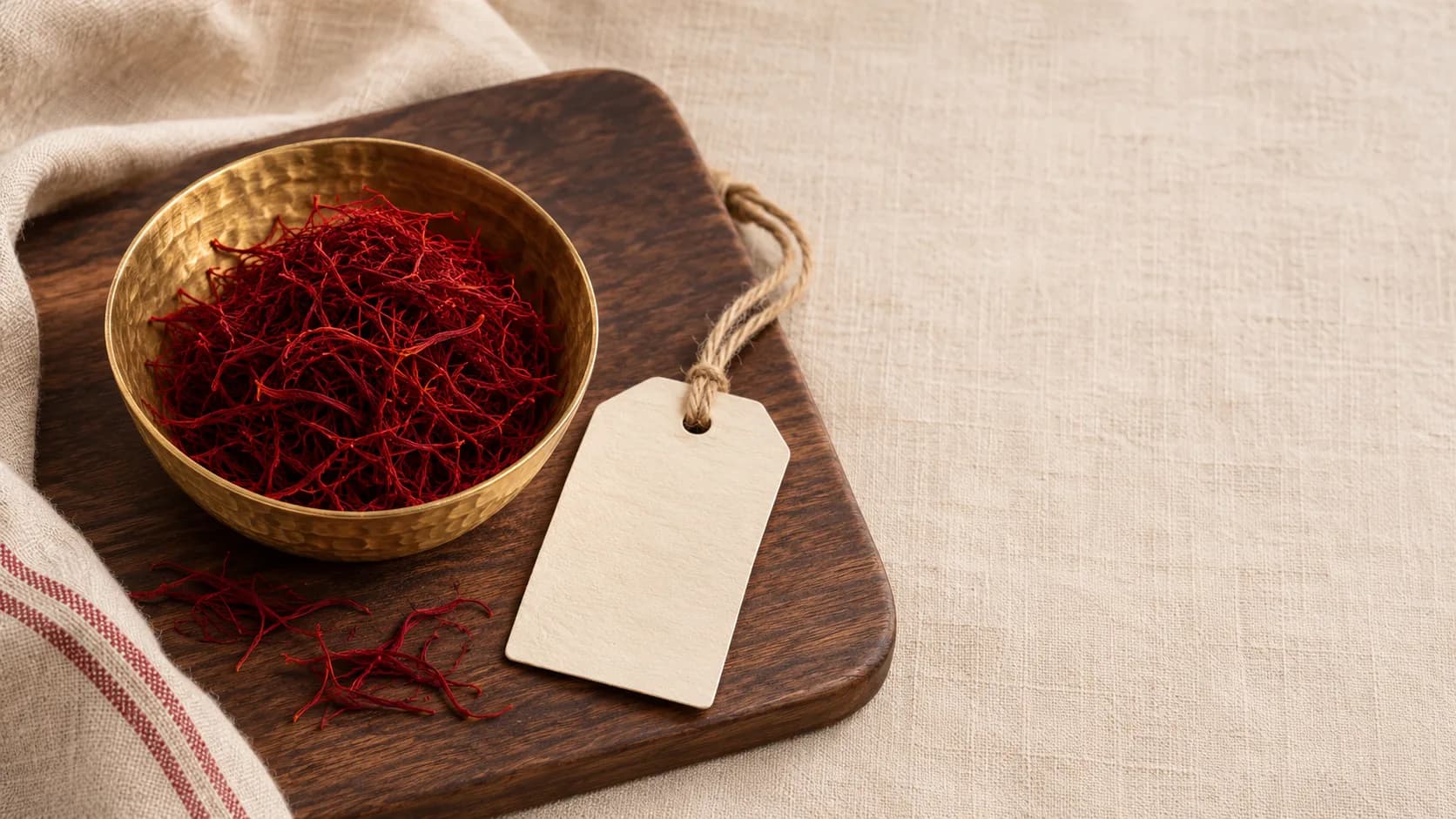
Two jars of kesar are open in your browser tabs. One says "GI tagged Kashmiri saffron" in bold gold type and costs a good deal more. The other just says "Kashmiri saffron". You pick the GI one, because a government tag has to mean something.
It does. Just not everything you think.
The Kashmiri saffron GI tag is a legal promise about where saffron comes from and how it's made. It isn't a purity test you can see in the jar, and the words on a label aren't the tag itself. In this guide, we'll walk through what GI No. 635 actually covers, who's allowed to use it, what the law says about misuse, and a simple way to check any GI claim before you pay.
A geographical indication, or GI, is a mark that ties a product to a place whose soil, climate or craft gives it a distinct character. Think Darjeeling tea or Mysore silk. Kashmir saffron joined that list in 2020.
Here's the thing: the tag belongs to the region, not to any one company. According to the GI Journal advertisement for application 635, the applicant was the Directorate of Agriculture, Kashmir, with help from SKUAST Kashmir and the Saffron Research Station at Dussu, Pampore. The application was filed on 3 December 2018, and The Tribune reported the Union Government issued the registration certificate in July 2020.
The dossier describes Kashmir saffron as the only saffron grown and harvested on the karewas of Jammu and Kashmir, the raised plateau soils that sit around 1,600 to 1,800 metres above sea level.
Key takeaway: a GI tag protects a name and a place. Every jar that honestly carries it should trace back to that place.
The GI isn't just "Pampore". The registered area spans four districts, each named in the dossier with its own saffron villages:
Pulwama: Pampore, Khrew, Ladoo, Dussu, Lathipora, Sambora, Awantipora and Koil.
Budgam: Chadoora, Nagam, Chirar-i-Sharief and nearby villages.
Srinagar: Zeewan, Khunmoh, Balhama and Sampora.
Kishtwar: Poochal, Hidyal, Berwarnag and others.
The dossier also lists three traditional forms, and they map onto what you see in shops. Lachha is stigmas dried straight after separation, with the yellow tail still on. Mongra is Lachha with the yellow tails removed by hand, leaving only the red, and the dossier calls it the costliest. Guchhi is Lachha tied into small bundles with thread, mostly from Kishtwar. If you want the long version, our guide to Mongra, Lachha and Guchhi goes deeper.
The physical description is specific, too. The dossier puts the dried stigma at roughly 28 to 35 mm long, with stigma and style together at 45 to 55 mm. Long, thick threads. Deep colour. Strong aroma.
This is where most buyers get caught.
A GI is an origin right. It says saffron sold under the name "Kashmir saffron" must come from the registered area and follow the described method. It doesn't send an inspector to every kitchen shelf in India, and it can't stop a seller from printing "GI" on a label they have no right to use.
The tag protects the name. It doesn't police every jar.
So a gold "GI tagged" sticker is a claim, not proof. Real proof is a trail: an authorised user, a tested lot, a traceable pack. When any link in that trail is missing, the sticker is just ink.
There's a second limit worth knowing. GI rules describe origin and traditional method, and the dossier sets out an inspection body that includes the Agriculture Department, the Spices Board, SKUAST and grower representatives. That's oversight of the system. It isn't a guarantee that a jar bought from an unknown seller on a marketplace has passed any test at all.
Key takeaway: treat "GI" on a label as a question to check, not an answer.
Under the Geographical Indications of Goods (Registration and Protection) Act, 1999, the registered proprietor (here, the Directorate of Agriculture) holds the GI, and producers can apply to the GI Registry under Section 17 to be listed as authorised users. Only the proprietor and registered authorised users get the right to use the GI on the goods.
And it gets serious fast. Section 22 treats a non-authorised user presenting goods in a way that misleads buyers about origin as infringement. Section 39 sets the penalty for falsely applying a GI at six months to three years in prison and a fine of ₹50,000 to ₹2 lakh.
In other words, the law is clear. Enforcement is the hard part, and that's why the label alone can't carry your trust.
The working end of the system is the India International Kashmir Saffron Trading Centre, IIKSTC, at Dussu, Pampore. According to a Rising Kashmir report from the 2024 harvest, growers bring fresh flowers to the centre for stigma separation and drying. Vacuum dryers there take about 30 minutes, compared with up to four days for traditional sun drying.
The result? A faster, cleaner process with fewer chances for quality to slip.
After drying, the same report says saffron is tested in a NABL-accredited laboratory, and lots that pass are certified with the GI tag. Growers can then sell in the open market or through an e-auction platform. The Kashmir Monitor reported in 2020 that this pan-India e-auction was built with NSE-IT, with growers and buyers asked to register as sellers and buyers.
A small real example shows how it works. In November 2023, Greater Kashmir reported that 1,150 g of saffron flowers from Berwar in Kishtwar were processed and analysed at IIKSTC. That gave 110 g of fresh filaments and 20 g of dry Lachha saffron, packed into 20 glass bottles with GI labelling. Notice the ratio. Roughly a kilo of flowers became 20 g of finished saffron.
Here's an uncomfortable fact. Kashmir doesn't grow much saffron.
According to figures the J&K government gave in the Assembly, reported by Greater Kashmir in February 2026, output was 17.33 tonnes in 2020-21, 14.87 in 2021-22, 14.94 in 2022-23, 23.53 in 2023-24 and 19.58 in 2024-25, on around 3,715 hectares. That's a small crop for a country this size.
The 2025 season looked worse on the ground. Kashmir Reader reported growers in Pampore saying output was barely 10 to 15 percent of normal, blaming long dry spells and poor corm sprouting.
Small supply plus a premium price creates pressure. When there's less real saffron, there's more temptation to stretch the name. Officials pointed to this when the tag arrived; one told The Tribune the certification would stop "the prevalent adulteration of Kashmir saffron". That's the hope. Checking is still on you.
You don't need a lab. You need five minutes and a bit of healthy doubt.
Look for the seller, not the sticker. Ask who the authorised user is. A seller using the GI honestly can name the registered user or the tested lot behind it. A vague answer is your answer.
Check the GI Registry. The GI Registry's public record for application 635 is where the registration sits. If a seller says they're an authorised user, that's the place to confirm it.
Read the FSSAI licence number. Every packaged food sold in India should show one. It won't prove origin, but a missing one is a red flag. You can check it on the FSSAI's FoSCoS portal.
Ask for a batch or lot code. A tested, traceable pack carries one. No code, no trail.
Test the threads at home. Real saffron doesn't bleed red. It releases gold, slowly, in warm water. Our guide on how to identify real saffron walks through the water, rub and taste tests.
And it gets better: steps 3 to 5 work on any saffron, GI or not. So even when you can't confirm a tag, you can still judge the jar.
We'd rather be plain about this. Zoon Naturals doesn't claim GI authorised-user status, so we don't call our saffron "GI tagged". We don't use certification language we don't hold.
What we do say is specific and checkable. Our saffron is sourced from the karewa plateaus of Pampore, hand-picked, shade-dried and graded by hand. Our Mongra is red tip only, with no yellow style and no added colour or oil. Every batch is tested for crocin, safranal and picrocrocin against ISO 3632, and every pack carries the code of the batch it was filled from. Our FSSAI licence number is 21026010000356.
If you want to know what those three compounds mean in the cup, our guide to crocin, safranal and picrocrocin explains it simply. And if you're weighing origins, read our Kashmiri vs Iranian saffron comparison.
A GI tag is a promise about place. Purity is a promise about the jar. You need both, and only one of them is printed in gold.
So here's the practical version. If a seller says "GI tagged", ask for the authorised user and the lot, then check the Registry. If they can't answer, judge the saffron on its FSSAI number, batch code and a home water test instead. If you're buying for a festive kheer or a winter kahwa, buy small first, test it, then buy more.
If you want saffron you can test at home and trust in the kitchen, explore our Mongra Kashmiri saffron or browse the full saffron and spices range.
Kashmir saffron is registered as GI No. 635. The Directorate of Agriculture, Kashmir, filed the application in December 2018, and the registration certificate was issued in 2020.
Not by itself. A GI protects the origin and traditional method of saffron sold as "Kashmir saffron". It can't stop a seller from printing "GI" falsely, so check the authorised user, FSSAI number and batch code, and test the threads at home.
Under the GI Act, 1999, the registered proprietor and producers registered with the GI Registry as authorised users can use the GI. Falsely applying a GI can attract six months to three years in prison and a fine of ₹50,000 to ₹2 lakh.
The GI covers saffron grown on the karewas of Pulwama (including Pampore), Budgam, Srinagar and Kishtwar districts, at roughly 1,600 to 1,800 metres above sea level.
Yes. The GI dossier lists three traditional forms of Kashmir saffron: Lachha, Mongra and Guchhi. Mongra is the all-red form with the yellow tails removed by hand.
Ask the seller to name the authorised user or tested lot, then check the GI Registry's public record for application 635. Whatever the answer, confirm the FSSAI licence number and batch code, and do a warm water test at home.
Taste the difference yourself.
Mongra saffron and fresh-crop dry fruits, sealed to order in Anantnag.
Shop the harvest