
Loading page
Free delivery on orders over ₹3,000
Free delivery on orders over ₹3,000
Wellness · 30 Oct 2026
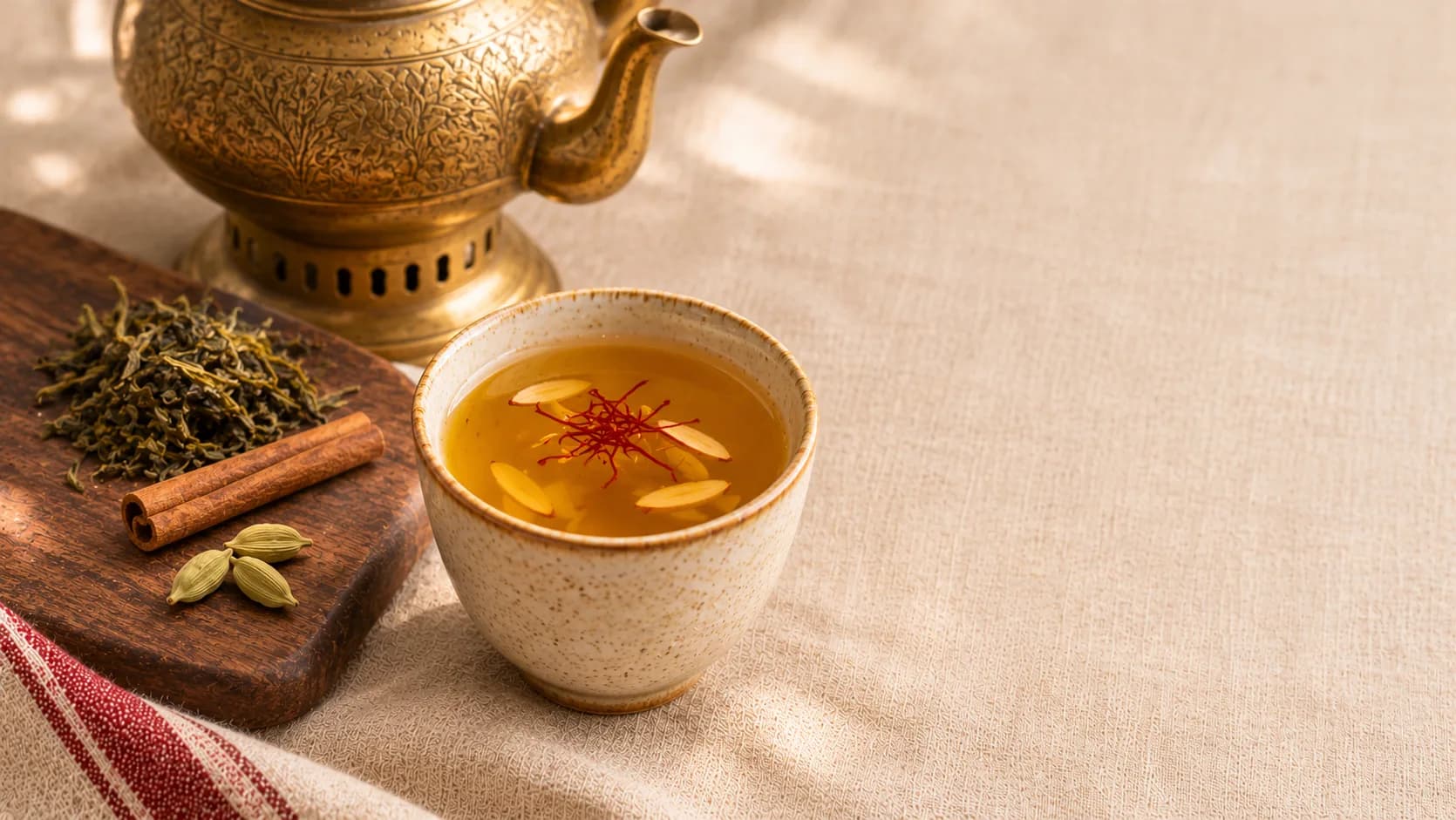
The kettle goes on before the guests have taken their shoes off. In a Kashmiri home in winter, kahwa isn't a choice you're offered. It's simply what arrives, golden and steaming, with almond slivers drifting on top.
Ask anyone in the room about Kashmiri kahwa benefits and you'll hear a long list. Digestion, immunity, glowing skin, weight loss, warmth. Some of that has research behind it. A lot of it doesn't. So we went through the studies ingredient by ingredient, green tea, saffron, cardamom, cinnamon and almonds, to separate what's been measured from what's just been repeated. You'll also find who should go easy on it, and how to brew a cup that actually contains the ingredients you're paying for.
A quick note: this article is for general information only and isn't medical advice. If you have a health condition, are pregnant, or take regular medicine, talk to your doctor before changing your diet.
Kahwa is a Kashmiri green tea, simmered with whole spices and finished with saffron and nuts. The Budgam district administration's page on Kashmiri kahwa lists the core ingredients as Kashmiri green tea leaves, whole spices like cardamom, cinnamon and cloves, saffron, and nuts. Traditionally it was brewed in a samovar, a brass kettle with a central chamber for hot coals.
That's the whole recipe. No milk, no flavour powder. (Milk belongs in noon chai, Kashmir's pink tea, which is a different drink altogether.)
Here's why this matters for the benefits question:
Green tea leaves bring catechins, the plant compounds most tea research focuses on, plus some caffeine.
Saffron threads bring crocin and safranal, the compounds behind its colour and aroma.
Cardamom and cinnamon bring flavour and aroma, in small kitchen amounts.
Almonds bring a little fat, protein and texture.
Every claim about kahwa is really a claim about one of these five things. And it gets more interesting when you look at the dose in a single cup.
If kahwa has a research backbone, it's the tea leaf. Green tea is one of the most studied drinks in the world.
A 2020 meta-analysis in Nutrition Journal pooled 31 randomised trials with 3,321 people. It found green tea intake lowered total cholesterol by about 4.66 mg/dL and LDL cholesterol by about 4.55 mg/dL on average, with no change in HDL. That's a modest shift. Real, but small.
A larger 2023 review in Frontiers in Nutrition looked at 55 trials covering 4,874 adults and found similar small drops in LDL and total cholesterol. There's a catch, though. Those trials used green tea extract, not a cup of brewed tea.
The US National Center for Complementary and Integrative Health sums it up plainly. Its green tea fact sheet says the evidence isn't conclusive for most uses, including weight loss, and that cholesterol results come mainly from extract studies.
The takeaway: kahwa is a pleasant way to drink green tea. It isn't a cholesterol plan.
Saffron gets the most excited claims, so it deserves the most careful reading.
A 2013 meta-analysis in the Journal of Integrative Medicine pooled five small randomised trials on saffron and depressive symptoms. Saffron did better than placebo, and about the same as the antidepressants it was compared with. The authors flagged clear limits: small groups, trials of six to eight weeks, and all of them run in Iran.
A later umbrella meta-analysis in Pharmacological Research pulled together seven earlier meta-analyses. The results were mixed. Saffron improved scores on one depression scale but not on two others. The authors concluded saffron might help as an add-on, but can't be treated as a standalone approach.
Notice what these studies tested. Measured saffron supplements, taken daily for weeks. Not four threads floating in a cup of tea.
So what does saffron do for your kahwa? It gives it that clear gold colour, a honeyed, hay-like aroma, and a faint bitter-sweet edge. That's the honest benefit, and it's a good one. If a kahwa smells of nothing, the saffron is either weak or fake. Our guide on how to identify real saffron walks through the home checks.
You'll read that cardamom "fixes digestion" and cinnamon "controls sugar". We didn't find human research strong enough to say either about the amounts that go into a pot of kahwa. A pod or two and a short piece of bark per pot is seasoning, not a supplement.
There is one number worth knowing, though. Cinnamon contains coumarin, a natural compound that can strain the liver in sensitive people at high intakes. Germany's Federal Institute for Risk Assessment (BfR) sets a tolerable daily intake of 0.1 mg of coumarin per kilogram of body weight. According to the BfR, cassia cinnamon is high in coumarin, and an adult can reach that limit with roughly 2 g of cassia a day. Ceylon cinnamon contains much less.
The result? A small piece of bark shared across a pot is nowhere near that. But if you're the kind of person who drinks six strong cups a day and adds extra cinnamon powder to each, it's worth easing off.
The slivered almonds on top are a Kashmiri touch, and they make the cup feel generous. Four or five slivers per cup add a little crunch and a mild, nutty sweetness.
That's about it. A few slivers don't add enough of anything to count as a nutrition benefit. Treat them the way Kashmiri hosts do, as hospitality.
Here's the thing: not every benefit has to come from a lab.
A hot, lightly caffeinated drink on a cold evening feels good. It warms your hands, it slows the conversation, and it gives you something better to sip than a sugary fizzy drink. Kahwa is also usually drunk without milk and with only a little sweetener, which makes it lighter than most winter drinks.
That's not a medical claim. It's just what the cup is. Kahwa doesn't heal. It hosts.
Green tea is generally considered safe as a drink. The NCCIH green tea fact sheet says no safety concerns have been reported for adults drinking green tea as a beverage. A few groups should still think before reaching for a third cup.
If you're pregnant or breastfeeding. Green tea contains caffeine. The NCCIH advises keeping caffeine moderate during pregnancy and asking your doctor. The same goes for saffron in more than kitchen amounts.
If you take regular medicine. The NCCIH notes that large amounts of green tea may interfere with some drugs, including the beta blocker nadolol. Talk to your doctor if you're unsure.
If you're watching your iron. The ICMR-NIN Dietary Guidelines for Indians note that tea can reduce iron absorption from plant foods, and advise keeping tea away from mealtimes in that context. A gap of an hour either side of a meal is a common, sensible habit.
If you sweeten with honey. Raw honey must never be given to babies under 12 months.
One more thing. Kahwa "detox" sachets and capsules aren't kahwa. Rare liver problems have been linked mostly to concentrated green tea extracts, not to brewed tea, according to the NCCIH. Stick to the cup.
Benefits only count if the ingredients are in the cup. And most of what goes wrong happens at the stove.
Here's a simple two-cup method, the same one in our full kahwa recipe:
Steep the saffron first. Put 4 to 6 threads in 2 tablespoons of warm water, not hot, and leave it for 15 minutes.
Simmer the spices. Bring 2 cups of water to a gentle boil with a 2 cm piece of cinnamon and 2 lightly crushed green cardamom pods. Simmer for 3 to 4 minutes.
Add the tea off the heat. Turn off the flame, add 2 teaspoons of green tea leaves, cover, and wait 2 minutes. Longer turns it bitter.
Finish. Strain into cups, pour in the saffron water with its threads, and add almond slivers and a little honey if you like.
If you'd rather skip the measuring, our Saffron Kehwa Blend combines whole green tea leaves, Mongra saffron strands from Pampore, crushed mamra almonds, green cardamom and cinnamon. Simmer a teaspoon in water for 3 to 4 minutes, never at a rolling boil, then strain. A 100 g pack brews around 40 cups.
Not sure how much saffron to add on top? Our guide on how much saffron to use has the counts, dish by dish.
Kahwa isn't medicine. It's a well-made cup of green tea, with real saffron and spices, that happens to sit on top of some decent research.
If you want the green tea part, drink it as an everyday tea, not a remedy, and keep it away from mealtimes if iron is a concern. If you want the saffron part, make sure the saffron is real, because a flavoured mix gives you colour without any of the compounds researchers study. If you're pregnant, on regular medicine, or managing a health condition, check with your doctor first. And if you want a cup that tastes the way it does in a Kashmiri home, brew it slowly and keep the saffron away from boiling water.
If you'd like a blend made from whole ingredients you can see and smell, explore our Kehwa & Teas range.
Most of the evidence comes from green tea. A 2020 meta-analysis of 31 trials found green tea intake lowered LDL and total cholesterol by small amounts. Saffron research is promising but used supplements, not tea. This isn't medical advice.
The NCCIH says no safety concerns have been reported for adults drinking green tea as a beverage. If you're pregnant, take regular medicine, or have low iron, check with your doctor first.
The NCCIH says evidence for green tea and weight loss isn't conclusive. Kahwa is a light drink with no milk, but it isn't a weight loss tool.
Many people drink it in the morning or after a gap from meals. The ICMR-NIN guidelines note tea can reduce iron absorption from plant foods, so an hour away from meals is a sensible habit.
Yes. Kahwa is made with green tea leaves, so it contains some caffeine. If you're sensitive, keep to one cup and avoid it late in the evening.
Real saffron releases a slow, golden colour in warm water and smells honeyed and hay-like. Many mixes use saffron flavour instead, so read the ingredient list for actual saffron strands.
Taste the difference yourself.
Mongra saffron and fresh-crop dry fruits, sealed to order in Anantnag.
Shop the harvest