
Loading page
Free delivery on orders over ₹3,000
Free delivery on orders over ₹3,000
Storage and usage · 2 Nov 2026
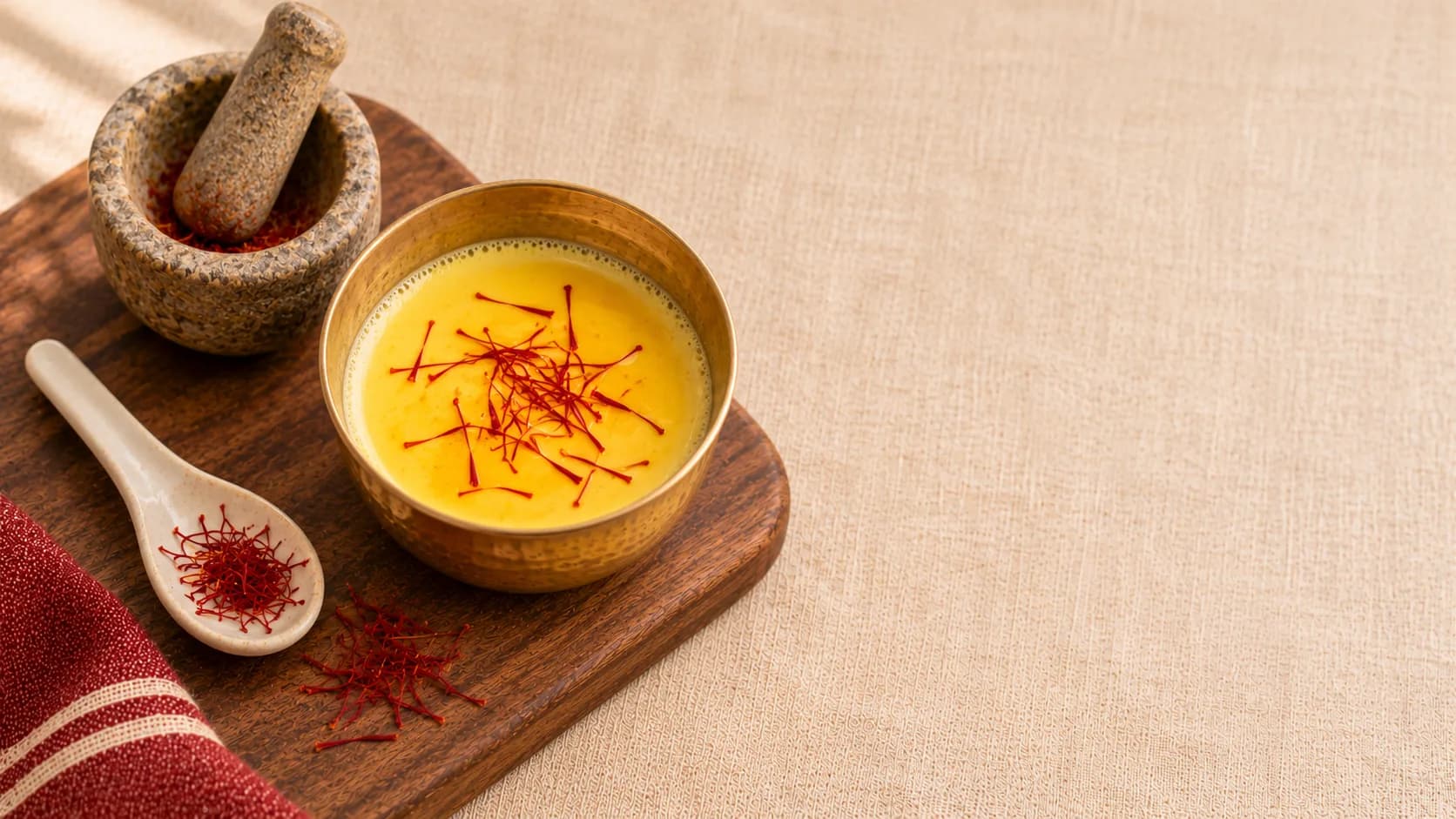
This year's saffron flowers in Pampore began to open in late October, after a dry spell that ran from September into October, Greater Kashmir reported. Families pick them by hand at dawn, and it takes roughly 150,000 flowers to make one kilogram of dried kesar, according to The Better India.
Then a good share of it gets wasted in the kitchen.
Not through bad saffron. Through bad technique. Dry threads scattered into a pot give up only part of what they hold, and the rest ends up on someone's plate as a red speck. Below, we'll walk through how to use saffron properly: how to bloom it, which liquid and temperature work best, when to add it for each kind of dish, and the small habits that quietly cost you colour and aroma.
Saffron's character comes from three compounds. Crocin gives the colour, picrocrocin the faintly bitter taste, and safranal the aroma. A 2022 review in Frontiers in Nutrition describes crocin as highly water-soluble, which is why kesar colours milk so easily, and notes that it loses its functionality when exposed to light, heat and acid.
Here's the thing: that one sentence is a cooking manual. Water pulls the colour out. Heat, light and sourness work against you.
So the job is simple. Give the threads warm liquid and time, then protect what comes out. Technique decides how much of your saffron reaches the plate. Quantity comes second.
If you want exact amounts for each dish, our guide to how much saffron to use has a full table. This article is about the method.
Blooming, soaking the threads before they go into the dish, is the single habit that changes everything. It takes thirty seconds of work and twenty minutes of waiting.
Count your threads. For a dish serving four to six, 15 to 30 threads of good Mongra is a typical range. In our kitchen, a pinch means 20 to 25 threads.
Crush them lightly. Rub the threads between your fingertips, or press them with the back of a spoon in a small katori. Broken threads release faster.
Add warm liquid. Pour in two to four tablespoons of warm milk or water. Warm means you can hold a finger in it comfortably.
Cover and wait. Leave it for at least 20 minutes, away from direct sunlight. The liquid should turn a deep gold to orange, and the threads should look soft.
Add everything. Pour the liquid and the threads into the dish together, usually near the end of cooking.
That's it. Ten threads bloomed this way will often do more than thirty thrown in dry.
Milk or water? Use whatever liquid the dish already contains. Milk suits sweets, kesar doodh and biryani, where a little fat helps carry the aroma. Water suits clear rice, sharbat and anything you don't want to cloud. Either way, the threads need the same two things, warmth and time.
Most Indian kitchens reach for hot milk straight off the gas. It works. But hotter isn't better.
A 2024 study in the journal Molecules infused saffron in water and oil at 60, 80 and 100 °C for 10, 20 and 30 minutes. The highest crocin level in water, 85.4 micrograms per milligram of saffron, came at 60 °C after 20 minutes, and crocin declined as temperature and time went up. In a separate low-temperature test, the researchers found colour transfer was actually favoured at 20 and 40 °C compared with 60 °C.
The result? Lukewarm liquid and patience beat a boiling pan.
Aroma behaves differently. In the same study, safranal appeared only in trace amounts in plain water, and the highest level came from a water and oil mix at 80 °C, with the authors advising temperatures no higher than 80 °C. In kitchen terms, your bloomed saffron does best when it meets a dish with some fat in it, like milk, kheer or ghee-cooked rice, at a gentle simmer rather than a rolling boil.
Colour wants water. Aroma wants a little fat. Neither wants a fierce boil.
Timing changes with what you're cooking. Here's how we use saffron in the dishes Indian kitchens make most.
Bloom 4 to 6 threads in two tablespoons of warm milk for 20 minutes. Heat the rest of the glass separately, take it off the flame, then stir the bloomed saffron in. Adding it after the boil keeps the colour brighter, and our post on kesar doodh covers the drink itself.
For a litre of milk, bloom a pinch, 15 to 20 threads, in two tablespoons of warm milk. Stir it in during the last five minutes, once the kheer has thickened. Saffron added at the start of a long reduction spends an hour losing its aroma.
This is where layering matters. For a biryani serving six, bloom 25 to 30 threads in three tablespoons of warm milk. Drizzle it over the top layer of rice just before you seal the pot for dum, so the steam carries it down. Hold back a spoonful to streak over the rice before serving and you get those gold and white grains.
Curd is sour, so don't soak the threads in it. For 500 g of hung curd, bloom 15 to 20 threads in a tablespoon of warm milk, let it cool, then fold it in with the sugar and cardamom. For a glass of lassi, three or four bloomed threads stirred in at the end give colour without turning the drink bitter.
Kahwa is the exception. Three or four threads go straight into the pot in the last two minutes of simmering, no separate bloom needed, because the pot itself does the blooming. Our Kashmiri kahwa recipe walks through the full brew.
For cakes, cookies and shrikhand, bloom 10 to 15 threads in the recipe's own warm milk or water, then add it with the wet ingredients. If the recipe has no liquid, grind the threads with a pinch of sugar in a small mortar and mix the powder into the batter.
You can buy excellent saffron and still get a pale, flat dish. These are the usual reasons.
1. Frying it in hot oil. Saffron belongs in liquid, not in a tadka. The threads scorch fast, and the aroma you paid for goes with them.
2. Adding it at the start of a long cook. Crocin is sensitive to heat, as the Frontiers review notes. An hour of boiling is the opposite of what it needs.
3. Soaking it in something sour. Acid is another of crocin's weak points. If a dish has lemon, tamarind or curd, bloom the threads in milk or water and add them near the end.
4. Using more to fix weak colour. Past roughly double the usual quantity, the bitterness takes over and the dish tastes medicinal. Bloom longer, or check the saffron itself with the home tests in our guide on how to identify real saffron.
5. Storing it where you cook. A jar beside the stove meets heat, steam and light every day. Saffron doesn't spoil. It fades.
Our article on how to store saffron shows how to keep it potent to the last pinch.
Good kesar shows its quality the moment it meets liquid. Real threads release colour slowly, a gold-orange that spreads over several minutes, while the threads themselves stay red. If the water turns dark red instantly, or the threads turn pale while the liquid floods with colour, treat that batch with suspicion.
The smell should be warm, honeyed and slightly hay-like, never chemical. The taste is faintly bitter, not sweet.
That's why grade matters too. Mongra, the top grade of Kashmiri saffron, is only the red tip of each thread, with the pale yellow style cut away, so you're paying for colour, not filler. It's what we sell as Mongra saffron from Pampore, hand-picked, shade-dried and graded by hand. Kashmir saffron has also held a Geographical Indication tag since 2020, as the Spices Board of India notes.
Using saffron well matters more when supply is tight. Pampore growers told Kashmir Reader in November 2025 that output had fallen to around 10 to 15 percent of normal, and the same report listed official production of 14.94 tonnes in 2023, down from 17.33 tonnes in 2021.
This year's flowers are being picked right now. According to The Better India, dried saffron from the harvest reaches markets from late November, after sorting and grading.
When a crop is this small, every thread deserves to be used properly.
Saffron isn't a spice you sprinkle. It's a spice you prepare.
If you're making milk, kheer or halwa, bloom in warm milk and add it near the end. If you're making biryani or pulao, bloom in warm milk and layer it in before dum. If you're baking, bloom in the recipe's liquid or grind with sugar. And if a dish comes out pale, look at your method before you reach for more threads.
If you want saffron that answers this method with a slow, clean gold, explore our Kashmiri Mongra saffron, in 1 g, 3 g and 5 g packs.
Bloom 4 to 6 threads in two tablespoons of warm milk for about 20 minutes. Heat the rest of the milk, take it off the flame, and stir in the saffron liquid along with the threads.
At least 20 minutes in warm milk or water. The liquid should turn deep gold and the threads should soften. In a 2024 study, the highest colour extraction in water at 60 °C came after 20 minutes.
You can, but you'll get less colour and aroma from the same threads. The exception is kahwa, where the threads go straight into the simmering pot for the last two minutes.
Warm, not boiling. Researchers found colour transfers well even at 20 to 40 °C, while hotter, longer infusions lowered crocin levels.
It's best not to. Saffron scorches quickly in hot fat. Bloom it in liquid first, then add it to dishes that contain ghee or milk at a gentle simmer.
For a biryani serving six, 25 to 30 threads of Mongra bloomed in three tablespoons of warm milk is a good starting point. The full dish-by-dish table is in our guide to how much saffron to use.
Taste the difference yourself.
Mongra saffron and fresh-crop dry fruits, sealed to order in Anantnag.
Shop the harvest