
Loading page
Free delivery on orders over ₹3,000
Free delivery on orders over ₹3,000
Wellness · 16 Oct 2026
One in five. That's roughly how many Ayurvedic products bought online contained detectable lead, mercury or arsenic in a 2008 study published in JAMA. The researchers tested 193 products, and 20.7% failed that basic check.
So learning how to take shilajit starts before the spoon ever touches milk. It starts with the jar.
Below, we'll walk through what shilajit is, how to check your resin, the traditional way to take it in warm milk or water, how big a serving should be, when to take it, how to store it, and who should speak to a doctor first.
Shilajit, also called salajit or shilajatu, is a blackish-brown exudate that seeps from high mountain rock, especially in the Himalayas. A review published in Evidence-Based Complementary and Alternative Medicine describes it as forming over centuries from plant matter broken down by microorganisms.
Here's the thing: it's mostly humic material. The same review reports that humic substances, including fulvic acid, make up around 60% to 80% of shilajit, plus a mix of trace elements.
It comes off the rock in a raw state. That raw state is the problem.
According to that review, eating shilajit without purification may risk intoxication from mycotoxins, heavy metal ions and free radicals. The authors are blunt about it: a purified, ready-to-use preparation is the one meant for people.
That's why you'll see shilajit sold in three forms.
Resin. A soft, tar-like paste. It's the closest to the traditional form and dissolves directly in warm liquid.
Powder. Dried and ground, often blended with other ingredients.
Capsules and tablets. Convenient, but you're trusting a label you can't see past.
At Zoon Naturals, we sell shilajit only as soft resin. Our product page describes it as collected from rock faces above 14,000 feet and purified with the traditional water-filtration method.
Before you take shilajit for the first time, give the jar a two-minute inspection. You're looking for a resin that behaves like resin.
Good resin is firm and slightly sticky at room temperature, softens in a warm hand, and turns brittle in the fridge. A small piece dissolves almost fully in warm water, leaving a clear golden-brown to reddish-black liquid with no grit at the bottom. It tastes bitter and smoky. Not sweet.
We cover each of these checks in detail in our guide on how to test shilajit purity at home.
Key takeaway: home checks catch crude fakes. They can't see heavy metals. Only lab testing can do that, which is why the JAMA figure above matters. The US Operation Supplement Safety programme makes the same point plainly, noting that without lab testing, you can't know whether a product is free of heavy metals.
So buy from a seller who tells you the resin has been tested, and keep the batch code on the pack in case you ever need to ask about it. Our shilajit resin is lab-tested for heavy metals before it's packed, and the jar carries an FSSAI licence number (21026010000356) along with the month and year of packing.
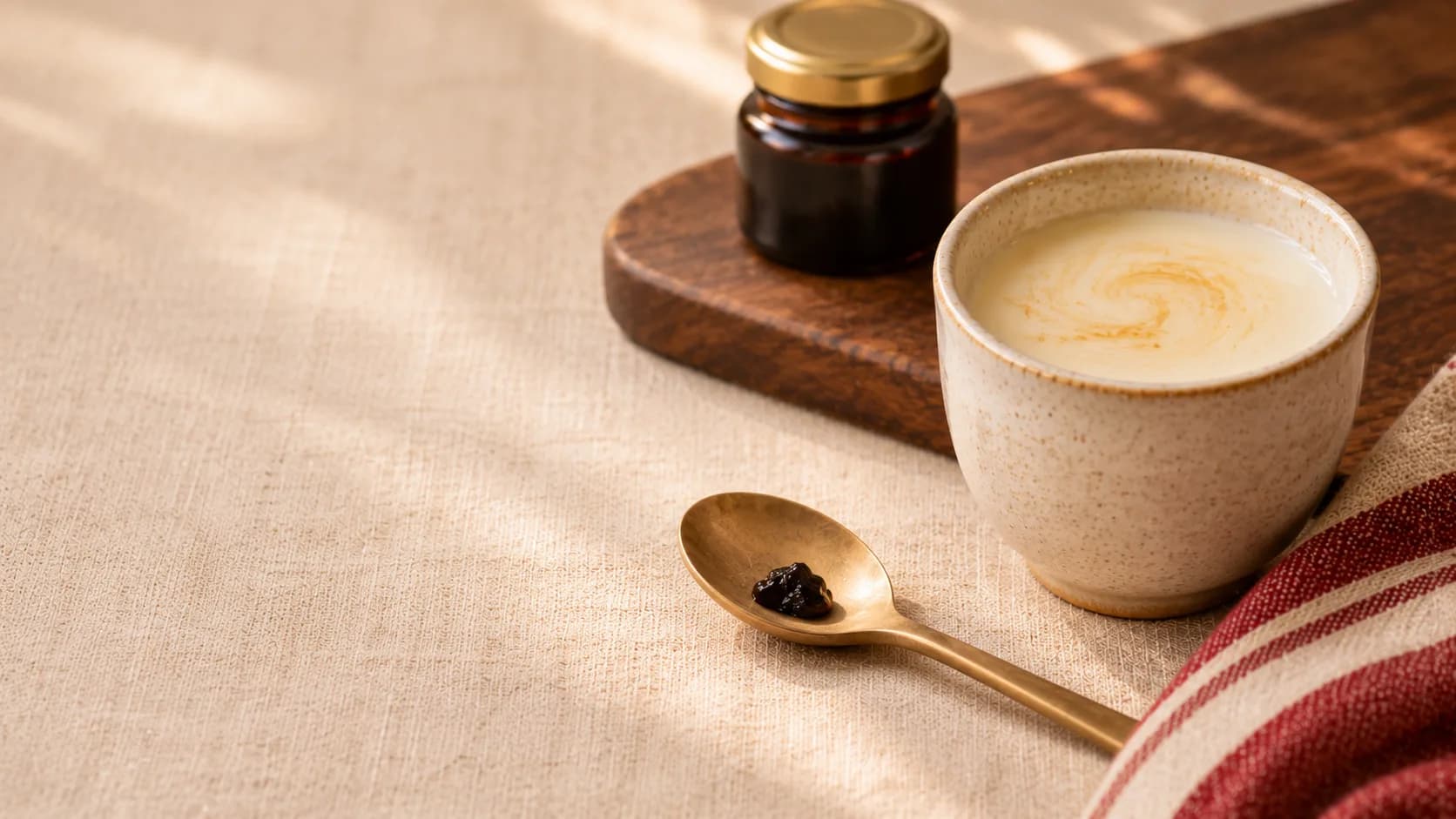
The traditional method is simple. A tiny piece of resin goes into something warm, and you drink it. The review above notes that in Nepal and North India, shilajit has traditionally been taken with milk at breakfast.
And it gets better: you don't need any special equipment. A cup, a spoon and two minutes.
Here's the routine we follow, step by step.
Warm your liquid. Heat about 150 to 200 ml of milk or water until it's comfortably warm, not boiling.
Take a rice-grain portion. Use a clean, dry spoon or the back of a toothpick to lift a piece of resin roughly the size of a grain of rice. Our product label calls this one serving.
Drop it in and stir. Stir for a minute or two. Resin softens in warmth, so it melts into the liquid rather than sitting on top.
Look before you sip. The liquid should turn an even golden brown. A little fine sediment is normal with natural resin. Gritty sludge isn't.
Drink it while warm. The taste is earthy, bitter and a little smoky. Milk softens it. Water keeps it plain.
Milk or water? Either works. Milk rounds off the bitterness, which is why it's the traditional choice. Water is lighter and suits anyone who avoids dairy. If you already drink kesar doodh at night, keep the two separate so you can taste each one properly.
Small. Smaller than most people expect.
Our label describes one serving as a rice-grain sized portion, taken once a day. A 20 g jar holds around 60 servings, which works out to roughly two months of daily use. That's a useful sense check. If a jar of the same size would last you two weeks, your portions are far too big.
Our product page also says it plainly: start small and stay consistent. There's no benefit in doubling up.
We won't give you a medical dose, and you should be wary of anyone who does. Shilajit is sold in India as a food product under an FSSAI licence. The FSSAI Advertising and Claims Regulations don't allow food to be sold with claims that it prevents, treats or cures a disease. If you want shilajit for a health reason, that's a conversation for your doctor, not a label.
Morning or night? Here's the honest answer: we're not aware of good research that says one time of day is better than another.
Tradition leans towards the morning, with breakfast. That's also the most practical choice for most people, because a morning habit is easy to remember and easy to keep.
The result? The best time is the time you'll stick to. A few things help:
Pair it with something you already do every day, like your first cup of the morning.
Keep the jar where you'll see it, but away from the stove and sunny windowsills.
Take it once a day, as the label suggests, rather than in several small doses.
If you notice shilajit doesn't sit well with you at a particular time of day, stop and talk to your doctor before trying again.
Shilajit has a long history in Ayurveda as a rasayana, a rejuvenating preparation, and plenty of claims have gathered around it. The research is far thinner than the marketing.
The Carrasco-Gallardo review lists many properties reported in lab and animal studies, but it also states that shilajit lacks systematic documentation and well-established clinical trials in humans. An older review in Phytotherapy Research says some traditional properties have support from modern study, while others remain unproven.
Operation Supplement Safety goes further. It reports that most studies were in rats and mice, that only a few small studies involved people, and that some of those were funded by companies selling shilajit.
That's why we write about shilajit as a traditional food, not as a remedy. You'll see bold promises about strength, stamina and much more elsewhere. We don't make them.
This article is for general information only and isn't medical advice. Speak to your doctor before starting shilajit, especially if you have a health condition or take any medicine.
Shilajit isn't for everyone, and the list of people who should check first is longer than most sellers admit. Cleveland Clinic suggests speaking to a doctor before taking it if you:
are pregnant, breastfeeding or trying to conceive
have heart disease, blood pressure problems, or a bleeding or clotting disorder
take blood thinners or any regular medicine
have diabetes, or liver or kidney disease
live with an autoimmune condition
have haemochromatosis, a condition where the body stores too much iron
Cleveland Clinic also advises against giving shilajit to children, since safety research is limited.
Side effects reported in that article include headaches, dizziness, nausea and allergic reactions. If anything feels off after you start, stop taking it and see your doctor.
Resin changes with temperature. That's normal. Storage just keeps those changes gentle.
Our label puts it simply: store the jar away from heat. In practice, that means a cool kitchen cupboard, not the shelf above the gas stove. In a hot Indian summer, the resin may turn soft and sticky. In a cold Kashmiri winter, it turns firm. Neither harms it.
Three habits help the most.
Always use a dry spoon or toothpick. Water or milk dripped back into the jar invites spoilage.
Close the lid straight after use. Resin picks up dust and kitchen smells.
Check the date. Our shilajit carries a best before of 24 months from packing, with the month and year printed on the pack.
Taking shilajit isn't about the spoon. It's about the jar. A rice-grain portion in warm milk or water, once a day, is the whole routine. Everything else rests on whether the resin was purified and tested in the first place.
So here's the short version:
If you're buying for the first time, choose purified resin from a seller who tests for heavy metals and prints an FSSAI licence on the pack.
If you're new to it, start with the smallest portion and keep it to once a day.
If you're pregnant, take medicine or have a health condition, talk to your doctor before your first serving.
If something feels wrong, stop.
If you'd like a soft resin collected high in the Himalayas, purified the traditional way and tested for heavy metals, explore our Himalayan Shilajit Resin or browse the full honey and shilajit range.
Dissolve a rice-grain sized piece of resin in about 150 to 200 ml of warm milk or water, stir for a minute or two until it melts, and drink it while warm. Take it once a day, and use a clean, dry spoon or toothpick to portion it.
Either works. Milk is the traditional choice and softens the bitter, smoky taste. Warm water is lighter and suits anyone who avoids dairy. Keep the drink simple, so you know exactly what's in it.
We're not aware of good research showing one time of day is better. Tradition favours the morning with breakfast, which is also the easiest habit to keep. Choose a time you'll remember and stay consistent.
Our label describes one serving as a rice-grain sized portion, once a day, so a 20 g jar lasts around two months. This is a serving suggestion for a food product, not a medical dose. For anything health-related, ask your doctor.
Anyone who is pregnant, breastfeeding or trying to conceive, anyone taking regular medicine, and people with heart, blood pressure, bleeding, liver, kidney, autoimmune or iron-storage conditions, or diabetes. It shouldn't be given to children without medical advice. This isn't medical advice.
Home checks can spot crude fakes, but they can't detect heavy metals. Choose purified resin from a seller that tests for heavy metals, shows an FSSAI licence and prints a batch code and packing date on the jar.
Taste the difference yourself.
Mongra saffron and fresh-crop dry fruits, sealed to order in Anantnag.
Shop the harvest