
Loading page
Free delivery on orders over ₹3,000
Free delivery on orders over ₹3,000
Wellness · 8 Oct 2026
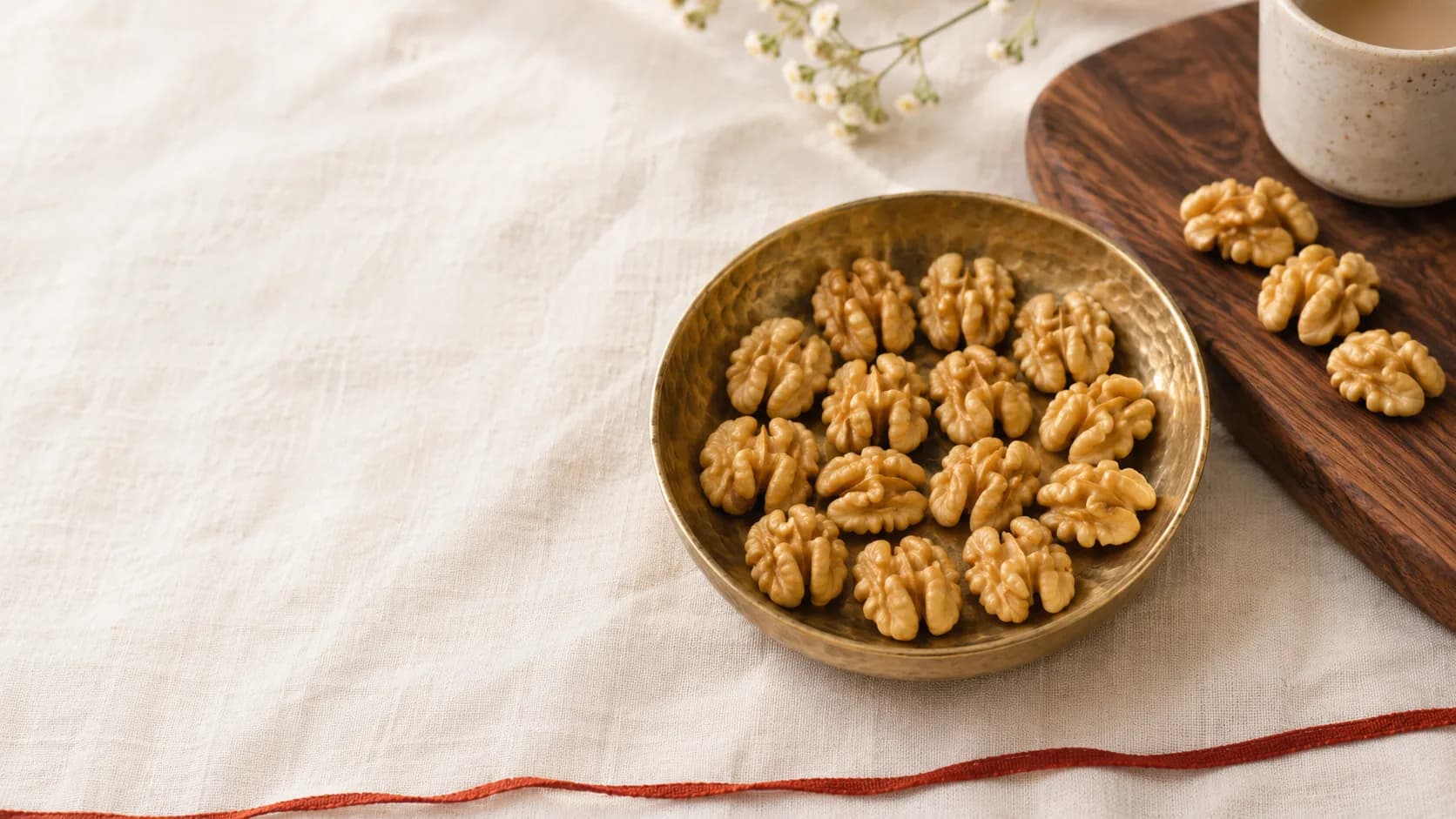
A pouch of akhrot bought in November usually goes one of two ways. It sits untouched until January, or it's gone in a week, despite the promise of a few every morning. Somewhere in between, someone tells you to soak them overnight, someone else says five, and a forwarded message says ten.
Willpower rarely decides it. A number you can trust does, and nobody has given you one.
So let's fix that. In this guide you'll learn how many walnuts a day the research actually used, what that portion looks like in halves and grams, whether soaking changes anything, and how to keep kernels sweet through an Indian winter.
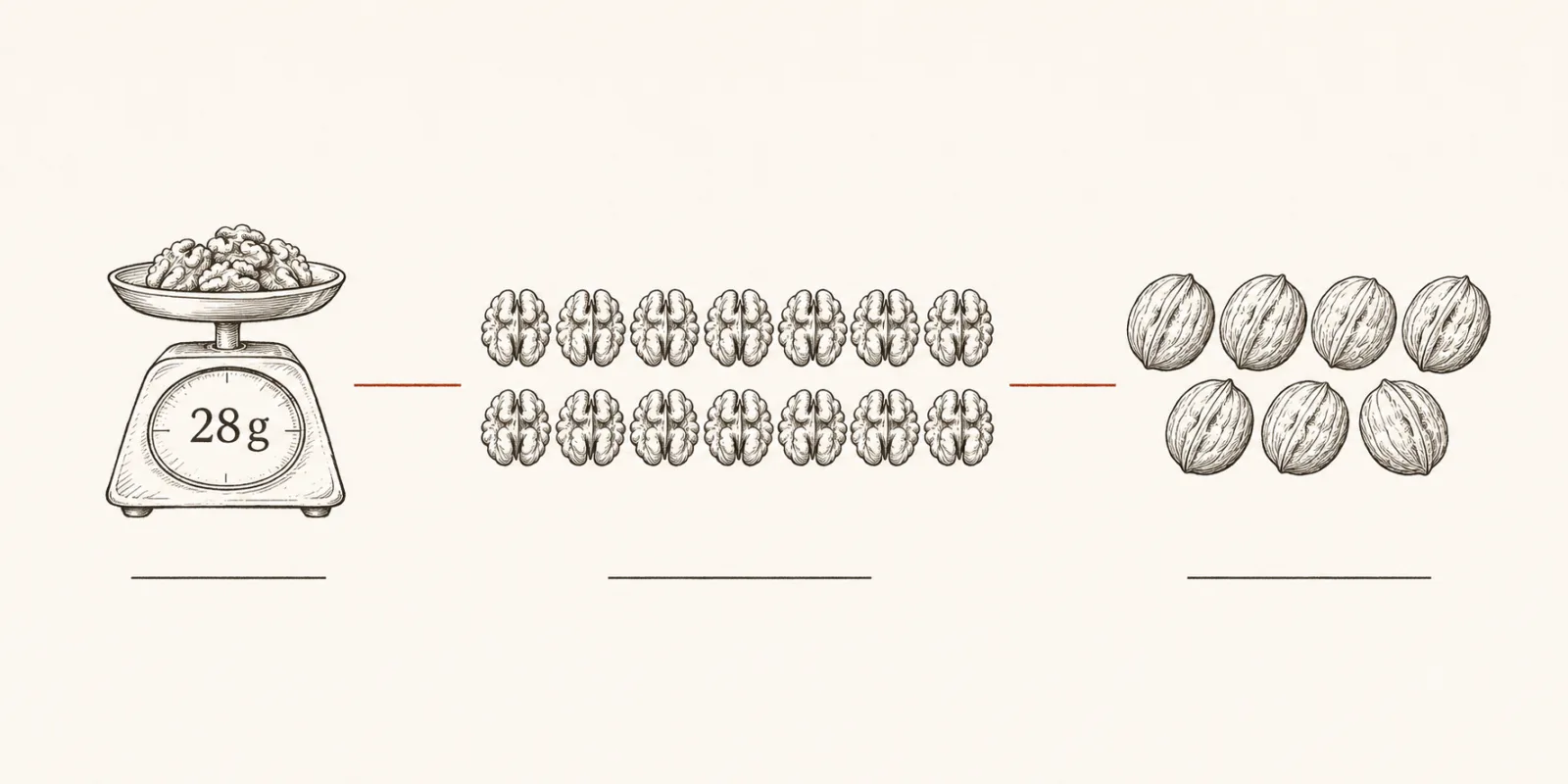
Here's the short answer: about 28 to 30 grams a day, which is roughly 12 to 14 halves, or 6 to 7 whole walnuts.
That number isn't pulled from thin air. India's own guidance gets you close. The ICMR National Institute of Nutrition's My Plate for the Day suggests about 35 grams of nuts and seeds a day on a 2,000 kcal diet. Notice the wording: nuts and seeds, together. If walnuts are your main nut, a 28 to 30 gram handful sits comfortably inside that.
The research trials land in the same zone. The largest long-term walnut trial, the Walnuts and Healthy Aging study, gave its walnut group 30 to 60 grams a day, according to a summary of the results published in Circulation. Back in 2004, the US FDA built its qualified walnut claim around 1.5 ounces a day, about 42 grams, and it described the evidence behind it as "supportive but not conclusive", as reported at the time.
The pattern is clear. Not a fistful. Not two kernels. A modest, steady handful.
Grams mean nothing at 7 a.m. Halves do.
According to USDA FoodData Central figures compiled in this one-ounce nutrient sheet, one ounce of walnuts (28 grams) is about 12 to 14 halves. That same ounce carries roughly:
190 kcal of energy
2.5 g of ALA, the plant omega-3 fat walnuts are known for
4 g of protein
2 g of fibre
Kashmiri kernels often run smaller than the large Californian halves you see in supermarkets, so your count may creep up to 15 or 16. That's fine. Weigh once on a kitchen scale, note how full your bowl looks, then stop weighing.
Key takeaway: you don't need a scale every day. You need to calibrate your eye once.
Walnuts are nearly two-thirds oil. That's the reason they taste rich, and the reason a "healthy" habit can quietly turn into a calorie habit.
Here's the thing: 28 grams is about 190 kcal. Double it without noticing and you've added a small meal. The trials that found positive results didn't just add walnuts on top of everything else. In the Walnuts and Healthy Aging study, walnuts made up around 15% of daily energy, which means something else on the plate made room for them.
And it gets better. A 2018 meta-analysis in The American Journal of Clinical Nutrition, covering 26 trials and 1,059 people, found walnut-enriched diets didn't appear to adversely affect body weight. The catch? Those were planned diets, not open pouches on a desk.
So swap, don't stack. Replace the biscuits with your handful, not the dal.
This is where most articles overreach, so let's be careful and specific.
That same 2018 meta-analysis found that walnut-enriched diets lowered total cholesterol by 3.25% and LDL cholesterol by 3.73% more than the comparison diets, and triglycerides by 5.52%, according to the Harvard T.H. Chan School of Public Health summary.
The two-year Walnuts and Healthy Aging trial followed 628 older adults aged 63 to 79. Compared with a walnut-free diet, the walnut group's LDL cholesterol fell by 4.3 mg/dL, about 3.6%, and total cholesterol by 8.5 mg/dL, about 4.4%, as summarised from the Circulation paper.
Read those numbers honestly. They're modest. Real, measured, and modest.
Walnuts aren't medicine. They're a good food that fits well in a balanced diet, and the research describes a small, steady shift, not a fix. If you're managing cholesterol, your doctor's plan comes first and walnuts sit inside it, never instead of it.
This section summarises published research and isn't medical advice. If you have a health condition or take regular medication, talk to your doctor before changing your diet.
Ask anyone's nani and she'll tell you to soak akhrot overnight. It's a lovely ritual. It softens the kernel, takes some of the bitterness out of the skin, and makes walnuts easier to chew for children and older family members.
What it doesn't seem to do is add nutrition.
A study from the University of Otago, published in Food Chemistry in 2020, soaked almonds, hazelnuts, peanuts and walnuts in water or salt water for 4 to 12 hours. Phytate, the compound soaking is supposed to reduce, changed by only about minus 12% to plus 10%. Mineral levels were generally lower after soaking, especially in chopped nuts. The authors concluded the evidence doesn't support the idea that "activating" nuts improves nutrient absorption.
So here's the honest version. Soak for texture. Soak for taste. Don't soak because you were told it doubles the goodness.
If you do soak, keep it simple:
Put your 12 to 14 halves in a small bowl with clean drinking water at night.
Keep the bowl covered in the fridge, not on the counter, in warm weather.
Drain and eat within the morning. Don't re-store soaked kernels.
Short answer: we couldn't find good evidence that one time beats another.
Morning works because it's a habit anchor. Mid-afternoon works because it replaces the 4 p.m. biscuit. After dinner works if you're mindful of the calories.
The best time is the one you'll repeat. Consistency did the work in the trials, not the clock.
A few easy ways to fit your handful in:
Crumble 3 or 4 halves over your morning poha, upma or dalia.
Stir chopped kernels into curd with a few sun-dried apricots.
Keep a small steel dabba of 14 halves in your bag for the commute.
Mix walnuts with a few almonds for variety. Our post on Mamra vs California almonds explains what you're paying for there.
Habits fail at the start, not the middle. So make the first week almost too easy.
On day one, weigh 28 grams once and count the halves. That's your number. On days two and three, keep that portion in the same bowl or dabba so your eye learns the size. By days four and five, pair it with something you already do every morning, like your first cup of chai. On days six and seven, try one new way to eat it, crumbled on curd or folded into a paratha filling.
The result? By the second week you're not deciding anything. You're just reaching for the bowl.
One small tip from our kitchen: portion the whole week on Sunday into seven small steel containers and keep them in the fridge. You'll see at a glance whether you've skipped a day, and you won't overpour from an open pouch.
Walnuts are an everyday food for most people. Not for everyone.
If you have a tree-nut allergy, skip them entirely and speak to your doctor. If you're on a prescribed diet for a medical condition, or you're pregnant or breastfeeding and changing your diet, ask your doctor or a registered dietitian what fits your plan. And for small children, whole kernels can be a choking risk, so chop or grind them finely.
That's the safety picture. Plain, and worth taking seriously.
You can get the portion right and still eat bad walnuts.
That rich oil we mentioned? It goes rancid. A stale walnut tastes bitter, papery and faintly like paint, and no amount of soaking hides it. Most "I don't like walnuts" stories are really stale-walnut stories.
This is why we care about how our Kashmiri walnut kernels are handled. They come from rain-fed Kashmiri trees, they're light halves, hand-sorted, never bleached, and packed within days of shelling. We explain the bleaching issue in more depth in our guide to Kashmiri walnut kernels.
Once a pouch is open, keep it sealed in the fridge. In a Delhi October or a Chennai anything, that one habit decides whether your last handful tastes as sweet as your first.
Here's a quick bit of maths. Our 250 g pouch is ₹340, so a 28 g daily handful works out to about ₹38. Our 1 kg pack is ₹1,260, which brings the same handful down to about ₹35.
The smaller pouch lasts about nine days. The larger one lasts over a month, as long as it lives in the fridge once opened. If you're just testing the habit, start small. If it's already part of your mornings, the larger pack makes sense.
More walnuts don't mean more benefit. The right handful, eaten steadily and fresh, does.
If you want a simple rule, eat about 28 to 30 grams, roughly 12 to 14 halves. If you like soaked walnuts, soak them for texture, not for extra nutrients. If you're managing a health condition, let your doctor set the plan and fit walnuts inside it. And if your walnuts taste bitter, the problem is freshness, not the nut.
If you want kernels that taste the way walnuts should, explore our Kashmiri dry fruits and nuts.
Most research and India's ICMR-NIN guidance point to a modest daily handful. About 28 to 30 grams, or 12 to 14 halves, is a sensible amount for most healthy adults, eaten in place of other snacks rather than on top of them.
Think in halves. Around 12 to 14 halves, which is roughly 6 to 7 whole walnuts, matches the 28 to 30 gram portion used as a guide. Smaller Kashmiri kernels may mean a couple more halves for the same weight.
Soaking softens the kernel and mellows the skin's bitterness, which many people prefer. A 2020 study in Food Chemistry found soaking barely changed phytate levels, so choose soaked or raw based on taste and texture.
For most people without a tree-nut allergy, yes, as part of a balanced diet and within your daily calories. This isn't medical advice, so if you have a health condition or are pregnant, check with your doctor first.
There's no strong evidence that one time of day is better. Pick the time you'll stick to, such as breakfast or an afternoon snack.
Stale walnuts taste bitter, papery or paint-like and may smell sharp. Keep an opened pack sealed in the fridge and discard any kernels that taste off.
Taste the difference yourself.
Mongra saffron and fresh-crop dry fruits, sealed to order in Anantnag.
Shop the harvest