
Loading page
Free delivery on orders over ₹3,000
Free delivery on orders over ₹3,000
Gifting & Festivals · 9 Oct 2026
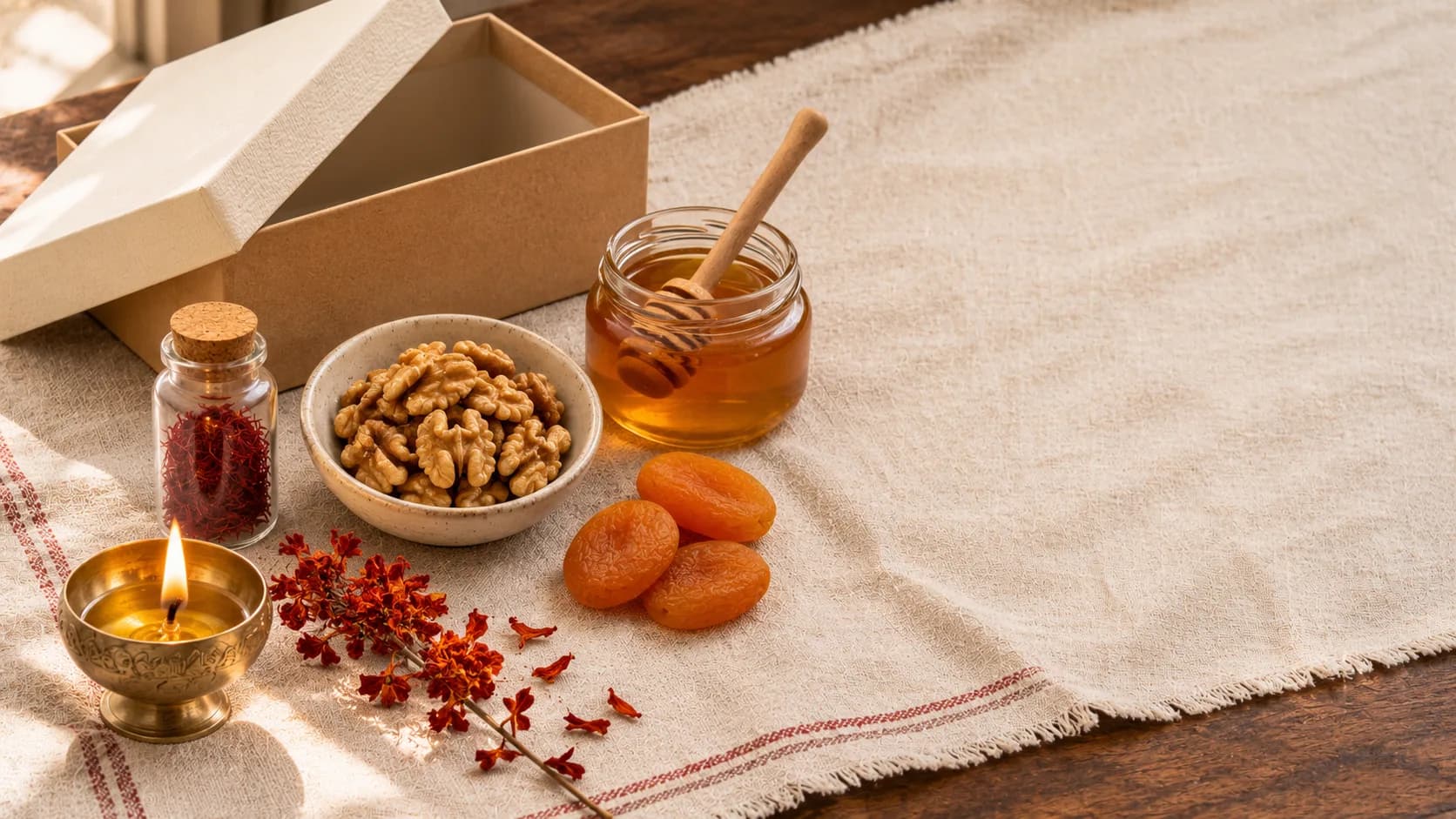
By Bhai Dooj, the fridge holds three half-eaten boxes of kaju katli, a tray of milk cake nobody has opened, and a box of gulab jamun from a neighbour you haven't thanked yet. By the weekend, half of it goes to the bin. The gifts were generous. They just weren't built to last.
That's the quiet problem with festive sweets. Most are made to be eaten within days, and Diwali gifting runs for weeks.
This guide gives you healthy Diwali gift ideas that keep for months, matched to the people on your list. You'll see why mithai spoils so fast, seven gifts that work better, three ready hamper budgets in rupees, and the two-minute purity checks that make any gift worth giving.
Here's the thing: khoya and chhena sweets are perishable dairy products. The FSSAI guidance note on traditional milk products puts kalakand at the same day, rasgulla, rasmalai and sandesh at 2 days under refrigeration, and khoya sweets such as milk cake, peda and burfi at 4 days from manufacture.
Four days. And Diwali falls on Sunday, 8 November 2026, according to Dekho Panchang's festival calendar, with gifting starting a week before and running through Bhai Dooj.
The supply side gets stretched too. In 2025, FSSAI ordered a special festive-season surveillance drive against adulterated ghee, khoa, paneer and sweets, with mobile testing labs placed in major markets. Since October 2020, an FSSAI order has also made a best-before date mandatory on trays of loose sweets.
None of this means skip the mithai. It means one box of sweets is plenty. The rest of the gift can be something that's still good in March.
"Healthy" gets stretched every festive season. A box of sugar-coated cashews with a green label isn't it. We use three simple tests before anything goes on our own gifting list.
It keeps. If it has to be eaten in four days, it competes with every other box in the house. Pantry gifts that hold for months don't.
It gets used. The best gift ends up in a daily routine, a morning cup, a weekend kheer, a handful after work. Not in a cupboard.
It's mostly the food itself. Read the ingredient line. Saffron should be saffron. Walnuts should be walnuts. Honey should be honey. Short labels, no added sugar syrups, no colour.
Pass all three and the gift does its job long after the visit.
A good gift fits the person, not the price tag. So start with who they are, then pick the product.
Kesar is the most Diwali of pantry gifts. It goes into kheer, phirni, shrikhand and the festive biryani, and a little goes a long way. Our Mongra Saffron 3g (₹1,510) comes in a glass vial, which looks like a gift on its own. The 1g pack (₹560) works for a smaller token.
Mongra is the red tip of the stigma only, with no yellow style. At Zoon Naturals, every saffron batch is tested, and every pack carries the code of the batch it was filled from. Saffron also keeps: our packs carry a best-before of 24 months from packing.
Some gifts get opened once. A tea drinker reaches for this one every morning. Our Kehwa Lover's Gift Set (₹1,449) holds 100g of saffron kehwa blend, a 0.5g vial of Mongra saffron for finishing the cup, and two hand-painted paper-mache coasters, all in a magnetic-lid box with a brewing guide card.
Pair it with a note pointing to our Kashmiri kahwa recipe so the first pot comes out right.
Swap one mithai box for a pouch of akhrot. Kashmiri Walnut Kernels come in 250g (₹340) and 1kg (₹1,260), light halves from rain-fed trees, never bleached, hand-sorted.
Nuts also have research behind them. A large US study in the New England Journal of Medicine, following 76,464 women and 42,498 men, found that people who ate nuts seven or more times a week had a lower death rate over the study period than those who ate none. It's an association, not proof of cause. This is general information, not medical advice; talk to your doctor about your own diet. Our walnut guide explains why rain-fed kernels taste different.
A jar of Kashmir Wildflower Honey (350g at ₹580, or 500g at ₹1,100) sits on the counter and gets used in warm water, on toast, in kahwa. Raw honey often crystallises in winter, which surprises people. Tuck in a line about it, or send them our post on why raw honey crystallises.
One rule for gifting honey: never give it to families for babies under 1 year.
Variety beats volume. Sun-dried Apricots (250g, ₹420), Chilgoza Pine Nuts (100g, ₹890) and Dried Figs or anjeer (400g, ₹549) make a trio that feels different from the usual kaju-badam box. Chilgoza is the surprise. Plenty of people have never tasted it.
For the friend who cooks like it matters, Gucchi Morel Mushrooms (50g, ₹2,299) are a rare gift. They're rare and priced accordingly, and our post on why gucchi costs more than silver explains why. Fifty grams is enough for a festive pulao or two.
Short on time? The Kashmir Heritage Gift Box (₹2,899) packs 1g of Mongra saffron, 50g of saffron kehwa, 100g of mamra almonds, 100g of walnut kernels and 250g of acacia honey into a rigid keepsake box with a chinar leaf motif, a jute ribbon and a message card. Best before is 9 months from packing. It's the one gift that works for parents, in-laws and clients alike.
You don't need a ready hamper to give a good one. Build it from single products and you control every gram. Using our current selling prices, here are three combinations that hold together.
Under ₹1,000: Mongra Saffron 1g (₹560) plus Kashmiri Walnut Kernels 250g (₹340). Total ₹900. Small, useful, and both go straight into the festive kitchen.
Under ₹2,000: Kehwa Lover's Gift Set (₹1,449) plus Kashmiri Walnut Kernels 250g (₹340). Total ₹1,789. A morning ritual and an evening snack in one.
Around ₹3,000: Mongra Saffron 3g (₹1,510), Kashmir Wildflower Honey 350g (₹580), Kashmiri Walnut Kernels 250g (₹340) and Sun-dried Apricots 250g (₹420). Total ₹2,850. Or take the Kashmir Heritage Gift Box at ₹2,899.
The result? Three tiers, no filler. And it gets better: orders above ₹3,000 qualify for free delivery anywhere in India, so a family buying for two or three homes can combine.
For a deeper look at what separates a hamper people keep from one they pass on, read our guide to choosing a dry fruit gift hamper.
A gift that keeps only keeps if it's stored right. A short line on your gift card does the work, and most people will thank you for it.
Saffron likes the dark. Our packs say it plainly: keep the vial closed, away from light and heat. A kitchen drawer beats the shelf above the stove. Walnut kernels, once opened, belong sealed in the fridge, which is also what our walnut page recommends. Honey needs nothing more than a dry spoon and a closed lid. If it turns grainy in a cold month, that's crystallisation, not spoilage.
Dried apricots and figs keep best in an airtight jar, away from moisture. And kahwa leaves lose their aroma fastest once the box is left open, so close it after every brew.
A gift is only as good as what's inside it. Saffron and honey both sit in FSSAI's own list of home adulteration checks. That tells you something.
FSSAI's own DART guide gives two home tests anyone can run in a minute.
Saffron: drop a few threads into a glass of water. Real saffron releases its colour slowly as it soaks. Adulterated saffron's artificial colour dissolves fast. Real saffron doesn't bleed red. It releases gold, slowly.
Honey: drop a little honey into a glass of water. Pure honey won't disperse. If it spreads out quickly, it may contain added sugar.
Beyond the glass test, check the pack. Look for an FSSAI licence number, a best-before date and a packing date. Ours shows FSSAI licence 21026010000356, and every saffron pack carries a batch code. For a full walkthrough, see how to identify real saffron.
Corporate Diwali gifting is a different job. You need one invoice, many addresses and a date that doesn't slip.
Our bulk and corporate page covers quantity dispatch to a single address or delivery to a list, GST invoicing as standard (with your GSTIN on the invoice if you share it), and a card in your name. Every order is dispatched from Anantnag within one working day. Write in early with quantities and dates, and we'll tell you honestly what lead time that volume needs.
A good Diwali gift isn't the one that impresses at the door. It's the one still in use when the diyas are packed away.
So keep it simple. If your list is mostly family cooks, give saffron. If they live on chai, give kahwa. If you can't decide, give one box that covers the basics, and keep the mithai to a single, fresh box from a shop that shows its best-before date.
If you want gifts that keep for months and pass a glass-of-water test, explore our Kashmiri gift boxes.
Pantry gifts that keep and get used work best: saffron for cooks, a kahwa set for tea drinkers, walnut kernels or dried apricots for snackers, and raw honey for morning routines. A mixed box covers everyone.
Try saffron, kahwa, dry fruits, honey or a Kashmiri gift box. Unlike khoya sweets, which FSSAI guidance says should be eaten within about 4 days, these keep for months when stored sealed and away from heat.
A kahwa gift set (₹1,449) with a 250g pouch of Kashmiri walnut kernels (₹340) comes to ₹1,789. It pairs a daily tea ritual with a snack that isn't loaded with sugar.
Yes, if it's real. Saffron is used in Diwali kheer, phirni and shrikhand, and a small pack lasts many dishes. Test a few threads in water: real saffron releases colour slowly, while dyed saffron colours the water fast.
Give it to the adults, with a note. Honey shouldn't be given to babies under 1 year, so make sure the family knows it's for grown-ups.
Taste the difference yourself.
Mongra saffron and fresh-crop dry fruits, sealed to order in Anantnag.
Shop the harvest