
Loading page
Free delivery on orders over ₹3,000
Free delivery on orders over ₹3,000
Buying Guides · 29 Oct 2026
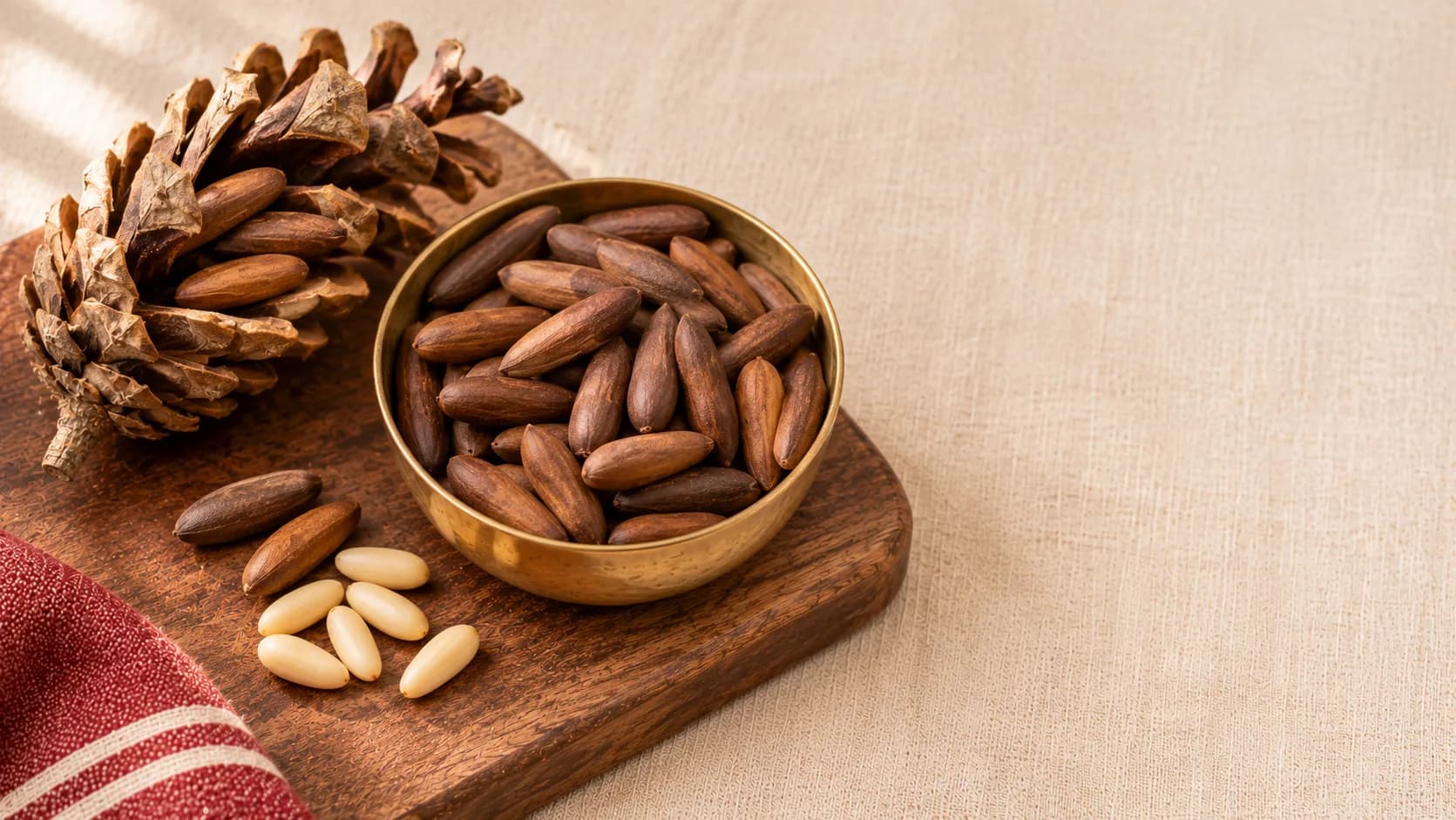
In Jangi, a village in Kinnaur, the chilgoza forest opens on a day the local deity approves. One person from each household goes up, the cones are pooled, sorted, and split equally between families, according to a first-hand account of the September 2024 harvest.
Nobody planted those trees. That single fact explains most of the chilgoza price you see in a dry fruit shop.
Below, we'll walk through what a kilo of neoza actually takes to gather, why supply keeps shrinking, what chilgoza costs in India right now, and the checks that separate fresh stock from tired nuts dressed up for the season.
Chilgoza comes from Pinus gerardiana, a wild pine of the western Himalayas. The Royal Botanic Garden Edinburgh's threatened conifers record lists it across eastern Afghanistan, northern Pakistan, Tibet and India, at roughly 2,000 to 3,350 metres.
In India, most of it grows in Himachal Pradesh. A Himachal Pradesh Council for Science, Technology and Environment booklet places the main stands in Kinnaur and Chamba, between 1,800 and 3,000 metres.
Here's the thing: almonds and walnuts come from orchards. Chilgoza mostly doesn't. It's collected from forests that took decades to grow, on slopes where every cone is picked by hand.
So you're not paying for a crop. You're paying for a forest's yearly surplus, gathered once, in a short window.
The same HIMCOSTE booklet gives two numbers worth knowing. A cone holds roughly 60 to 70 seeds. A kilo of chilgoza holds roughly 3,500 to 4,500 seeds.
Do the maths and one kilo needs somewhere around 50 to 75 cones. Every one of them is knocked or cut from a tall tree, usually in September and October.
And it gets slower from there. The cones are dried for 15 to 20 days, per the booklet. Then they're cracked open, often with a small axe, and the nuts are picked out by hand, as Pramiti Negi describes for her own Kinnauri household.
There's no machine shortcut in most villages. The labour is the product.
The IUCN listed chilgoza pine as Near Threatened in 2011, and Mongabay India reports an estimated decline of close to 30% across its range.
The causes stack up. Hydropower projects and transmission lines have cleared trees. Mongabay cites a study that counted 2,743 chilgoza trees felled for projects in Kinnaur up to 2014. Add forest fires, landslides and thinner snowfall, and the picture gets harder.
Then there's overharvesting. HIMCOSTE puts natural regeneration at less than 15%, partly because almost every cone gets taken. Mongabay notes a 2020 study recommending at least 30% of cones be left on the tree.
The result? Smaller harvests. A Jangi farmer quoted in the Himdhara account recalls families once collecting 1.5 to 2 quintals each. Recently it's been 20 to 25 kg per family.
Less supply, steady demand, and no orchard to fall back on. That's the price.
Timing plays a part too. Cones come down in September and October, and the seeds mature around October and November, per HIMCOSTE. So the freshest chilgoza reaches city shops just as winter demand peaks.
That demand is old. In Kinnaur, chilgoza is strung into garlands, called ri u, and offered to hosts at weddings and festive occasions, Negi writes. Families still send neoza to relatives as winter gifts, and the nuts have long been traded at the Lavi fair in Rampur Bushahr, which has run for more than 300 years.
Then the plains join in. Wedding season, gifting boxes and winter snacking all land in the same few months as the new crop.
A once-a-year harvest meets a once-a-year rush. Prices respond accordingly.
The upside for you? Late autumn is also when the freshest stock of the year is on sale. Buy now, store it cold, and you're eating this season's nuts through Chillai Kalan instead of last year's in spring.
Price reports vary a lot, and that tells you something.
The Himdhara piece, published in March 2025, put packaged chilgoza at ₹4,000 to ₹5,000 per kg in the market. Negi's 2023 account mentions a kilo pack seen at ₹7,000 in a Chandigarh shop, while local collectors earned about ₹1,000 per kg after labour. The older HIMCOSTE booklet quotes ₹1,500 to ₹2,000, which shows how far prices have climbed.
Imports add another layer. FreshPlaza reported in September 2026 that Afghanistan's Nangarhar province expected about 1,115 tons of pine nuts this season, with local prices well below last year. Afghanistan exported 1,031 tons in 2025, the report adds, and India is one of the listed markets.
That matters for you. Cheaper Afghan stock can sit in the same loose bins as Indian chilgoza, and nobody has to tell you which is which. Under India's rules, imported packaged food must declare its country of origin, but loose products at retail carry no such label requirement.
A few practical rules for reading any price tag:
Compare per kilo, not per pack. A 100 g pack always looks cheap next to a 1 kg bag. Divide it out.
Check in-shell or shelled. Shells add weight, so shelled kernels cost far more per kilo.
Look for a packing date. Chilgoza is a once-a-year harvest. A pack with no month and year could be from any season.
Ask for country of origin. If the seller can't answer, assume you don't know.
For reference, our own chilgoza pine nuts are ₹890 for 100 g, in shell, with the month and year of packing printed on the pack and country of origin India. Small packs cost more per kilo than bulk, and we're upfront about that. We buy one season's harvest, pack it in small lots and sell until it runs out.
Price only makes sense if the nut is fresh. Chilgoza is about half fat (HIMCOSTE lists 49.9%), and fat goes stale. Old stock doesn't look dramatically different. It tastes different.
Here's how to check before you commit to a big bag:
Shell shine. Fresh shells look glossy and a little oily. Dull, dusty or chalky shells suggest long storage.
Kernel colour. Crack one. The kernel should be ivory and even. Yellowed, spotted or shrivelled kernels have aged.
Texture. A fresh kernel feels soft and buttery when you bite it. A dry, hard or crumbly bite means it's past its best.
Smell and taste. Fresh chilgoza smells faintly of pine resin and tastes sweet. Any sharp, bitter or paint-like note is rancidity. Spit it out.
Empties. Shake a handful. Very light shells are often empty or shrunken inside.
One cracked nut tells you more than any label. If a seller won't let you taste one from a loose bin, that's an answer too.
A printed date helps when you can't taste first. On our own chilgoza, the month and year of packing are on the pack, and the best before is six months from that date. Short, yes. That's what an oil-rich wild nut honestly allows. If a pack promises a much longer life with no date at all, ask how.
Buying online? Check the packing month the day it arrives, then crack one nut before you put the rest away.
Shelled chilgoza is convenient. It's also exposed. Once the shell is gone, air and light reach the kernel directly, and the oils start turning faster.
In-shell is the traditional way neoza is sold and eaten, roasted and cracked by hand through winter. The shell does the protecting for you.
There's a weight question, too. When you buy in shell, part of what you pay for is shell. That's fine, as long as you compare like with like. A shelled kilo and an in-shell kilo are different products, and a seller who lists them side by side without saying which is which isn't helping you.
So the choice is simple. If you'll use the nuts within a few weeks for a recipe, shelled can make sense from a seller you trust. If you're buying for winter snacking or gifting, in-shell keeps better.
At ₹4,000 a kilo or more, a stale handful is real money. Storage is where most of it is lost.
The HIMCOSTE booklet, citing research from YS Parmar University of Horticulture and Forestry in Solan, found glass jars and aluminium laminate pouches worked best for shelf life. At home, that means an airtight glass jar in the fridge. We give the same advice on our product page, because cold slows the oils from turning.
To eat it the way Kinnaur does, roast a handful lightly on a warm tawa, let it cool, and crack each shell between your fingers. No salt, no oil. Keep the heat low, because the kernels scorch fast.
Chilgoza also sits well in a winter dry fruit bowl alongside Kashmiri walnuts, and it makes a thoughtful addition to a dry fruit gift hamper. If you're curious why other Himalayan wild foods are priced the way they are, our piece on why gucchi mushrooms cost so much follows the same logic.
Chilgoza isn't expensive because it's fashionable. It's expensive because it's wild, slow, and getting scarcer every season.
If you're comparing prices, divide everything to a per-kilo figure and note in-shell or shelled. If a pack has no packing month, treat it as old. If you're buying loose, taste one first. And if you're buying for the whole winter, choose in-shell and keep it cold.
If you want in-shell chilgoza packed from a single season, with the packing date on the pack, explore our dry fruits and nuts.
Chilgoza comes from wild pine forests, not orchards, and the cones are collected and cracked by hand. One kilo needs roughly 50 to 75 cones, and forest decline and overharvesting have cut what each family gathers.
Reports vary widely. A 2025 account put packaged chilgoza at ₹4,000 to ₹5,000 per kg, and a 2023 account mentioned ₹7,000 per kg in a Chandigarh shop. Pack size, in-shell or shelled, and freshness all move the price.
Look for glossy shells, ivory kernels and a soft, buttery bite. A bitter, sharp or paint-like taste means the oils have gone rancid.
For storage, yes. The shell protects the kernel from air and light, so in-shell chilgoza keeps longer. Shelled kernels suit quick use in recipes.
Keep it in an airtight glass jar in the fridge. Cold slows the natural oils from turning stale.
Cones are usually harvested in September and October, so fresh stock reaches markets in late autumn and winter.
Taste the difference yourself.
Mongra saffron and fresh-crop dry fruits, sealed to order in Anantnag.
Shop the harvest